
About Arthur Frank Burns
Lived 1904 – 1987 (aged 83). Arthur Frank Burns was an American economist and diplomat.
Arthur Frank Burns (April 27, 1904 – June 26, 1987) was an American economist and diplomat who served as the 10th chairman of the Federal Reserve from 1970 to 1978. He previously chaired the Council of Economic Advisers under President Dwight D. Eisenhower from 1953 to 1956 and served as the first Counselor to the President under Richard Nixon from January to November 1969. He also taught and researched at Rutgers University, Columbia University, and the National Bureau of Economic Research. In 1914, he immigrated to Bayonne, New Jersey, with his parents.
At age 17, Burns enrolled in Columbia University on a scholarship offered by the university secretary. He worked in jobs ranging from postal clerk to shoe salesman during his time at Columbia as a student before earning his B.A. and M.A. in 1925, graduating Phi Beta Kappa.
Academic career
Rutgers University After college, he began teaching economics at Rutgers University in 1927, a role that he continued until 1944. Burns through his lectures became one of two professors, the other being Homer Jones, credited by Milton Friedman as a key influence for his decision to become an economist. Burns had convinced Friedman, Rutgers class of 1932, that modern economics could help end the Great Depression.
In 1930, he married Helen Bernstein, a teacher.
In 1943 he was elected as a Fellow of the American Statistical Association. In 1944, he left Rutgers and assumed the role of director of research at the NBER in 1945 following Mitchell's retirement.
Columbia University In 1945, Burns became a professor at Columbia University. In 1959, he received the John Bates Clark endowed chair. At Columbia, he blocked the acceptance of Murray Rothbard's thesis on the Panic of 1819, despite having known Rothbard since the latter was a child.
During his time at Columbia, Burns was elected a member of both the American Academy of Arts and Sciences and the American Philosophical Society.
National Bureau of Economic Research Beginning in 1933, the academic part of Burns's career focused on the measurement of business cycles, including questions such as the duration of economic expansions, and what economic variables rise during expansions and fall during recessions. In 1934, Burns wrote Production Trends in the United States Since 1870 his first major publication in the field.
Often, he collaborated with Wesley Clair Mitchell, whose research directorate role he assumed from 1945 to 1953. In 1946, Burns and Mitchell published Measuring Business Cycles, which presented the characteristic NBER methods of analyzing business cycles. During his tenure, Burns began the academic tradition of determining recessions, a role continued by the NBER's business cycle dating committee. Today, the NBER is still considered authoritative in dating recessions.
In the late 1940s, Burns asked Milton Friedman, then a professor at the University of Chicago, to join the NBER as a researcher of the role of money in the business cycle. Burns's detailed macroeconomic analysis influenced Milton Friedman and Anna Schwartz's classic work A Monetary History of the United States, 1867–1960.
Public service
Counselor to the President Burns was appointed as Counselor to the President when Richard Nixon took office in 1969. The newly created position held cabinet rank and was meant as a placeholder until Burns could be appointed as Chairman of the Federal Reserve. Burns advised Nixon on economic policy during his brief time in the White House.
As expected, Burns was appointed to replace the outgoing William McChesney Martin as Fed Chairman in November 1969 and resigned his post in the Nixon administration.
Federal Reserve Chairman Burns served as Fed Chairman from February 1970 until the end of January 1978. He has a reputation of having been overly influenced by political pressure in his monetary policy decisions during his time as Chairman and for supporting the policy, widely accepted in political and economic circles at the time, that Fed action should try to maintain an unemployment rate of around 4 percent.
While Vice President Richard Nixon was running for President in 1959–1960, the Fed, under Truman-appointed chairman William McChesney Martin, Jr., was undertaking monetary tightening, increasing the cost of borrowing and reflected in a recession by April 1960. In his book Six Crises, Nixon later blamed his defeat in 1960 in part on Fed policy and the resulting tight credit conditions and slow growth.
Later, when Burns resisted, negative press about him was planted in newspapers and, under the threat of legislation to dilute the Fed's influence, Burns and other Governors succumbed. Burns's relationship with Nixon was often rocky. Reflecting in his diary about a 1971 meeting attended by himself, Nixon, Treasury Secretary John Connally, the Chairman of the Council of Economic Advisors, and the Director of the Bureau of the Budget, Burns wrote:
The President looked wild; talked like a desperate man; fulminated with hatred against the press; took some of us to task – apparently meaning me or [chairman of the Council of Economic Advisors, Paul] McCraken or both – for not putting a gay and optimistic face on every piece of economic news, however discouraging; propounded the theory that confidence can be best generated by appearing confident and coloring, if need be, the news.
In 1976, Burns received the U.S. Senator John Heinz Award for Greatest Public Service by an Elected or Appointed Official, an award given out annually by Jefferson Awards.
American Enterprise Institute William Baroody, then president of the American Enterprise Institute, brought Burns to the economics think tank in 1978 after Burns left his position at the Federal Reserve. From the AEI, Burns continued to influence public policy.
Death He died on June 26, 1987 from complications of cardiac bypass surgery , at Johns Hopkins Hospital in Baltimore, Maryland.
Criticism Conservative economist Bruce Bartlett gives Burns poor marks for his tenure as Fed chairman because the inflationary forces that began in 1970 took more than a decade to resolve.
In more recent years, the famous quote, "The ultimate purpose of an economy is to produce more consumer goods," has erroneously been attributed to Burns in popular culture. However, there is no evidence that Burns uttered this statement; to the contrary, both his speeches and his policies record his advocacy for thrift and fiscal responsibility.
Selected works Burns, Arthur Frank; Mitchell, Wesley C., Measuring Business Cycles, National Bureau of Economic Research (Studies in Business Cycles), 1946 Burns, Arthur Frank, Wesley Clair Mitchell: The Economic Scientist. New York: National Bureau of Economic Research, 1952 Burns, Arthur Frank, The Frontiers of Economic Knowledge: Essays, Princeton University Press, 1954. Reprinted from a National Bureau of Economic Research publication.
Burns, Arthur Frank, Prosperity Without Inflation, Buffalo, Smith, Keynes & Marshall; distributed by Doubleday, Garden City, N.Y., 1958 Burns, Arthur Frank, et al., The Anguish of Central Banking, Per Jacobsson Foundation, 1979
Don’t just read it —
keep it.
Full-length biographies made to live with: read them, listen on the way to work, watch them tonight.
- E-book
- Audio
- Video
Instant download · yours to keep · every purchase keeps this site free
Important facts
People in Arthur Frank Burns's life
Named in this biography and alive at the same time

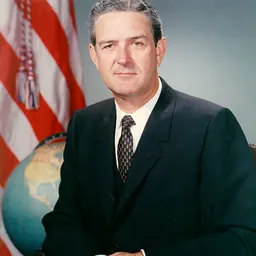


Related people
Same field, nearest in time



Contemporaries
People whose lives overlapped Arthur Frank Burns's



Frequently asked questions
Who was Arthur Frank Burns?
American economist and diplomat (1904-1987)
When was Arthur Frank Burns born?
Arthur Frank Burns was born on 27 April 1904 in Ivano-Frankivsk.
When did Arthur Frank Burns die?
Arthur Frank Burns died on 26 June 1987 in Johns Hopkins Hospital, Baltimore.
What was Arthur Frank Burns's occupation?
Arthur Frank Burns was an economist and diplomat.
What nationality was Arthur Frank Burns?
Arthur Frank Burns was American.
Sources & further reading
· Wikipedia: Arthur Frank Burns
Cite this page
APA: Biography.guide. (2026). Arthur Frank Burns. https://biography.guide/arthur-frank-burns/
MLA: "Arthur Frank Burns." Biography.guide, https://biography.guide/arthur-frank-burns/.
Chicago: "Arthur Frank Burns." Biography.guide. https://biography.guide/arthur-frank-burns/.
Data last updated: 2026-09-25 · Spot an error? Report a correction.
Page generated 2026-09-27 05:11 UTC