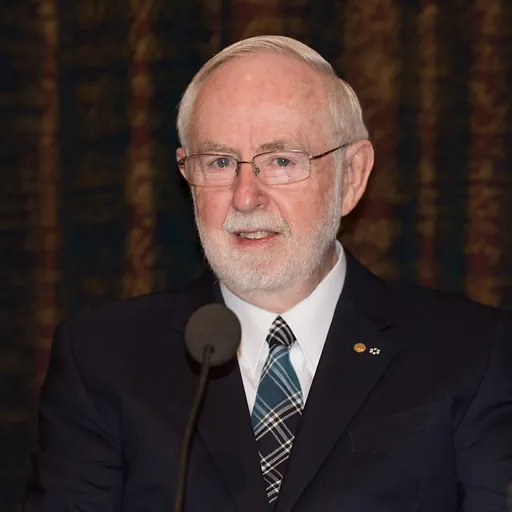
Arthur B. McDonald
Canadian physicist (born 1943)
About Arthur B. McDonald
Born 1943. Arthur B. McDonald is a Canadian physicist, university teacher and astrophysicist, known for Solar neutrino problem.
Arthur Bruce McDonald P.Eng (born August 29, 1943) is a Canadian astrophysicist. McDonald is the director of the Sudbury Neutrino Observatory Collaboration and held the Gordon and Patricia Gray Chair in Particle Astrophysics at Queen's University in Kingston, Ontario from 2006 to 2013. He was awarded the 2015 Nobel Prize in Physics jointly with Japanese physicist Takaaki Kajita.
Early life
Arthur McDonald was born on August 29, 1943, in Sydney, Nova Scotia. He graduated with a B.Sc. in physics in 1964 and M.Sc. in physics in 1965 from Dalhousie University in Nova Scotia. He then obtained his Ph.D. in physics in 1969 from the California Institute of Technology.
Academic career Arthur McDonald worked as a research officer at the Chalk River Nuclear Laboratories northwest of Ottawa from 1969 to 1982. He became professor of physics at Princeton University from 1982 to 1989, leaving Princeton to join Queen's University where he was a professor from 1989 to 2013.
McDonald was a visiting scientist at the European Organization for Nuclear Research (CERN) in Geneva in 2004.
His visiting positions include CERN, University of Washington (1978), Los Alamos National Laboratory (1981), University of Hawaii (2004, 2009), University of Oxford (2003, 2009), Queen's University (1988).
Research
Physicists have been investigating whether or not neutrinos have mass. Since the late 1960s, experiments have hinted that neutrinos may have mass. Theoretical models of the Sun predict that neutrinos should be made in large numbers. Neutrino detectors on the Earth have repeatedly seen fewer than the expected number of neutrinos. Because neutrinos come in three varieties (electron, muon, and tau neutrinos), and because solar neutrino detectors have been primarily sensitive only to electron neutrinos, the preferred explanation over the years is that those "missing" neutrinos had changed, or oscillated, into a variety for which the detectors had little or no sensitivity. If a neutrino oscillates, according to the laws of quantum mechanics, then it must have a mass. Unlike previous detectors, using heavy water would make the detector sensitive to two reactions, one reaction sensitive to all neutrino flavours, the other sensitive to only the electron neutrino. Thus, such a detector could measure neutrino oscillations directly. Chen, Professor George Ewan, Professor David Sinclair, McDonald, and 12 other scientists formed the original Sudbury Neutrino Observatory (SNO) collaboration to exploit this idea in 1984. SNO was to be a detector facility using 1000 tonnes of heavy water located underground in a mine outside Sudbury, Ontario. Chen died of leukemia in November 1987, however.
In August 2001, the Sudbury Neutrino Observatory, led by McDonald since 1989, reported observations that directly suggested electron neutrinos from the Sun were oscillating into muon and tau neutrinos. McDonald is a co-recipient of the 2007 Benjamin Franklin Medal in Physics, the 2015 Nobel Prize in Physics, and the Breakthrough Prize in Fundamental Physics in 2016 for the discovery of neutrino oscillations and demonstrating that neutrinos have mass.
Professor McDonald is now participating in research with the SNO+ and DEAP-3600 experiments at SNOLAB, an expanded underground laboratory at the original SNO underground site and with the DarkSide-20k collaboration developing an experiment at the underground laboratory near Gran Sasso, Italy.
Arthur B. McDonald Canadian Astroparticle Physics Research Institute The Arthur B. McDonald Canadian Astroparticle Physics Research Institute was inaugurally named the Canadian Particle Astrophysics Research Centre before renaming itself the Arthur B. McDonald Canadian Astroparticle Physics Research Institute in May 2018, in recognition of Dr. Arthur B. McDonald's trailblazing work making Canada a leader in astroparticle physics.
Humanitarian work In the spring of 2020, amid the COVID-19 pandemic and the ensuing shortages, McDonald became one of the leaders of a project to mass-produce mechanical ventilators at low cost. McDonald has stated that the project was initiated by Princeton Professor Cristiano Galbiati who was locked down in Milan, Italy. He inspired action by his colleagues on the DarkSide-20k Dark Matter physics experiment after recognizing the similarities between the requirements of a ventilator and those of particle physics experiments. McDonald led the Canadian team with members from TRIUMF laboratory, CNL Chalk River, SNOLAB and the McDonald Canadian Astroparticle Physics Research Institute after strong positive response from the Directors of these institutions. The design, called the Mechanical Ventilator Milano, is based on the Manley ventilator but uses modern electronics wherever possible. The details, first published on March 23 by about 150 collaborators, were released under the CERN Open Hardware Licence. The project received the support of Prime Minister Justin Trudeau who anticipated an initial order of 30,000 to Canadian hospitals from several suppliers. An order has been placed for 10,000 units with Vexos, Markham.
Selected honours and awards 1983, Fellow of the American Physical Society 1998, Canada Council Killam Research Fellowship 2007, Benjamin Franklin Medal in Physics with Yoji Totsuka 2009, Member of Canadian Science and Engineering Hall of Fame 2010, Canada Council Killam Prize in Natural Sciences 2011, Royal Society of Canada's Henry Marshall Tory Medal 2011, The Cocconi Prize of the European Physical Society (jointly with Yoichiro Suzuki) 2012, Member of the Order of Ontario 2015, Nobel Prize in Physics (jointly with Takaaki Kajita) 2015, Promotion to Companion of the Order of Canada 2016, asteroid 229781 Arthurmcdonald, discovered by Vincenzo Casulli at Vallemare di Borbona in 2008, was named in his honour. 2016, Member of the Order of Nova Scotia
Don’t just read it —
keep it.
Full-length biographies made to live with: read them, listen on the way to work, watch them tonight.
- E-book
- Audio
- Video
Instant download · yours to keep · every purchase keeps this site free
Important facts
People in Arthur B. McDonald's life
Named in this biography and alive at the same time




Related people
Same field, nearest in time

Contemporaries
People whose lives overlapped Arthur B. McDonald's


Frequently asked questions
Who is Arthur B. McDonald?
Canadian physicist (born 1943)
When was Arthur B. McDonald born?
Arthur B. McDonald was born on 29 August 1943 in Sydney.
What is Arthur B. McDonald's occupation?
Arthur B. McDonald is a physicist, university teacher and astrophysicist.
What is Arthur B. McDonald known for?
Arthur B. McDonald is known for Solar neutrino problem.
What nationality is Arthur B. McDonald?
Arthur B. McDonald is Canadian.
Sources & further reading
· Wikipedia: Arthur B. McDonald
Cite this page
APA: Biography.guide. (2026). Arthur B. McDonald. https://biography.guide/arthur-b-mcdonald/
MLA: "Arthur B. McDonald." Biography.guide, https://biography.guide/arthur-b-mcdonald/.
Chicago: "Arthur B. McDonald." Biography.guide. https://biography.guide/arthur-b-mcdonald/.
Data last updated: 2026-09-22 · Spot an error? Report a correction.
Portrait: Wikimedia Commons · author & licence
Page generated 2026-09-27 05:02 UTC