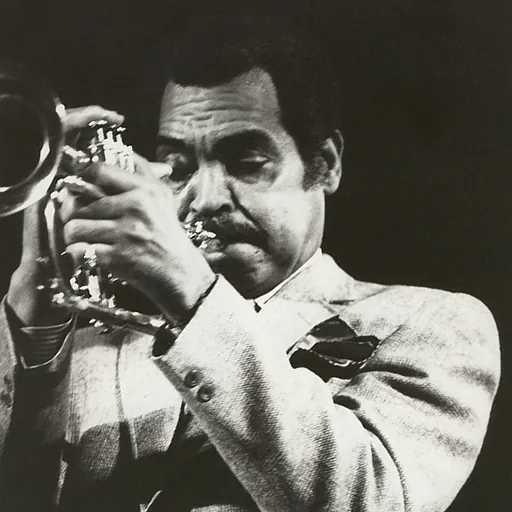
About Art Farmer
Lived 1928 – 1999 (aged 71). Art Farmer was an American composer, jazz musician, trumpeter and recording artist.
Arthur Stewart Farmer (August 21, 1928 – October 4, 1999) was an American jazz trumpeter and flugelhorn player. He also played flumpet, a trumpet–flugelhorn combination especially designed for him. He and his identical twin brother, double bassist Addison Farmer, started playing professionally while at high school in Los Angeles. Art gained greater attention after the release of a recording of his composition "Farmer's Market" in 1952. He subsequently moved from Los Angeles to New York, where he performed and recorded with musicians such as Horace Silver, Sonny Rollins, and Gigi Gryce and became known principally as a bebop player.
As Farmer's reputation grew, he expanded from bebop into more experimental forms through working with composers such as George Russell and Teddy Charles. He went on to join Gerry Mulligan's quartet and, with Benny Golson, to co-found the Jazztet. Continuing to develop his own sound, Farmer switched from trumpet to the warmer flugelhorn in the early 1960s, and he helped to establish the flugelhorn as a soloist's instrument in jazz. He settled in Europe in 1968 and continued to tour internationally until his death. Farmer recorded more than 50 albums under his own name, a dozen with the Jazztet, and dozens more with other leaders. His playing is known for its individuality – most noticeably, its lyricism, warmth of tone and sensitivity. Their parents, James Arthur Farmer and Hazel Stewart Farmer, divorced when the boys were four years old, and their steelworker father was killed in a work accident not long after this. He started to play the piano while in elementary school, then moved on to bass tuba and violin before settling on cornet and then trumpet at the age of 13. His family was musical: most of them played as a hobby, and one was a professional trombonist. Art's grandfather was a minister in the African Methodist Episcopal Church. These opportunities came about through a combination of his ability and the absence of numerous older musicians, who were still in the armed forces following World War II. Farmer left high school early but persuaded the principal to give him a diploma, which he did not collect until a visit to the school in 1958.
Later life and career
Early career in Los Angeles and New York
Farmer left school to tour with a group led by Johnny Otis, but this job lasted for only four months, as Farmer's lip gave out.
Farmer's first studio recording appears to have been on June 28 or July 2, 1948, in Los Angeles, under the leadership of vocalist Big Joe Turner and pianist Pete Johnson. They recorded "Radar Blues", and at some point in the same or the following year they added a further seven sides; the eight tracks were released as four singles by Swing Time Records. Farmer recorded further singles with Roy Porter and then, on January 21, 1952, as a member of Wardell Gray's sextet. The latter session produced six tracks that were released as singles. These included "Farmer's Market", a piece that was written by Farmer and brought him greater attention. and shared the organization's trumpet chairs with Clifford Brown, Quincy Jones and Benny Bailey.
Farmer relocated to New York and, on July 2, 1953, had his first recording session as leader. This was combined with another recorded 11 months later to form the eight-track Prestige LP, The Art Farmer Septet, featuring arrangements by Quincy Jones and Gigi Gryce. Farmer became "one of the most sought-after trumpeters of the fifties": he continued to work with Gryce (1954–56), and also with Horace Silver (1956–58) and Gerry Mulligan (1958–59), among others. One of the others was pianist Thelonious Monk, who led a sextet that included Farmer on its performances on a version of the Steve Allen Show, broadcast on television on June 10, 1955. The following month, Farmer played in the Charles Mingus sextet's performance at the Newport Jazz Festival.
Farmer recorded only twice with Horace Silver's group, as Silver recorded for Blue Note Records, while Farmer was signed to Prestige. Feuds between the label bosses ruled out extensive cross-label collaboration. The transition from Silver's piano-led quintet to Mulligan's piano-less quartet was not straightforward: "to suddenly find yourself in a pianoless group was like walking down the street naked", commented Farmer. As a member of Mulligan's band, Farmer appeared on film twice – in I Want to Live! (1958) and The Subterraneans (1960) – and again toured Europe, as part of a Jazz at the Philharmonic tour, helping him to develop an international reputation. In New York, Farmer worked with Lester Young, who told him to "tighten up and tell a 'story' in each solo". At this time, Farmer also rented his trumpet on a nightly basis to Miles Davis, who had pawned his own due to his drug dependency. Farmer's playing around this time is summarized by critic Whitney Balliett, commenting on his performance on Hal McKusick's 1957 album Hal McKusick Quintet: "Farmer has become one of the few genuinely individual modern trumpeters. (Nine out of ten modern trumpeters are true copies of Dizzy Gillespie or Miles Davis.)" Farmer was one of 57 jazz musicians to appear in the 1958 photograph "A Great Day in Harlem" and was later interviewed for the 1994 documentary of the same title.
Farmer formed the Jazztet in 1959, with the composer and tenor saxophonist Benny Golson, after each man independently came to the conclusion that the other should be a member of his new sextet. The Jazztet lasted until 1962, recorded several albums for Argo and Mercury Records, and assisted in the early careers of pianist McCoy Tyner and trombonist Grachan Moncur III. In the early 1960s Farmer established a trio with guitarist Jim Hall and bassist Steve Swallow; his relationship with Hall lasted from 1962 to 1964, and included two tours of Europe, one of which had concerts recorded for the BBC's Jazz 625 programme, which were later released on DVD. Hall left the second tour while the quartet, which included Swallow and drummer Pete La Roca, was engaged in Berlin, and a pianist replaced him; this was ultimately Steve Kuhn.
Farmer toured Europe in 1965–66, then returned to the US and led a small group with Jimmy Heath. A 1982 revival of the Jazztet, with Golson, led him to play more frequently in the United States than he had over the previous decade. In the 1980s Farmer also created a quintet, featuring saxophonist Clifford Jordan, that toured internationally.
From the early 1990s, Farmer had a second house in New York and divided his time between Vienna and there. He had regular gigs with Clifford Jordan at the Sweet Basil Jazz Club and, later, with Ran Blake and Jerome Richardson at the Village Vanguard, both in New York. Farmer also recorded extensively as a leader throughout his later career, including some pieces of classical music with US and European orchestras.
Personality and family life Farmer first married in the mid-1950s, to a woman from South America. They lived together in a house that they had built in Vienna, and Farmer reported contentment with his lifestyle; notably, in contrast with his homeland, he did not experience racism in Europe.
Playing style Descriptions of Farmer's playing style typically stress his lyricism and the warmth of his sound. The Los Angeles Times obituary writers noted that his playing had "a sweetly lyrical tone and a melodic approach to phrasing, neither of which minimized his capacity to produce rhythmically swinging phrases".
Farmer's determination to keep exploring forms of expression continued throughout his life. One comment on a concert given when Farmer was 67 was that "his style was continuing to evolve"; he "delivered several solos in which his characteristically flowing lines were interrupted by sudden, wide melodic leaps and disjunct rhythmic accents". A few months before his death, although faster numbers had become perhaps too challenging, The Guardian observed, Farmer's playing on slower tunes achieved a new level of emotional expression.
Discography and filmography
Don’t just read it —
keep it.
Full-length biographies made to live with: read them, listen on the way to work, watch them tonight.
- E-book
- Audio
- Video
Instant download · yours to keep · every purchase keeps this site free
Important facts
People in Art Farmer's life
Named in this biography and alive at the same time




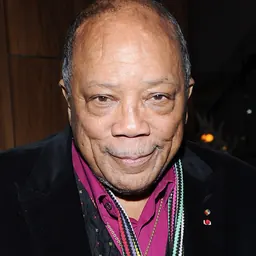

Related people
Same field, nearest in time


Contemporaries
People whose lives overlapped Art Farmer's


Frequently asked questions
Who was Art Farmer?
American jazz trumpeter (1928–1999)
When was Art Farmer born?
Art Farmer was born on 21 August 1928 in Council Bluffs.
When did Art Farmer die?
Art Farmer died on 4 October 1999 in New York City.
What was Art Farmer's occupation?
Art Farmer was a composer, jazz musician, trumpeter and recording artist.
What nationality was Art Farmer?
Art Farmer was American.
Sources & further reading
Cite this page
APA: Biography.guide. (2026). Art Farmer. https://biography.guide/art-farmer/
MLA: "Art Farmer." Biography.guide, https://biography.guide/art-farmer/.
Chicago: "Art Farmer." Biography.guide. https://biography.guide/art-farmer/.
Data last updated: 2026-09-21 · Spot an error? Report a correction.
Portrait: Wikimedia Commons · author & licence
Page generated 2026-09-27 04:58 UTC