
About Arnulf Øverland
Lived 1889 – 1968 (aged 78). Arnulf Øverland was a Norwegian poet and writer.
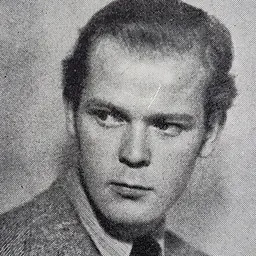
Portrait of Arnulf Øverland. Postcard in the collection of the National Library of Norway
Ole Peter Arnulf Øverland (27 April 1889 – 25 March 1968) was a Norwegian poet and artist. He is principally known for his poetry which served to inspire the Norwegian resistance movement during the German occupation of Norway during World War II.
Biography Øverland was born in Kristiansund and raised in Bergen. His parents were Peter Anton Øverland (1852–1906) and Hanna Hage (1854–1939). The early death of his father, left the family economically stressed. He was able to attend Bergen Cathedral School and in 1904 Kristiania Cathedral School. He graduated in 1907 and for a time studied philology at University of Kristiania.
Øverland published his first collection of poems (1911). Øverland became a communist sympathizer from the early 1920s and became a member of Mot Dag. He also served as chairman of the Norwegian Students' Society 1923–28. He changed his stand in 1937, partly as an expression of dissent against the ongoing Moscow Trials. He was an avid opponent of Nazism and in 1936 he wrote the poem "Du må ikke sove" which was printed in the journal Samtiden. It ends with . ("I thought:: Something is imminent . Our era is over – Europe's on fire!"). Probably the most famous line of the poem is ("You mustn't endure so sincerely well the injustice that doesn't affect yourself!").
During the German occupation of Norway from 1940 in World War II, he wrote to inspire the Norwegian resistance movement. He wrote a series of poems which were clandestinely distributed, leading to the arrest of both him and his future wife Margrete Aamot Øverland in 1941. Arnulf Øverland was held first in the prison camp of Grini before being transferred to Sachsenhausen concentration camp in Germany. He spent a four-year imprisonment until the liberation of Norway in 1945. His poems were later collected in Vi overlever alt and published in 1945.
Øverland played an important role in the Norwegian language struggle in the post-war era. He became a noted supporter for the conservative written form of Norwegian called Riksmål, he was president of Riksmålsforbundet (an organization in support of Riksmål) from 1947 to 1956. In addition, Øverland adhered to the traditionalist style of writing, criticising modernist poetry on several occasions. His speech Tungetale fra parnasset, published in Arbeiderbladet in 1954, initiated the so-called Glossolalia debate.
Personal life In 1918, he married the singer Hildur Arntzen (1888–1957). Their marriage was dissolved in 1939. In 1940, he married Bartholine Eufemia Leganger (1903–1995). They separated shortly after, and were officially divorced in 1945. Øverland married the journalist Margrete Aamot Øverland (1913–1978) in June 1945. In 1946, the Norwegian Parliament arranged for Arnulf and Margrete Aamot Øverland to reside at the Grotten. He lived there until his death in 1968 and she lived there for another ten years until her death in 1978.
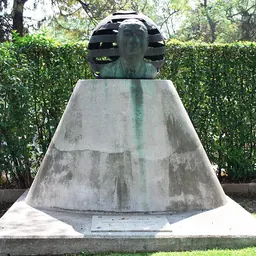
Arnulf Øverland was buried at Vår Frelsers Gravlund in Oslo. Joseph Grimeland designed the bust of Arnulf Øverland (bronze, 1970) at his grave site.
Famous quotes
"For a "monotheistic" religion it should be sufficient with three gods." "What is there to be said about a Church which certainly promises its believers eternal salvation, but at the same time condemns the non-believers, all those who think differently, to an eternal torment in hell? – If that Church absolutely must talk about love, then it should do so very quietly."
Selected works Den ensomme fest (1911) Berget det blå (1927) En Hustavle (1929) Den røde front (1937) Vi overlever alt (1945) Sverdet bak døren (1956) Livets minutter (1965)
Awards Gyldendal's Endowment (1935) Dobloug Prize (1951) Mads Wiel Nygaards legat (1961)
Don’t just read it —
keep it.
Full-length biographies made to live with: read them, listen on the way to work, watch them tonight.
- E-book
- Audio
- Video
Instant download · yours to keep · every purchase keeps this site free
Important facts
People in Arnulf Øverland's life
Named in this biography and alive at the same time


Related people
Same field, nearest in time

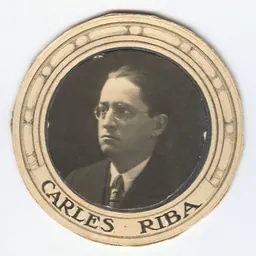
Contemporaries
People whose lives overlapped Arnulf Øverland's




Frequently asked questions
Who was Arnulf Øverland?
Norwegian writer (1889–1968)
When was Arnulf Øverland born?
Arnulf Øverland was born on 27 April 1889 in Kristiansund Municipality.
When did Arnulf Øverland die?
Arnulf Øverland died on 25 March 1968 in Oslo, Oslo Municipality.
What was Arnulf Øverland's occupation?
Arnulf Øverland was a poet and writer.
What nationality was Arnulf Øverland?
Arnulf Øverland was Norwegian.
Sources & further reading
Cite this page
APA: Biography.guide. (2026). Arnulf Øverland. https://biography.guide/arnulf-overland/
MLA: "Arnulf Øverland." Biography.guide, https://biography.guide/arnulf-overland/.
Chicago: "Arnulf Øverland." Biography.guide. https://biography.guide/arnulf-overland/.
Data last updated: 2026-09-20 · Spot an error? Report a correction.
Page generated 2026-09-27 05:30 UTC