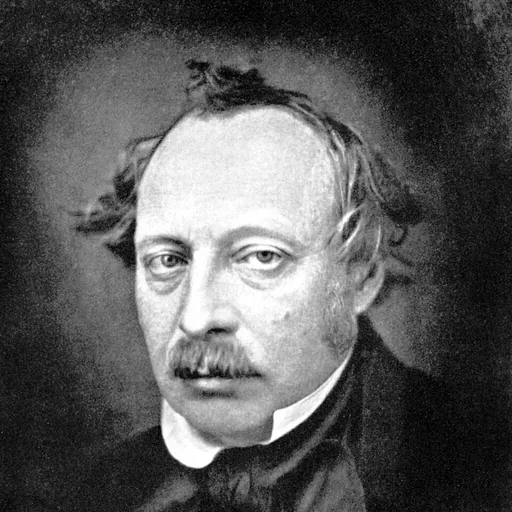
About Arnold Ruge
Lived 1802 – 1880 (aged 78). Arnold Ruge was a German philosopher, writer, translator, journalist, politician and autobiographer.
Arnold Ruge (; 13 September 1802 – 31 December 1880) was a German philosopher and political writer. He was the older brother of Ludwig Ruge.
Studies in university and prison Born in Bergen auf Rügen, he studied at Halle, Jena and Heidelberg. As an advocate of a free and united Germany, he shared in the student agitations of 1821–24 and was jailed from 1824 to 1830 in the fortress of Kolberg, where he studied Plato and the Greek poets. Moving to Halle on his release, he published a number of plays (including Schill und die Seinen, a tragedy) and translations of ancient Greek texts (e.g. Oedipus at Colonus). He became a Privatdozent at the University of Halle in 1832. According to Frederick Copleston: "Ruge shared Hegel's belief that history is a progressive advance towards the realization of freedom, and that freedom is attained in the State, the creation of the rational General Will.[...] At the same time he criticized Hegel for having given an interpretation of history which was closed to the future, in the sense that it left no room for novelty." The Jahrbücher was detested by the orthodox party in Prussia; and was finally suppressed by the Saxon government in 1843, and Ruge left for Paris.
In Paris, Ruge co-edited the Deutsch–Französische Jahrbücher with Karl Marx briefly. He had little sympathy with Marx's socialistic theories, and soon left him. He left Paris in 1845 for Switzerland, and then became a bookseller in Leipzig.
The Prussian government intervened and Ruge soon afterwards left again for Paris, hoping, through his friend Alexandre Ledru-Rollin, to establish relations between German and French republicans; but in 1849 both Ledru-Rollin and Ruge had to take refuge in London.
London and Brighton
In London, in company with Giuseppe Mazzini and other advanced politicians, he formed a "European Democratic Committee." From this Ruge soon withdrew, and in 1850, Ruge moved to Brighton to live as a teacher and writer. In 1866, he vigorously supported Prussia against Austria in the Austro-Prussian War, and in 1870, he supported Germany against France in the Franco-Prussian War. On a smaller scale, while in Brighton, he was chairman of the successful Park Crescent Residents' Association. In his last years, beginning in 1877, he received from the German government a pension of 1000 marks.
He died in Brighton in 1880.
Works In his time, Ruge was a leader in religious and political liberalism. In 1846-48 his Gesammelte Schriften (Collected writings) were published in ten volumes. After this time he wrote, among other books, Manifest an die deutsche Nation (1866), Geschichte unserer Zeit (1881), Unser System, Revolutionsnovellen, Die Loge des Humanismus, and Aus früherer Zeit (his memoirs; 1863–67). He also wrote many poems, and several dramas and romances, and translated into German various English works, including the Letters of Junius and Buckle's History of Civilization. His Letters and Diary (1825–80) were published by Paul Nerrlich (Berlin, 1885–87). See A. W. Bolin's L. Feuerbach, pp. 127–52 (Stuttgart, 1891).
Don’t just read it —
keep it.
Full-length biographies made to live with: read them, listen on the way to work, watch them tonight.
- E-book
- Audio
- Video
Instant download · yours to keep · every purchase keeps this site free
Important facts
People in Arnold Ruge's life
Named in this biography and alive at the same time


Related people
Same field, nearest in time




Contemporaries
People whose lives overlapped Arnold Ruge's






Frequently asked questions
Who was Arnold Ruge?
German philosopher and political writer (1802–1880)
When was Arnold Ruge born?
Arnold Ruge was born on 13 September 1802 in Bergen auf Rügen.
When did Arnold Ruge die?
Arnold Ruge died on 31 December 1880 in Brighton.
What was Arnold Ruge's occupation?
Arnold Ruge was a philosopher, writer, translator, journalist, politician and autobiographer.
What nationality was Arnold Ruge?
Arnold Ruge was German.
Sources & further reading
Cite this page
APA: Biography.guide. (2026). Arnold Ruge. https://biography.guide/arnold-ruge/
MLA: "Arnold Ruge." Biography.guide, https://biography.guide/arnold-ruge/.
Chicago: "Arnold Ruge." Biography.guide. https://biography.guide/arnold-ruge/.
Data last updated: 2026-09-23 · Spot an error? Report a correction.
Portrait: Wikimedia Commons · author & licence
Page generated 2026-09-27 05:06 UTC