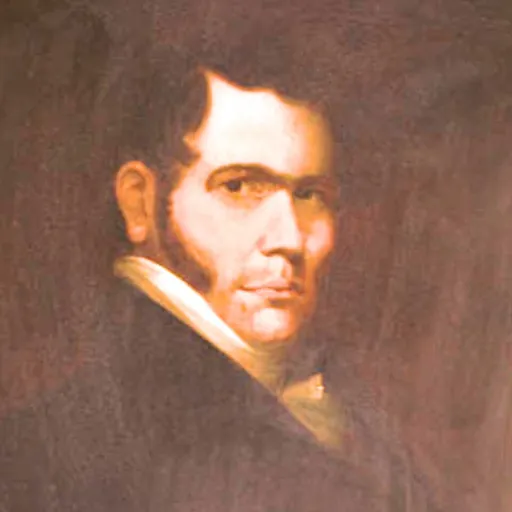
About Arnaud Beauvais
Lived 1783 – 1843 (aged 60). Arnaud Beauvais was an American politician and governor.
Arnaud Julie Beauvais (September 6, 1783 – November 18, 1843), also known as Armand Beauvais, or Arnaud Jules Beauvais, was the seventh Governor of Louisiana, as well as member and Speaker of the Louisiana House of Representatives, and member and President of the Louisiana State Senate. His governorship oversaw little change, aside from the transition of the capital of Louisiana being moved from New Orleans to Donaldsonville. He worked as a merchant and plantation owner, as well.
Biography Early life Arnaud Beauvais was born on September 6, 1783, in Pointe Coupee Parish to slaveholding, wealthy, parents Pierre Charles St. James Beauvais and Marie Françoise Richer. He was the youngest of eight siblings and received limited education in the form of private tutoring. By 1806, he purchased a plantation from his widowed mother and a slave. His plantation included eleven arpents (2,112 feet) of frontage land on the Mississippi River.
A French Louisianian, he was Catholic.
Career His first political role came about when William C. C. Claiborne named him the Justice of the peace of Pointe Coupee Parish in 1810. Shortly thereafter, he became an administrators of the Point Coupee school district. His career continued, and he, a supporter of John Quincy Adams, soon thereafter was elected into the Louisiana House of Representatives, serving in 1814, 1816, and 1818. He then took a short break, before returning in 1821 to serve as the Speaker of the Louisiana House of Representatives from 1821 to 1823. During his tenure as Speaker of the House, he also ran for State Senate office as a Whig, being elected in 1822. He would soon thereafter serve as President of the Louisiana State Senate from 1827 to 1830, but was soon thereafter required to serve as the Governor.
After his governorship, he served on the House from 1833 to 1834 after the resignation of a Representative Chenevert.
Governor As President of the Senate, Arnaud was next in line to governorship. This came when Governor Pierre Derbigny was thrown from a carriage after ten months in office, dying from injuries sustained.
Under Beauvais, the Louisiana capital was moved from New Orleans to Donaldsonville. His three-month period as acting Governor ended when his bid for reelection as Governor during the special election of 1830 failed. He only ended up receiving 18% of the vote. This campaign was financed using a loan, which he eventually had to pay off, leading to financial woes and the selling of his estate in 1839.
Death Arnaud Beauvais died in his New Orleans home on 18 November 1843. He is buried in Saint Louis Cemetery No. 2.
Don’t just read it —
keep it.
Full-length biographies made to live with: read them, listen on the way to work, watch them tonight.
- E-book
- Audio
- Video
Instant download · yours to keep · every purchase keeps this site free
Important facts
People in Arnaud Beauvais's life
Named in this biography and alive at the same time

Related people
Same field, nearest in time



Contemporaries
People whose lives overlapped Arnaud Beauvais's

Frequently asked questions
Who was Arnaud Beauvais?
American politician (1783-1843)
When was Arnaud Beauvais born?
Arnaud Beauvais was born on 6 September 1783 in Pointe Coupee Parish.
When did Arnaud Beauvais die?
Arnaud Beauvais died on 18 November 1843 in New Orleans.
What was Arnaud Beauvais's occupation?
Arnaud Beauvais was a politician and governor.
What nationality was Arnaud Beauvais?
Arnaud Beauvais was American.
Sources & further reading
Cite this page
APA: Biography.guide. (2026). Arnaud Beauvais. https://biography.guide/arnaud-beauvais/
MLA: "Arnaud Beauvais." Biography.guide, https://biography.guide/arnaud-beauvais/.
Chicago: "Arnaud Beauvais." Biography.guide. https://biography.guide/arnaud-beauvais/.
Data last updated: 2026-09-21 · Spot an error? Report a correction.
Portrait: Wikimedia Commons · author & licence
Page generated 2026-09-27 04:59 UTC