
About Armand Lanoux
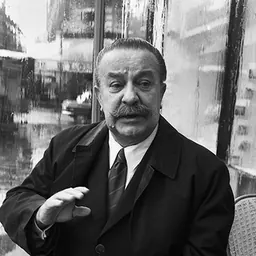
Lived 1913 – 1983 (aged 69). Armand Lanoux was a French writer, biographer, painter, journalist and poet.
Armand Lanoux (24 October 1913 – 23 March 1983) was a French writer.
Biography Lanoux was born in Paris, France. Early in life he had several jobs: he was a teacher, designer of candy boxes, bank employee, painter and journalist.
He became an editor for the literary Artheme Fayard (1950), editor of the magazine À la page (1964), chaired the Committee on French television in 1958–1959, and was appointed Secretary General of the Radio and Television International University. He was a member of a 13-member panel that chose "Dors, mon amour" as the French Eurovision entry in 1958, where it finished first out of 10. He was a member of the France-USSR Association. He participated in drafting the Code des Usages.
Lanoux wrote in many genres: the novel, non-fiction, chronicles, drama, poetry (Apollinaire 1953 Chapman prize).
From 1957 to 1964, he spent several months a year in Saint-Jean-Cap-Ferrat. In 1963, he earned accolades in winning the Prix Goncourt for his novel Quand la mer se retire (When the tide goes out).
In 1970, he co-wrote with Marcel Cravenne Le Lys dans la vallée, directed by Marcel Cravenne, based on the novel of the same name by Honoré de Balzac. In 1980, Lanoux adapted Balzac's novel La Peau de chagrin for television, directed by Michel Favart.
Lanoux died in Champs-sur-Marne, aged 69.
The fonds of Armand Lanoux are stored at the Archives nationales à Montréal of the Bibliothèque et Archives nationales du Québec (BAnQ).
Awards Prix du roman populiste, for La Nef des fous Grand Prix du roman of Société des Gens de Lettres, Les Lézards dans l'horloge Prix Interallié, Le Commandant Watrin Prix Goncourt, Quand la mer se retire
Works La Canadienne assassinée (Colbert) 1943 Le Pont de la folie (Colbert) 1946 L'Affaire de l'impasse Ronsin 1947 La Nef des fous (Amiot-Dumont/Julliard) 1948 L'Enfant en proie aux images (Labeyrie) 1949 La Classe du matin (Fayard) 1949 Cet âge trop tendre (Éditions Julliard) 1951 Colporteur (Seghers), 1953 Prix Apollinaire Les Lézards dans l'horloge (Julliard), 1953 Bonjour, Monsieur Zola (Amiot-Dumont/Hachette) 1954 Le Photographe délirant (Seghers) 1956 Le Commandant Watrin (Julliard), 1956 Yododo (Fayard) 1957 Le Rendez-vous de Bruges (Julliard) 1958 Un jeune homme en habit 1958 La Tulipe orageuse (Seghers) 1959 La Tête tranchée : à quoi jouent les enfants du bourreau (Julliard) 1959 1900, la bourgeoisie absolue (Hachette) 1961 Quand la mer se retire (Julliard) 1963 Le Berger des abeilles (Grasset) 1974 La Corsetière prodigieuse (Jean-Pierre Kupczyk éditor) 1988
Don’t just read it —
keep it.
Full-length biographies made to live with: read them, listen on the way to work, watch them tonight.
- E-book
- Audio
- Video
Instant download · yours to keep · every purchase keeps this site free
Important facts
Related people
Same field, nearest in time



Contemporaries
People whose lives overlapped Armand Lanoux's





Frequently asked questions
Who was Armand Lanoux?
French writer (1913–1983)
When was Armand Lanoux born?
Armand Lanoux was born on 24 October 1913 in 12th arrondissement of Paris, Paris.
When did Armand Lanoux die?
Armand Lanoux died on 23 March 1983 in Champs-sur-Marne.
What was Armand Lanoux's occupation?
Armand Lanoux was a writer, biographer, painter, journalist and poet.
What nationality was Armand Lanoux?
Armand Lanoux was French.
Sources & further reading
Cite this page
APA: Biography.guide. (2026). Armand Lanoux. https://biography.guide/armand-lanoux/
MLA: "Armand Lanoux." Biography.guide, https://biography.guide/armand-lanoux/.
Chicago: "Armand Lanoux." Biography.guide. https://biography.guide/armand-lanoux/.
Data last updated: 2026-09-20 · Spot an error? Report a correction.
Page generated 2026-09-27 05:26 UTC