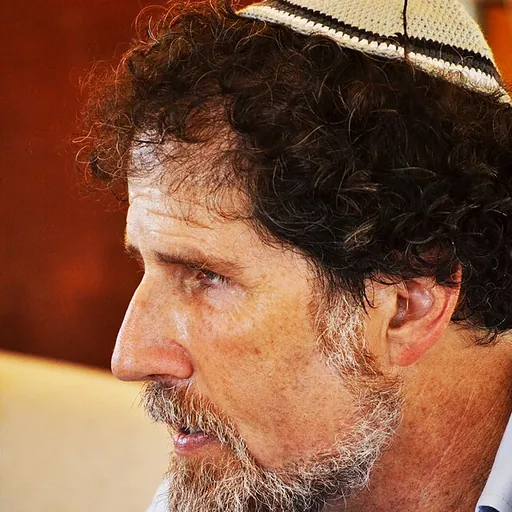
About Arik Ascherman
Born 1959. Arik Ascherman is an American rabbi, known for Rabbis for Human Rights.
Arik Ascherman (; born 1959) is an American-born Israeli rabbi, and executive director of the Israeli human rights organization Torat Tzedek-Torah of Justice. For 21 years, starting in 1995, he served as co-director (1995–1998), executive director (1998–2010), director of special projects (2010–2012) and president and senior rabbi (2012–2017) for Rabbis for Human Rights, an Israeli organization.
As a human rights activist and a follower of Reform Judaism, he has spearheaded activities to defend Palestinians against Israeli settler violence, and has stood trial several times for acts of civil disobedience. He appears in the 2010 documentary Israel vs Israel. He is fluent in both Hebrew and Arabic. He immigrated to Israel in 1994. He attributes his interest in activism on behalf of universal human rights to the rabbinic concept of tikkun olam (lit. "repairing the world"), referring to universal human rights and social justice. He draws his inspiration specifically from a remark in the Mishnaic ethical tract Pirkei Avot: "In a place where there are no men (decent people) strive to be a man."
Ascherman and Rabbis for Human Rights were known for dispatching volunteers to act as human shields to protect the Palestinian olive harvest from vandalism and assault by settlers living on nearby land; every year, clashes are reported between settlers and Palestinian farmers. In 2008, the volunteer effort encompassed 40 villages. The effort was launched in 2002 when a Palestinian peace activist solicited RHR's help to protect olive pickers against attacks by settlers living near the village of Yasuf. He was arrested again in March 2008 after witnessing an attack on Palestinians in Silwan. When he went to give testimony, he found himself accused of "inciting Palestinians to oppose the police" near the ongoing archaeological dig in the City of David.
In 2006, Rabbis for Human Rights, the Association for Civil Rights in Israel and five Palestinian local councils won a landmark Israeli High Court case requiring Israeli security forces to allow and protect the access of Palestinian farmers to all of their agricultural lands. As a result, many Palestinian farmers today work lands that settlers or the army had prevented them from working for many years.
Rabbi Ascherman casts his position as a moral and religious one rather than a political one, as he stated at his 2005 trial:
That moral inheritance tells us that the policy of home demolition is immoral. It may be technically legal according to Israeli law narrowly interpreted. However, not everything that is legal is just. The policy is certainly illegal according to international law and tramples on the Torah, which I as a rabbi am sworn to uphold. The Torah commands us to love those different to us, not to have double standards and to have one law for all.
During his tenure at Rabbis for Human Rights, the organization expanded into the field of socioeconomic justice for all Israelis. RHR led efforts that ended of the "Israeli Wisconsin Plan" in 2010, was active in the social protest movement of 2011, and was instrumental in creating the "Public Housing Forum." RHR also began to teach in pre-army academies and created "human rights yeshivas" at Israeli universities and colleges. RHR also began to advocate for African asylum seekers in Israel.
In August 2016, Rabbi Ascherman and two additional RHR senior staff people left Rabbis for Human Rights to found an interfaith human rights organization, "Haqel (The Field) – Jews and Arabs in Defense of Human Rights. In 2017, Rabbi Ascherman left Haqel, and founded "Torat Tzedek-Torah of Justice." Torat Tzedek is seeking to stop the chipping away at the 2006 High Court decision, accompany and protect Palestinian shepherds, advocate on behalf of the "unrecognized" Israeli Bedouin villages in the Negev, and for public housing for Israelis. Rabbi Ascherman continues to be active in "HaMaabarah", a public housing advocacy collective he helped found in 2011.
Awards
2002: Torch Lighter in the Yesh Gvul Alternative Israeli Independence Day Ceremony 2005: Abraham Joshua Heschel Award of the "Jewish Peace Fellowship" 2006: Humanitarian Achievement Prize by the "Wholistic Peace Institute" 2009: Keter Shem Tov Prize awarded by the Reconstructionist Rabbinical College In 2009, he was co-recipient (with Alice Shalvi) of the Leibowitz Prize, presented by the Yesh Gvul. In 2011, he was co-recipient (with Rabbi Ehud Bandel, a co-founder of Rabbis for Human Rights) of the Gandhi Peace Award, "for their nonviolent methods of resolving human rights abuses in Israel and the Occupied Territories". 2014: Honorary Doctor of Divinity from HUC-JIR 2015: Honorary Doctor of Divinity from Chicago Theological Seminary 2016: Tikkun Magazine Award In 2019 The Rabbi David J. Forman Memorial Fund awarded Rabbi Ascherman and Torat Tzedek the Fund's Human Rights Prize for the Jewish year 5779. Under Rabbi Ascherman's leadership, Rabbis For Human Rights won the Niwano Peace Prize in 2006.
Publications
"Born with a Knife in Their Hearts: Children and Political Conflict" in Nurturing Child and Adolescent Spirituality: Perspectives from the World's Religious Traditions edited by Yust, Sasso, Johnson and Roehikepartain, 2005 "On the Human Rights of the 'Other" in Judaism: The Israeli Context" (Hebrew) in Human Rights and Social Exclusion in Israel edited by Ya'ir Ronen, Israel Doron, Vered Slonim-Nevo, 2008 "Does Judaism Teach Universal Human Rights" in Abraham's Children edited by Kelly Clark, 2012 "The Little Acts That Tip The Scales" in Defending Hope – Dispatches from the front lines in Palestine and Israel edited by Eoin Murray and James Mehigan, 2018
Personal life Ascherman is married to Dr. Einat Ramon, the first Israeli-born woman ordained as a Conservative rabbi. They and their two children reside in Jerusalem.
Don’t just read it —
keep it.
Full-length biographies made to live with: read them, listen on the way to work, watch them tonight.
- E-book
- Audio
- Video
Instant download · yours to keep · every purchase keeps this site free
Important facts
People in Arik Ascherman's life
Named in this biography and alive at the same time





Related people
Same field, nearest in time


Contemporaries
People whose lives overlapped Arik Ascherman's



Frequently asked questions
Who is Arik Ascherman?
American rabbi
When was Arik Ascherman born?
Arik Ascherman was born in 1959 in Erie.
What is Arik Ascherman's occupation?
Arik Ascherman is a rabbi.
What is Arik Ascherman known for?
Arik Ascherman is known for Rabbis for Human Rights.
What nationality is Arik Ascherman?
Arik Ascherman is American.
Sources & further reading
Cite this page
APA: Biography.guide. (2026). Arik Ascherman. https://biography.guide/arik-ascherman/
MLA: "Arik Ascherman." Biography.guide, https://biography.guide/arik-ascherman/.
Chicago: "Arik Ascherman." Biography.guide. https://biography.guide/arik-ascherman/.
Data last updated: 2026-09-20 · Spot an error? Report a correction.
Portrait: Wikimedia Commons · author & licence
Page generated 2026-09-27 04:58 UTC