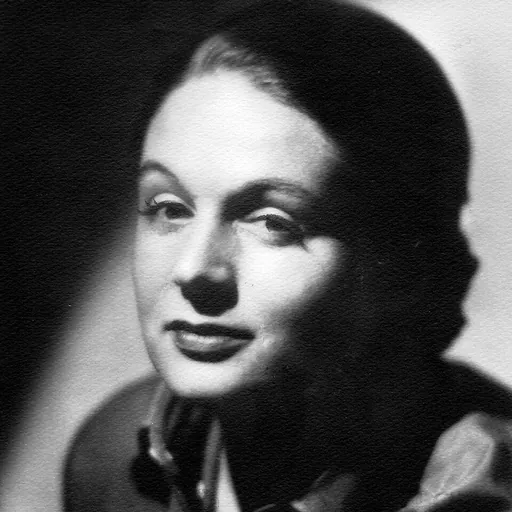
About Ardel Wray
Lived 1907 – 1983 (aged 75). Ardel Wray was an American screenwriter and story editor.
Ardel Wray ( Mockbee; October 28, 1907 – October 14, 1983) was an American screenwriter and story editor, best known for her work on Val Lewton's classic horror films in the 1940s. Her screenplay credits from that era include I Walked with a Zombie, The Leopard Man and Isle of the Dead.
In a late second career in television, she worked as a story editor and writer at Warner Bros. on 77 Sunset Strip, The Roaring 20s, and The Travels of Jaimie McPheeters.
Early life and career Born Ardel Mockbee on October 28, 1907, in Spokane, Washington, Ardel Wray was the only child of Virginia Brissac and Eugene Mockbee, both stage actors working in West Coast stock companies in the early 1900s. When her parents separated, she was brought to live with her maternal grandparents in San Francisco while her mother continued her career. She spent most of her childhood moving back and forth between her grandparents' home and a boarding school, and was raised primarily by her grandfather, B. F. Brisac, a prominent San Francisco businessman who was a surrogate father and mentor until his death in 1940.
Divorced from Mockbee, her mother married theatre director-manager John Griffith Wray in 1915 and moved with him to Los Angeles when he accepted a directing job at the Thomas Ince Studios. Ardel came to live with them in 1922, later taking her stepfather's last name. After graduating from high school, she worked as a model for Hollywood fashion designer Howard Greer, briefly attended the University of California at Los Angeles, and lived for a while at The Rehearsal Club in New York, where she considered and ultimately rejected the idea of becoming an actress. She had two short-lived marriages in the decade following high school, both to California artists, Henry D. Maxwell (1928–1930) and Don Mansfield Caldwell (1933–1939).
Wray began her career working in studio story departments. In 1933, after working as a staff writer developing properties for Carl Laemmle Jr.'s reopening of Universal Studios, she went to work in the Story Department at Warner Bros. where she met Dalton Trumbo, who was also working in the department at the time. An early draft of Trumbo's novel Johnny Got His Gun with a handful of Wray's margin notes was found among her papers after she died, and anecdotes in Wray's family history suggest that she and Trumbo became "an item" for a while, but if there was a relationship beyond their shared interest in writing it did not last. A treatment found in her estate papers puts her in that program in 1941. In 1942, she was given an opportunity to work with Val Lewton, a producer of low-budget horror movies. Lewton had to recruit his production team from inside RKO, and he may have discovered Wray through her work in the Young Writers' program, but it is also possible that she was referred to him by Mark Robson, who Lewton had recruited from the editing department, along with Robert Wise.
In 1948, Wray was again approached by Lewton, then at Paramount Pictures, who was trying to rescue a project he was working on about the life of Lucrezia Borgia, with Paulette Goddard set to play the title role. Paramount Pictures production records show that Wray signed a contract in February 1948 to rewrite a script written by Michael Hogan titled A Mask for Lucrezia. By the time she completed that assignment a month later, Lewton had already been taken off the project
As it did for so many, Wray's decision had personal consequences as well as professional ones. Her mother (long divorced from John Wray and moving toward the end of a second career as a character actress in Hollywood) was frightened by the incident. Concerned for her own career, she did not support her daughter's decision, and publicly questioned her loyalty. Wray's husband had just returned from serving in the Philippines in WWII and was unemployed; the situation put a strain on their marriage, which ended in divorce a few years later. Her circle of friends scattered.
Wray would not work as a screenwriter again for twelve years — a phenomenon that would come to be known as the "graylist." To support herself and her daughter, she worked as a reader in various studio story departments and took occasional side-jobs doing research and novelizing films for newspapers. She never remarried and, although she continued to look after her mother, their relationship never fully recovered from this period. and had helped others get off the 'graylist'. Boris Ingster's career had not been affected, but both men took a calculated risk in orchestrating Wray's return to screenwriting, and because of them and others like them, the era of the Hollywood blacklist and graylist slowly came to an end. A few months after Huggins asked Wray to work on some scripts for him, Dalton Trumbo received screen credit under his own name for the first time in fourteen years for his screenplays for Exodus and Spartacus.
Wray would go on to write two (credited) episodes of The Roaring 20s, and she continued to work with Ingster for the next six years as a writer and story editor on 77 Sunset Strip, The Travels of Jaimie McPheeters, and as assistant to the producer on the movie Guns of Diablo at MGM.
Retirement and death
While working at MGM, Wray was diagnosed with cataracts. When her contract on Guns of Diablo ended, she returned to Warner Bros., which was closer to home and did not require driving at night, and she continued working as a story analyst there and at The Walt Disney Studios until her failing vision forced her to stop. She retired in 1972 and lived in Santa Fe, New Mexico for the next several years, an area she remembered fondly from her trip there in 1943 to find and photograph the places that would become the sets and backdrops in The Leopard Man.
Wray returned to Los Angeles in 1980, was diagnosed with breast cancer in 1983 and died on October 14, 1983, aged 75. Her mother had died only four years earlier at age 96. As she directed, her ashes were scattered at sea.
Contribution to the Lewton legacy Wray wrote three of the collection films celebrated in Martin Scorsese’s 2007 documentary film Val Lewton: The Man in the Shadows, two of them groundbreaking screenplays that helped define the genre of the psychological thriller and establish Lewton's reputation as the master of horror. In Wray, Lewton found a writer with a gift for character development who was also willing to take on challenging or controversial subject matter: the supernatural, a serial killer, the plagues of war and superstition, and the relationships in the notorious Borgia family—all were out of the mainstream when Wray sat down to write about them. Her ability to seduce 1940s audiences into following Lewton down a path to some of the darker corners of human experience was evident in the unexpected critical and box office success of those films. The scene she had written was pure psychological terror, trading on very basic fears -- of the dark, of being punished unjustly, locked out of your own home, abandoned by people you trust -- and at the same time it sets up the mystery that is the premise of the entire film. They were under pressure to get this sequence right, and almost everyone was there that night. The session went well into the small hours of the morning, was filled with laughter, and included a hilarious riff as one of them experimented with a set of castanets, which turned out to be the key to building the tension and suspense. They worked their way through a dozen different shot sequences before they were satisfied and, listening to her, I had the very strong impression that they would have come up with that same elegant, powerful scene even if they had been working with an A-movie budget and had more time. As Agee so famously observed about Lewton, these were people who understood film and cared about human beings. I can still see the smile on her face as she recalled that night. -- Stefani Warren, September 2016
Filmography
Writer I Walked with a Zombie, 1943 (screenplay) The Leopard Man, 1943 (screenplay) The Falcon and the Co-Eds, 1943 (story and screenplay) Blackbeard the Pirate... original screenplay, RKO circa 1945, unproduced (RKO's Blackbeard the Pirate project, developed by the Lewton group, was put on hold following the death of studio executive and Lewton supporter Charles Koerner and Lewton's subsequent release from RKO.) The RKO shooting draft of Wray's screenplay for the project was found among her papers and is thought to be one of the items returned to her in the mail following her release from Paramount in October 1948. (See also Dawson
Story Editor 77 Sunset Strip, 1962-1964 (TV Series) The Roaring 20s, 1961-1962 (TV Series) The Travels of Jaimie McPheeters, 1964 (TV Series) Guns of Diablo'' (1965)
Notes and related history
Don’t just read it —
keep it.
Full-length biographies made to live with: read them, listen on the way to work, watch them tonight.
- E-book
- Audio
- Video
Instant download · yours to keep · every purchase keeps this site free
Important facts
People in Ardel Wray's life
Named in this biography and alive at the same time




Related people
Same field, nearest in time


Contemporaries
People whose lives overlapped Ardel Wray's



Frequently asked questions
Who was Ardel Wray?
American screenwriter
When was Ardel Wray born?
Ardel Wray was born on 28 October 1907 in Spokane.
When did Ardel Wray die?
Ardel Wray died on 14 October 1983 in Los Angeles.
What was Ardel Wray's occupation?
Ardel Wray was a screenwriter and story editor.
What nationality was Ardel Wray?
Ardel Wray was American.
Sources & further reading
Cite this page
APA: Biography.guide. (2026). Ardel Wray. https://biography.guide/ardel-wray/
MLA: "Ardel Wray." Biography.guide, https://biography.guide/ardel-wray/.
Chicago: "Ardel Wray." Biography.guide. https://biography.guide/ardel-wray/.
Data last updated: 2026-09-22 · Spot an error? Report a correction.
Portrait: Wikimedia Commons · author & licence
Page generated 2026-09-27 05:02 UTC