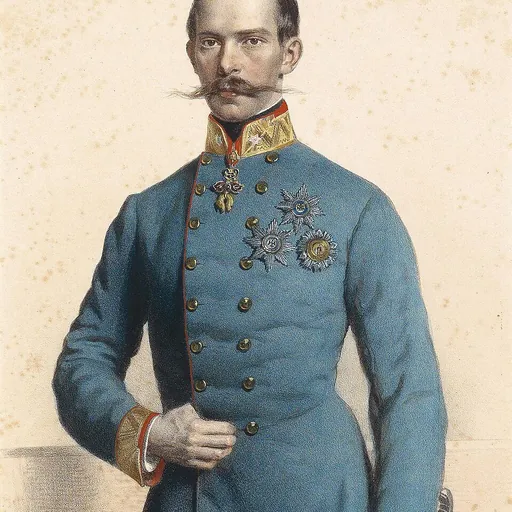
Archduke Rainer Ferdinand of Austria
Archduke of Austria
About Archduke Rainer Ferdinand of Austria
Lived 1827 – 1913 (aged 86). Archduke Rainer Ferdinand of Austria was an Austrian politician, military personnel and archduke.
Archduke Rainer Ferdinand Maria Johann Evangelist Franz Ignaz of Austria (11 January 1827 – 27 January 1913) was an Austrian prince and politician who served as Minister-President of Austria from 1861 to 1865. Later in his life, he took up the collection of preserved papyri, largely from Egypt, and served as a benefactor and patron while working with the Oriental studies department of the University of Vienna. His purchases of papyri from Egypt formed the Rainer collection at the Austrian National Library.
Biography Archduke Rainer Ferdinand was born in Milan, the capital of the Austrian Kingdom of Lombardy–Venetia. He was a son of the viceroy, Archduke Rainer, and Princess Elisabeth of Savoy. He spent most of his youth at the Royal Villa of Monza. Rainer studied law at the University of Vienna and in 1843 joined the Austrian Imperial Army in the rank of an Oberst (Colonel).
In 1852, Archduke Rainer married his cousin Archduchess Maria Karoline (1825–1915), whose father, Charles, was known for his victory at the 1809 Battle of Aspern. The marriage was a very happy one, and, with numerous public appearances and charitable activities, the couple was probably the most popular amongst the Habsburg family. The lavish celebration of their diamond wedding in 1912 was rated as one of the last great events of the Austro-Hungarian Monarchy before World War I. However, the marriage remained childless.
In 1854, Rainer achieved the rank of Generalmajor in the Imperial Army and in 1861 was raised to Feldmarschall-Leutnant (Field marshal lieutenant). In 1857, Archduke Rainer was appointed president of the Austrian Imperial Council by Emperor Francis Joseph I. In the course of the implementation of the 1861 February Patent constitution, he took up office as nominal Minister-President chairing the liberal cabinet of State Minister Anton von Schmerling.
Rainer was popular with the nonaristocratic population of Vienna, often walking the streets on foot.
Papyrus collection
While Rainer's military and political career was largely forgotten, his interest in art and science proved more lasting. Later in his life, Archduke Rainer became interested in the emerging science of papyrology, the study of preserved papyrus in the deserts of Egypt that offered primary source documents from centuries earlier. In 1878–1879, the Viennese dealer in antiquities purchased recently found papyri from Faiyum, known as Arsinoe in the Hellenistic period. Graf contacted Professor of Oriental History at the University of Vienna and arranged the shipping of around 10,000 papyri to him. The papyri made their way to Vienna in 1881 and 1882 while awaiting a buyer; at the end of 1883, Archduke Rainer agreed to purchase the papyri. Professor Karabacek managed and processed both the sale and the collection. The collection was initially stored at the Österreichischen Museum für Kunst und Industrie (the predecessor of the modern Museum of Applied Arts). Archduke Rainer continued to expand the collection with new purchases that Graf arranged, including papyri from digs at Hermopolis, Heracleopolis Magna, and other sites in the Faiyum area such as Soknopaiou Nesos. Rainer gifted the collection to his uncle Emperor Franz Joseph I of Austria on August 18, 1899 as a birthday present. At Rainer's request, Franz Joseph incorporated them as a special collection at the Imperial and Royal Court Library (now known as the Austrian National Library). Rainer's vast purchases provided the core of the collection that still exists today as one of the most significant collection of papyri in the world. The Rainer collection at the Austrian National Library was given the honour of becoming part of the UNESCO Memory of the World Register in 2001.
Honours and awards Austro-Hungarian Knight of the Golden Fleece, 1852 Grand Cross of the Royal Hungarian Order of St. Stephen, 1862 Knight of St. Hubert, 1860 Grand Cordon of the Order of Leopold (military), 2 February 1874 Grand Cross of the Southern Cross Ernestine duchies: Grand Cross of the Saxe-Ernestine House Order Grand Cross of the Legion of Honour Kingdom of Greece: Grand Cross of the Redeemer Grand Cross of the Ludwig Order, 11 September 1860 Knight of the Golden Lion Knight of the Annunciation, 21 September 1873 Mecklenburg: Grand Cross of the Wendish Crown Grand Cross of St. Charles Nassau Ducal Family: Knight of the Gold Lion of Nassau Grand Cross of the Netherlands Lion Grand Cross of the Tower and Sword Kingdom of Prussia: Knight of the Black Eagle, 4 June 1853 Knight of the Red Eagle, 1st Class Grand Cross of the Star of Romania Knight of St. Andrew Knight of St. Alexander Nevsky Knight of the White Eagle Knight of St. Anna, 1st Class Grand Cross of the White Falcon, 1885 Knight of the Rue Crown, 1891 Grand Cross of the Order of Charles III, with Collar, 24 November 1879 Knight of the Seraphim, 5 December 1908 Grand Duchy of Tuscany: Grand Cross of St. Joseph Knight of St. Januarius Grand Cross of St. Ferdinand and Merit Honorary Grand Cross of the Royal Victorian Order, 9 October 1903 Grand Cross of the Württemberg Crown, 1873
Ancestry
Don’t just read it —
keep it.
Full-length biographies made to live with: read them, listen on the way to work, watch them tonight.
- E-book
- Audio
- Video
Instant download · yours to keep · every purchase keeps this site free
Important facts
People in Archduke Rainer Ferdinand of Austria's life
Named in this biography and alive at the same time

Related people
Same field, nearest in time




Contemporaries
People whose lives overlapped Archduke Rainer Ferdinand of Austria's






Frequently asked questions
Who was Archduke Rainer Ferdinand of Austria?
Archduke of Austria (1827-1913)
When was Archduke Rainer Ferdinand of Austria born?
Archduke Rainer Ferdinand of Austria was born on 11 January 1827 in Milan.
When did Archduke Rainer Ferdinand of Austria die?
Archduke Rainer Ferdinand of Austria died on 27 January 1913 in Vienna.
What was Archduke Rainer Ferdinand of Austria's occupation?
Archduke Rainer Ferdinand of Austria was a politician, military personnel and archduke.
What nationality was Archduke Rainer Ferdinand of Austria?
Archduke Rainer Ferdinand of Austria was Austrian.
Sources & further reading
· Wikipedia: Archduke Rainer Ferdinand of Austria
· DBpedia: Archduke Rainer of Austria (1827–1913)
Cite this page
APA: Biography.guide. (2026). Archduke Rainer Ferdinand of Austria. https://biography.guide/archduke-rainer-ferdinand-of-austria/
MLA: "Archduke Rainer Ferdinand of Austria." Biography.guide, https://biography.guide/archduke-rainer-ferdinand-of-austria/.
Chicago: "Archduke Rainer Ferdinand of Austria." Biography.guide. https://biography.guide/archduke-rainer-ferdinand-of-austria/.
Data last updated: 2026-09-22 · Spot an error? Report a correction.
Portrait: Wikimedia Commons · author & licence
Page generated 2026-09-27 05:04 UTC