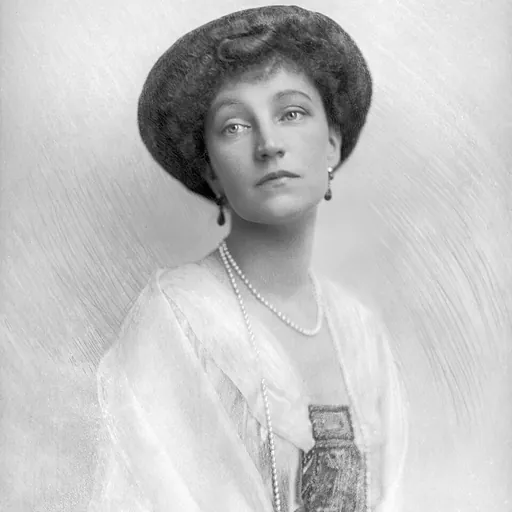
Archduchess Elisabeth Marie of Austria
Archduchess of Austria
About Archduchess Elisabeth Marie of Austria
Lived 1883 – 1963 (aged 79). Archduchess Elisabeth Marie of Austria was an Austrian social democrat.
Archduchess Elisabeth Marie Henriette Stephanie Gisela of Austria (; 2 September 1883 – 16 March 1963) was the only child of Rudolf, Crown Prince of Austria, and Princess Stéphanie of Belgium. Her father was the son and heir apparent of Emperor Franz Joseph I of Austria, and her mother was a daughter of King Leopold II of Belgium. She was known to her family as "Erzsi", a diminutive of her name Erzsébet in Hungarian. Later nicknamed The Red Archduchess, she was famous for becoming a socialist and a member of the Austrian Social Democratic Party.
Early life Archduchess Elisabeth (nicknamed 'Erzsi' – the abbreviation of the Hungarian version of her first name Erzsébet) was born at Schloss Laxenburg on 2 September 1883 to Crown Prince Rudolf and Stéphanie, daughter of King Leopold II of Belgium. She was named after her grandmothers, Empress Elisabeth of Austria and Queen Marie Henriette of Belgium. Erzsi was Franz Joseph's only grandchild through his son.
In 1889, when Erzsi was a little over five years old, her father and Baroness Mary von Vetsera, his mistress, were found dead in what was assumed to be a murder-suicide pact at the Imperial hunting lodge at Mayerling. Her father's death interrupted the dynastic succession within the Austrian imperial family, fractured her grandparents' already tenuous marriage and was a catalyst in Austria-Hungary's gradual destabilization, which culminated in the First World War and the subsequent disintegration of the Habsburg Empire.
After Rudolf's death, Franz Joseph took over guardianship of Erzsi; by his order, she was forbidden to leave Austria with her mother. At a young age she displayed a strong personality, as well as an opposition to the Viennese court.
Her grandmother, the capricious and image obsessed Empress Elisabeth, did not enjoy being identified as a grandmother and was therefore not close to any of her grandchildren. However, after her assassination in 1898, her will specified that, outside a large bequest of the sale of her jewels to benefit charities and religious orders, all of her personal property was bequeathed to Erzsi, her namesake and Rudolf's only child. The Empress made no secret of her dislike of her daughter-in-law prior to the scandal, and after the Mayerling incident, blamed Stéphanie's jealous behavior for her son's depression and suicide. The crown princess was entirely dependent on the Emperor's charity, so the lack of imperial support for Stéphanie following her husband's death negatively affected her relationship with Erzsi, and the mother and child were never close.
In 1900, Stéphanie renounced her title of Crown Princess to marry the Protestant Hungarian count Elemér Lónyay von Nagy-Lónya und Vásáros-Namény (he was eventually made a Prince in 1917 by Emperor Karl I.). Although Emperor Franz Joseph provided his daughter-in-law with a dowry, and Lónyay eventually converted to Catholicism, Erzsi broke off all contact with her mother because she disapproved of the marriage, feeling it was a betrayal of her father's memory. Later, following her marriage, Stéphanie retaliated by disinheriting Erzsi in 1934.
First marriage Elisabeth was considered a potential bride for several princes in Europe; among them was her cousin Prince Albert, heir presumptive to the throne of Belgium. However, King Leopold II vehemently disapproved of Stéphanie's recent morganatic marriage to Count Elemér Lónyay and thus refused to give Albert his permission. Albert's sister Henriette was horrified at her brother's choice, feeling Elisabeth's background was too unstable for the marriage to be a success.
During a court ball in 1900, Elisabeth met Prince Otto Weriand of Windisch-Graetz (1873–1952), the second son of Prince Ernst Ferdinand Weriand of Windisch-Graetz (1827–1918) and his wife, Princess Kamilla Amalia Caroline Notgera of Oettingen-Oettingen und Oettingen-Spielberg (1845–1888). Ten years her senior, he was below her in rank. Nonetheless, she importuned her grandfather to be allowed to marry him. Franz Joseph resisted at first, having intended for Elisabeth to marry the German Crown Prince, but eventually relented. Elisabeth and Prince Otto were related through her grandmother Sissi. They were third cousins twice removed as Otto was third cousin of the late Empress, both descending from Duke Charles Marie of Arenberg. By many accounts it was Elisabeth alone who wanted the marriage, as Otto was already engaged and was reportedly dumbfounded when Franz Joseph informed him of his new engagement. Ordered by the Emperor to break his "lesser" engagement to marry his granddaughter, he complied.
In order to avoid future succession issues, the Emperor made the marriage conditional on Elisabeth's renouncing her right to succession, although he allowed her to keep her personal title and style, as well as providing her with a generous dowry. While Otto's family was officially listed among the Habsburg-approved families for equal marriages (Ebenbürtigkeit) with an imperial house, the complication lay in the specific branch of his lineage. Otto did not descend from the first Prince of Windisch-Graetz, whose title as Prince of the Holy Roman Empire made his elder line of the Windisch-Graetz family legally equal for dynastic marriages with other royals. Instead, Otto came from the line of his brother, Weriand, who was created Fürst zu Windisch-Graetz only on 18 May 1822 by Francis I, Emperor of Austria. Otto's title of Prince was an Austrian creation, not one of the Holy Roman Empire, and therefore his branch of the family did not meet the Habsburg standard that their members were to marry only into European reigning families or mediatised princely houses—families that descended from former ruling princes of the Holy Roman Empire—rather than from their non-reigning lines. As a result, while his family was considered princely, many regarded the marriage as a mésalliance or even wished it to be treated as morganatic. Because the emperor's favorite granddaughter was involved and Otto's family main-line was legally equal, the marriage was officially treated as equal; however, his branch's technical inferiority remained a point of dispute and could have given Otto's family grounds to press for Elisabeth's dynastic rights should succession circumstances change.
The couple married at the Hofburg on 2 January 1902.
They had three sons: Prince Franz Joseph, Prince Ernst and Prince Rudolf.
"The Red Archduchess" Throughout their marriage both Elisabeth and Otto were open in having affairs, most notably the former's liaison with the young Austrian naval officer Egon Lerch, who would later command the submarine U-12 during World War I.
Only after the death of Franz Joseph in 1916 and the end of the monarchy in 1918 did the couple officially separate. In 1921 Elisabeth joined the Social Democratic Party, where she met Leopold Petznek from Bruck an der Leitha, then president of the audit office, at one of the election meetings. A teacher and a committed Social Democratic politician who became president of the Lower Austrian Landtag (state parliament) after the war, Petznek came from a modest background, but was highly cultivated. He was also married; his wife, with whom he had a son, was institutionalized at a psychiatric hospital in Mauer-Ohling, where she died on 9 June 1935.
The lengthy legal process dragged on, and it was not until March 1924 that Elisabeth was able to obtain a judicial separation. A custody battle for their four children ensued. Originally the court granted Elisabeth custody of the two elder sons, while their younger son and daughter were to live with Otto. She is supposed to have prevented this either by presenting Otto with a house full of armed Socialists when he came to remove them, or else by threatening him with suicide should she have to give them up. In any event, Elisabeth ultimately retained custody of all four children. Elisabeth doted on her children when they were young, but her relationship with them deteriorated as they grew older. Rudolf, in accordance with her socialist views, was reportedly taken out of school and put to work in a factory. Elisabeth and her daughter Stephanie did not have a good relationship; she reportedly stated that she married her first husband based on the fact that her mother did not like him.
Elisabeth moved to her villa in Hütteldorf, a district of Vienna, which she had inherited from her father. In 1944, he was arrested by the Nazis and sent to Dachau concentration camp until the camp was liberated by the Americans in March 1945. After the war he became the first President of the Austrian Federal Court of Audit.
Issue Franz Joseph (1904 in Prague – 1981 in Nairobi), m. in 1934 Countess Ghislaine d'Arschot Schoonhoven (1912–1997) and had: Stéphanie Windisch-Graetz (1939–2019) became an artist, known for her photographic portraits using only candles as a source of light and for her sensual images from the animal world. She married Dermot Blundell-Hollinshead-Blundell (1935–2009) (a descendant of Nicholas Blundell). They were the parents of: Henry Victor William Blundell-Hollinshead-Blundell (born 1967) Alexander Otto Blundell-Hollinshead-Blundell (born 1969), whose surname was changed to "de Windisch-Graetz" in Belgium in 2011. Guillaume Franz Josef Maria Windisch-Graetz (born 1950; unmarried). Ernst (1905–1952), m. in 1927 Helena Skinner (1906–1982) and in 1947 Baroness Eva Marcelline Jacqueline Marie von Isbary (b. 1921), daughter of Lothar Rudolf Walter, Baron von Isabry (1887–1963), and Aloisia Klepsch-Kloth von Roden (1899–1964). He had: Otto Ernst Wilhelm (1928–2013) Stephanie Maria Magdalena (1933–2015) Eleonore Aloysia Elisabeth Maria (b. 1947) Elisabeth Maria Eva Margarita (b. 1951) Rudolf (1907–1930), never married and had no issue; Stephanie (1909–2005), m. in 1934 Pierre d'Alcantara de Querrieu (1907–1944) and in 1945 Karl Axel Björklund (1906–1986) and had: Alvar Etienne d'Alcantara de Querrieu (1935–2019) Bjorn-Axel Björklund (1944–1995)
Ancestry
Don’t just read it —
keep it.
Full-length biographies made to live with: read them, listen on the way to work, watch them tonight.
- E-book
- Audio
- Video
Instant download · yours to keep · every purchase keeps this site free
Important facts
Family & relationships
People in Archduchess Elisabeth Marie of Austria's life
Named in this biography and alive at the same time







Contemporaries
People whose lives overlapped Archduchess Elisabeth Marie of Austria's



Frequently asked questions
Who was Archduchess Elisabeth Marie of Austria?
Archduchess of Austria (1883-1963)
When was Archduchess Elisabeth Marie of Austria born?
Archduchess Elisabeth Marie of Austria was born on 2 September 1883 in Laxenburg.
When did Archduchess Elisabeth Marie of Austria die?
Archduchess Elisabeth Marie of Austria died on 16 March 1963 in Vienna.
What was Archduchess Elisabeth Marie of Austria's occupation?
Archduchess Elisabeth Marie of Austria was a social democrat.
What nationality was Archduchess Elisabeth Marie of Austria?
Archduchess Elisabeth Marie of Austria was Austrian.
Sources & further reading
· Wikipedia: Archduchess Elisabeth Marie of Austria
· DBpedia: Archduchess Elisabeth Marie of Austria
Cite this page
APA: Biography.guide. (2026). Archduchess Elisabeth Marie of Austria. https://biography.guide/archduchess-elisabeth-marie-of-austria/
MLA: "Archduchess Elisabeth Marie of Austria." Biography.guide, https://biography.guide/archduchess-elisabeth-marie-of-austria/.
Chicago: "Archduchess Elisabeth Marie of Austria." Biography.guide. https://biography.guide/archduchess-elisabeth-marie-of-austria/.
Data last updated: 2026-09-21 · Spot an error? Report a correction.
Portrait: Wikimedia Commons · author & licence
Page generated 2026-09-27 05:00 UTC