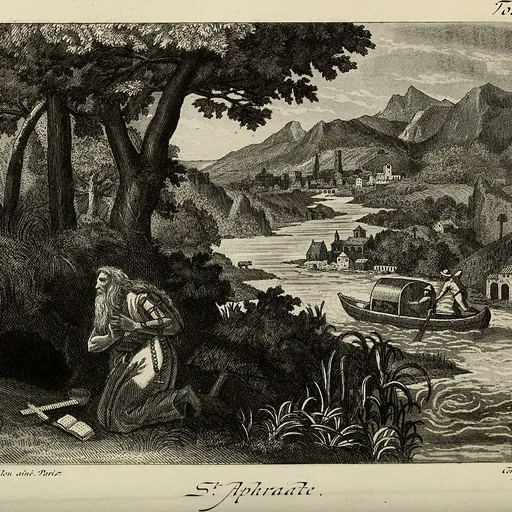
About Aphrahat
Lived 270 – 346 (aged 75–76). Aphrahat was a writer and monk.
Aphrahat (c. 280–c. 345; , Ap̄rahaṭ, , , , and Latin Aphraates), venerated as Saint Aphrahat the Persian, was a third-century Syriac Christian author of Iranian descent from the Sasanian Empire, who composed a series of twenty-three expositions or homilies on points of Christian doctrine and practice. All his known works, the Demonstrations, come from later on in his life. He was an ascetic and celibate, and was almost definitely a son of the covenant (an early Syriac form of communal monasticism). He may have been a bishop, and later Syriac tradition places him at the head of Mar Mattai Monastery near Mosul in what is now northern Iraq. He was a near contemporary to the slightly younger Ephrem the Syrian, but the latter lived within the sphere of the Roman Empire. Called the Persian Sage (, Ḥakkimā Pārsāyā), Aphrahat witnessed to the concerns of the early church beyond the eastern boundaries of the Roman Empire.
Life, history and identity Aphrahat was born near the border of Roman Syria and Sasanian Iran around 280, during the rule of Shapur II.
The name Aphrahat is the Syriac version of the Persian name Frahāt, which is the modern Persian Farhād . He might have had Persian Jewish ancestors. The author, who was known as "the Persian sage", came from a Zoroastrian family and may have himself been a convert from Zoroastrianism, though this appears to be later speculation. An early tradition, found in the colophon to a manuscript dated to 510, instead ascribes to him the name Jacob, which may have been his baptismal name. Hence he was already confused with Jacob of Nisibis, by the time of Gennadius of Massilia (before 496), and the ancient Armenian version of nineteen of The Demonstrations has been published under this latter name. Thorough study of the Demonstrations makes identification with Jacob of Nisibis impossible. Aphrahat, being a Persian subject, cannot have lived at Nisibis, which became Persian only by Emperor Jovian's treaty of 363. George, bishop of the Arabs, writing in 714 to a friend who had sent him a series of questions about the "Persian sage", confesses ignorance of his name, home and rank, but gathers from his works that he was a monk, and of high esteem in the clergy. The fact that in 344 he was selected to draw up a circular letter from a council of bishops and other clergy to the churches of Ctesiphon and Seleucia
A portion of ‘’Demonstration 11’’ is selected in the Liturgy of the Hours III, Lenten Season and Easter Season for Wednesday during the first week of Lent. The selection explains the theology of the ‘circumcision of the heart’ as the final covenant and inheritance of Christians.
Translations The Demonstrations were originally composed in the Syriac language, but were quickly translated into other languages. The Armenian version, published by Antonelli in 1756 and containing only 19 homilies, circulated mistakenly under the name Jacob of Nisibis. Important versions in Georgian and Ge'ez exist. A few of the Demonstrations were translated into Arabic, but wrongly attributed to Ephrem the Syrian.
Order and subjects of The Demonstrations Demonstration on faith — Demonstrations 1–10 were probably written 336–7 Demonstration on charity Demonstration on fasting Demonstration on prayer Demonstration on wars Demonstration on members of the covenant Demonstration on penitents Demonstration on resurrection Demonstration on humility Demonstration on pastors Demonstration on circumcision — Demonstrations 11–22 were probably written 344 Demonstration on the Passover Demonstration on the Sabbath Demonstration on preaching Demonstration on various foods Demonstration on the call of the Gentiles Demonstration on Jesus the Messiah Demonstration on virginity Demonstration on the dispersion of Israel Demonstration on almsgiving Demonstration on persecution Demonstration on death and the last days Demonstration concerning the grape — Demonstration 23 was probably written in the winter of 344–5
Don’t just read it —
keep it.
Full-length biographies made to live with: read them, listen on the way to work, watch them tonight.
- E-book
- Audio
- Video
Instant download · yours to keep · every purchase keeps this site free
Important facts
People in Aphrahat's life
Named in this biography and alive at the same time
Related people
Same field, nearest in time


Contemporaries
People whose lives overlapped Aphrahat's





Frequently asked questions
Who was Aphrahat?
4th century Syriac-Christian theologian and author
When was Aphrahat born?
Aphrahat was born in 270 in Asuristan.
When did Aphrahat die?
Aphrahat died in 346 in Adiabene.
What was Aphrahat's occupation?
Aphrahat was a writer and monk.
What nationality was Aphrahat?
Aphrahat's recorded nationality: Sasanian Empire.
Sources & further reading
Cite this page
APA: Biography.guide. (2026). Aphrahat. https://biography.guide/aphrahat/
MLA: "Aphrahat." Biography.guide, https://biography.guide/aphrahat/.
Chicago: "Aphrahat." Biography.guide. https://biography.guide/aphrahat/.
Data last updated: 2026-09-23 · Spot an error? Report a correction.
Portrait: Wikimedia Commons · author & licence
Page generated 2026-09-27 05:08 UTC