
Apacuana
16th-century indigenous rebel from Venezuela
About Apacuana
Lived 1550 – 1577 (aged 26–27). Apacuana was a cacique, curandera and shaman, known for Spanish colonization of the Americas.
Apacuana —also transliterated as Apacuane, Apakuama or Apakuana—was a 16th-century woman of the Quiriquires (also known as Kirikires), a branch of the Kalina people that inhabited the Valles del Tuy region (then known by the Spanish as Salamanca), in present-day Venezuela, notable for her leading role in a failed Indigenous uprising against Spanish colonization in 1577. Her story was presented nearly a century and a half later by writer José de Oviedo y Baños in his 1723 book The Conquest and Settlement of Venezuela, a foundational work on the country's history. Introduced by the author as an "elderly sorceress and herbalist", Apacuana is considered to have been a piache, that is, a curandera, a term used in Hispanic America to call a healer or shaman. She was the mother of Guásema, who served as cacique—a term used to designate Indigenous tribal chiefs in Hispanic America—while several modern writers consider her to have been a cacica (feminine form of the title) as well.
Apacuana was highly regarded in her community, both as a healer and as a political leader, which allowed her to instigate an attack against two Spanish colonists as they traversed their territory. In response to the attack, a military unit led by Sancho García was sent from the nearby Spanish settlement of Caracas to punish the natives. In the territory of the Quiriquires, García's company set fire to several settlements and managed to thwart a surprise attack by an army formed from an alliance between different Indigenous groups. Among the prisoners trapped during this combat—from which the Spanish emerged victorious—was Apacuana, who was tortured and hung in full view of the Quiriquires, prompting them to reportedly ask for peace. Nevertheless, the Quiriquires continued to offer resistance to the Spanish, most notably in 1660.
Although often ignored by the hegemonic historiography of Venezuela, Apacuana is regarded a national symbol of Indigenous resistance, as well as a notable figure in the country's women's history. On International Women's Day 2017, the national government transferred the symbolic remains of the Indigenous leader to the National Pantheon of Venezuela, where the main figures of the country's history rest. In 2018, a seven-meter statue of Apacuana was placed in Caracas, causing controversy by replacing an old monument that was considered by some as a symbol of the city.
Background The story of Apacuana comes from José de Oviedo y Baños' book The Conquest and Settlement of Venezuela (in Spanish: Historia de la conquista y población de la Provincia de Venezuela), Oviedo y Baños' main historical source is Fray Pedro Simón's book Noticias historiales de las conquistas de Tierra Firme en las Indias Occidentales (1626). He also went through the books of the Caracas town hall (Spanish: Ayuntamiento de Caracas) while serving as Alcalde de primer voto in 1710, a judicial and administrative title in the Spanish Viceroyalties in the Americas responsible for the administration of justice within their municipal jurisdiction.
Apacuana belonged to the Indigenous Quiriquires (also transliterated as Kirikires), a branch of the Kalina people that lived in the Valles del Tuy, the valley around the Tuy River, in the north-central region of Venezuela. The other ethnic groups that inhabited the area at the time the Spanish arrived were the Arbacos, Caracas, Chagaragatos, Mariches, Meregotos, Taramainas, Tarmas and Teques. In various sections of the book, Oviedo y Baños indicates the location of the Quiriquires. Oviedo y Baños also states that the territory of the Quiriques bordered that of the Teques, They also bordered the Arbacos and Meregotos.
Account Apacuana's name has also been transliterated as Apacuane, Writer Emilio Salazar claims that the name Apakuama comes from the Cumanagoto language, meaning "beautiful mountain", and formed by the words apak ("mountain") and uama ("beautiful"). Therefore, she is considered to have been a piache, that is, a curandera, a term used in Hispanic America to call a healer or shaman. Today, Apacuana is also described as a cacica, She was the mother of the cacique Guásema, also transliterated as Guacema. Apacuana was highly respected in her community, both for her role as a sorceress as well as political leader, which allowed her to instigate an attack against the Spanish. In the conquest era of the 15th century, the comenderos were the holders of a grant awarded by the Spanish Crown called encomienda, which gave them the monopoly on the labor of particular groups of Indigenous peoples. The badly wounded Garci-González managed to carry the also injured Francisco Infante on his shoulders and reach Caracas, causing the outrage of the mayors and residents of the town.
Aftermath Despite the supposed peace that followed the violent execution of Apacuana, According to Fray Pedro Simón, they abandoned their lands around the 1580s, relocating to the south of Lake Maracaibo. looting it and setting fire to all its houses. She is also the subject of playwright César Rengifo's work Apacuana y Cuaricurián, a so-called "dramatic poem" that premiered in 1975. Rengifo created a fictitious son for Apacuana named Cuaricurán, an artist that refuses to join the war.
On March 8, 2017—on the occasion of International Women's Day—the national government transferred the symbolic remains of Apacuana, along with those of the African slaves Hipólita and Matea, to the National Pantheon of Venezuela, where the main figures of the country's history rest.
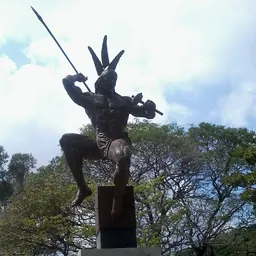
In December 2018, the government of Caracas placed a seven-meter statue of Apacuana on the Valle-Coche highway, the entrance to the capital from the center and west of the country, replacing that of the León de Caracas, a standing lion symbolizing the founding of the city. The plaque on the monument states that Apacuana's "legacy shakes the patriarchal history of the West, fueling the spirit of rebellion in all our generations."
The role of women during the Indigenous resistance to Spanish colonization is a subject largely ignored by Venezuelan historians, and Apacuana is one of the few known figures along with Urimare. Thus, her name is often invoked by researchers focused on the country's women's history.
Don’t just read it —
keep it.
Full-length biographies made to live with: read them, listen on the way to work, watch them tonight.
- E-book
- Audio
- Video
Instant download · yours to keep · every purchase keeps this site free
Important facts
People in Apacuana's life
Named in this biography and alive at the same time
Related people
Same field, nearest in time




Contemporaries
People whose lives overlapped Apacuana's



Frequently asked questions
Who was Apacuana?
16th-century indigenous rebel from Venezuela
When was Apacuana born?
Apacuana was born in 1550 in Valles del Tuy.
When did Apacuana die?
Apacuana died in 1577 in Valles del Tuy.
What was Apacuana's occupation?
Apacuana was a cacique, curandera and shaman.
What was Apacuana known for?
Apacuana was known for Spanish colonization of the Americas.
What nationality was Apacuana?
Apacuana's recorded nationality: Kalina people.
Sources & further reading
Cite this page
APA: Biography.guide. (2026). Apacuana. https://biography.guide/apacuana/
MLA: "Apacuana." Biography.guide, https://biography.guide/apacuana/.
Chicago: "Apacuana." Biography.guide. https://biography.guide/apacuana/.
Data last updated: 2026-09-22 · Spot an error? Report a correction.
Page generated 2026-09-27 05:08 UTC