
Hatuey
Hispaniolan Cacique (died 1512)
About Hatuey
Lived 1479 – 1512 (aged 32–33). Hatuey was a cacique and traditional leader or chief.
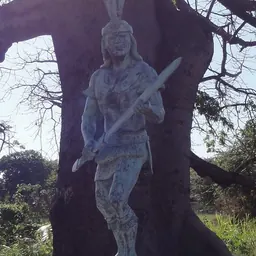
Monument of Taíno chief Hatuey in Yara city, depicting the moment he was burnt by Spanish soldiers, bound to a tamarind tree planted in 1907. alt=Stone slab with an embossed inscription in Spanish, for which refer to the caption. Plate at the base of the monument. It reads "To the memory of Chief Hatuey, the unforgettable Indian, precursor of Cuban liberty who offered his life and glorified his rebellion in martyrdom by flames on February 2, 1512. Monuments Delegation of Yara, 1999".
Hatuey , also Hatüey (; died February 2, 1512), was a Taíno Cacique (chief) of the Hispaniolan cacicazgo of Guanaba (in present-day La Gonave, Haiti).
Life and death In 1511, Diego Velázquez set out from Hispaniola to what is now known as present-day Guantánamo Province in easternmost Cuba to conquer and subjugate the local Indigenous population, who had previously been recorded there by Christopher Columbus. Velázquez was preceded, however, by Hatuey, who fled Hispaniola with a party of four hundred in canoes and warned some of the Indigenous people of eastern Cuba about what to expect from the Spaniards.
Bartolomé de Las Casas later attributed the following speech to Hatuey which was addressed against Christianity. He showed the Taíno of Caobana a basket of gold and jewels, saying:
The Taíno chiefs in Cuba did not respond to Hatuey's message, and few joined him to fight. Hatuey resorted to guerrilla tactics against the Spaniards, and was able to confine them for a time. He and his fighters were able to kill at least eight Spanish soldiers. Eventually, using mastiff dogs and torturing the Indigenous for information, the Spaniards succeeded in capturing him. On 2 February 1512, he was tied to a stake and burned alive at Yara, near the present-day city of Bayamo.
Before he was burned, a priest asked Hatuey if he would accept Jesus and go to heaven. Las Casas recalled the reaction of the chief:
alt=Image of a bas-relief of the portal of El Capitolio of Havana depicting the burning of Hatuey. Burning of Hatuey. From a bas-relief of the portal of El Capitolio of Havana.
Legacy Hatuey is considered "Cuba's first national hero" and one of the earliest fighters against Spanish colonialism. Hatuey is also a brand of a type of sugary, non-alcoholic malt beverage called malta. Hatuey is also a Dominican brand of soda cracker.
The logo of the Cuban cigar and cigarette brand Cohiba is a picture of Hatuey.
In a 2010 film shot in Bolivia, Even the Rain, Hatuey is a main character in the film-within-the-film. The film includes a cinematic account of Hatuey's execution.
Fine arts The imagery of Hatuey has been appropriated and/or incorporated into diverse artistic genres, most notably into the Afro-Cuban Yiddish opera, Hatuey: Memory of Fire. In the visual arts, multiple artists have used the Taíno chief's image, most notably Cuban-American artist Ric Garcia and U.S. Marine Corps artist Donald Dickson, among others.
Don’t just read it —
keep it.
Full-length biographies made to live with: read them, listen on the way to work, watch them tonight.
- E-book
- Audio
- Video
Instant download · yours to keep · every purchase keeps this site free
Important facts
People in Hatuey's life
Named in this biography and alive at the same time

Related people
Same field, nearest in time



Contemporaries
People whose lives overlapped Hatuey's



Frequently asked questions
Who was Hatuey?
hispaniolan Cacique (died 1512)
When was Hatuey born?
Hatuey was born in 1479 in Hispaniola.
When did Hatuey die?
Hatuey died on 2 February 1512 in Yara.
What was Hatuey's occupation?
Hatuey was a cacique and traditional leader or chief.
Sources & further reading
Cite this page
APA: Biography.guide. (2026). Hatuey. https://biography.guide/hatuey/
MLA: "Hatuey." Biography.guide, https://biography.guide/hatuey/.
Chicago: "Hatuey." Biography.guide. https://biography.guide/hatuey/.
Data last updated: 2026-09-26 · Spot an error? Report a correction.
Page generated 2026-09-27 05:16 UTC