About Antonio Vélez Alvarado
Lived 1864 – 1948 (aged 83). Antonio Vélez Alvarado was an American journalist.
Antonio Vélez Alvarado (June 12, 1864 – January 16, 1948) was a Puerto Rican journalist, politician and revolutionary who was an advocate of Puerto Rican independence. He is also known as "the Father of the Puerto Rican Flag". A close friend of Cuban patriot José Martí, Vélez Alvarado joined the Puerto Rican Revolutionary Committee in New York City and is among those who allegedly designed the Flag of Puerto Rico. Vélez Alvarado was one of the founding fathers of the Puerto Rican Nationalist Party.
Early years Vélez Alvarado was born in the town of Manatí in Puerto Rico to José María Vélez Escobar and Cecilia Alvarado Rodríguez. There he received his primary and secondary education. His family were the wealthy owners of various farms in Manati. His father, a former Captain in the local militia, wanted to send him to study at the Artillery Academy in Toledo, Spain, hoping that his son would follow in his foot steps with a military career. However, Vélez Alvarado wanted to be a writer.
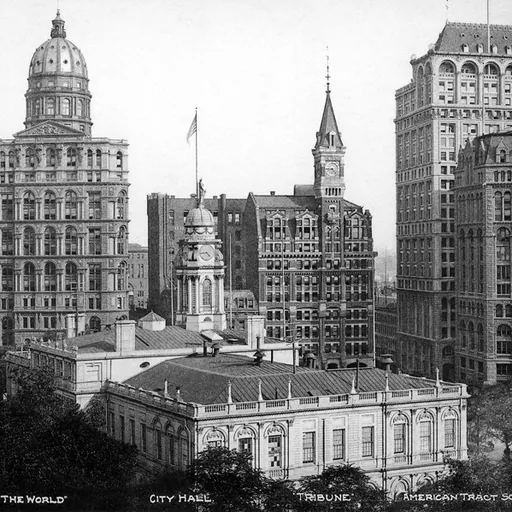
Puerto Rican Independence N. Y. World Building at left, where Vélez Alvarado had his printing facility Vélez Alvarado began writing in 1881, for "El Criterio" in Humacao under the name of "Yuri". He later wrote for "La Crónica" in Ponce, "La Propaganda" in Mayagüez and "El Agente" in San Juan. In his articles he expressed his ideals in regard to Puerto Rican independence from Spain. The local Spanish authorities' tolerated his written work out of respect for his father, however in 1887, he was exiled from the island. Vélez Alvarado went to New York City, where he met and befriended the Cuban revolutionary leader José Martí. He also befriended Louis Weiss owner of a printing press. He used Weiss's facilities to publish two magazines, the "Revista Popular" and the "Gaceta del Pueblo". He used the latter to publish articles related to politics and the Cuban and Puerto Rican revolutionary movements. He also published some of Martí's written works. It was not long before Vélez Alvarado was able to establish his own printing facility in the seventh floor of the New York World Building.
Other sources document Gonzalo Marín with presenting a Puerto Rican flag prototype in 1895 for adoption by the Puerto Rican Revolutionary Committee in New York City. Marín has since been credited by some with the flag's design. There is a letter written by Juan de Mata Terreforte which gives credit to Marin. The original contents of the letter in Spanish are the following:
La adopción de la bandera cubana con los colores invertidos me fue sugerida por el insigne patriota Francisco Gonzalo Marín en una carta que me escribió desde Jamaica. Yo hice la proposición a los patriotas puertorriqueños que asistieron al mitin de Chimney Hall y fue aprobada unánimemente.
Which translated in English states the following:
The adaptation of the Cuban flag with the colors inverted was suggested by the patriot Francisco Gonzalo Marín in a letter which he wrote from Jamaica. I made the proposition to various Puerto Rican patriots during a meeting at Chimney Hall and it was approved unanimously.
Plus, in a letter written by Maria Manuela (Mima) Besosa, the daughter of the Puerto Rican Revolutionary Committee member Manuel Besosa, she stated that she sewed the flag. This created a belief that her father could have been its designer.
It may never be known who really designed the current flag, however what is known is that on December 22, 1895, the Puerto Rican Revolutionary Committee officially adopted the design which represents the current flag. On September 17, 1922, the three political organizations joined forces and formed the Puerto Rican Nationalist Party. Coll y Cuchi was elected president, José S. Alegría (father of Ricardo Alegría) vice-president and Vélez Alvarado was elected to the Supreme Counsel of the party. In the Plaza de la Historia, located in the Calle (Street) Patriota Pozo of Manati, there is a bronze bust of Vélez Alvarado. The Government of Puerto Rico honored his memory by naming a public school in Manati the "Antonio Velez Alvarado School".
Don’t just read it —
keep it.
Full-length biographies made to live with: read them, listen on the way to work, watch them tonight.
- E-book
- Audio
- Video
Instant download · yours to keep · every purchase keeps this site free
Important facts
People in Antonio Vélez Alvarado's life
Named in this biography and alive at the same time


Related people
Same field, nearest in time


Contemporaries
People whose lives overlapped Antonio Vélez Alvarado's



Frequently asked questions
Who was Antonio Vélez Alvarado?
Puerto Rican politician
When was Antonio Vélez Alvarado born?
Antonio Vélez Alvarado was born on 12 June 1864 in Manatí.
When did Antonio Vélez Alvarado die?
Antonio Vélez Alvarado died on 16 January 1948 in Manatí, Puerto Rico.
What was Antonio Vélez Alvarado's occupation?
Antonio Vélez Alvarado was a journalist.
What nationality was Antonio Vélez Alvarado?
Antonio Vélez Alvarado was American.
Sources & further reading
· Wikipedia: Antonio Vélez Alvarado
· DBpedia: Antonio Vélez Alvarado
Cite this page
APA: Biography.guide. (2026). Antonio Vélez Alvarado. https://biography.guide/antonio-velez-alvarado/
MLA: "Antonio Vélez Alvarado." Biography.guide, https://biography.guide/antonio-velez-alvarado/.
Chicago: "Antonio Vélez Alvarado." Biography.guide. https://biography.guide/antonio-velez-alvarado/.
Data last updated: 2026-09-23 · Spot an error? Report a correction.
Portrait: Wikimedia Commons · author & licence
Page generated 2026-09-27 05:07 UTC