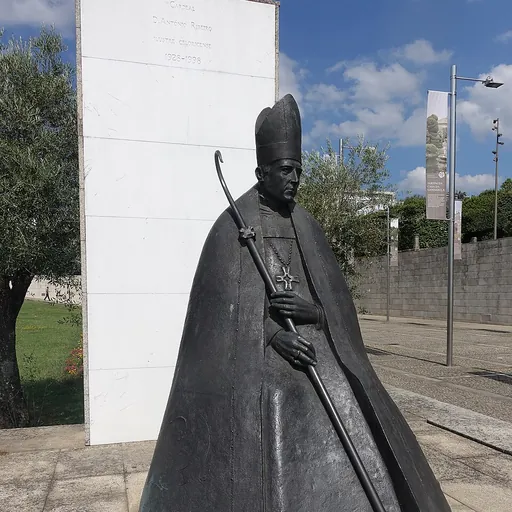
About António Ribeiro
Lived 1928 – 1998 (aged 69). António Ribeiro was a Portuguese theologian, catholic priest and catholic bishop.
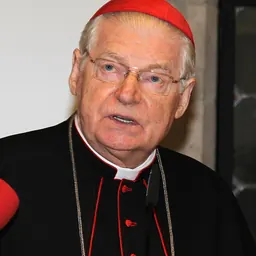
Dom António II Ribeiro (21 May 1928 – 24 March 1998) was a Portuguese cardinal of the Roman Catholic Church, and Patriarch of Lisbon from 1971 until his death in 1998.
Born at São Clemente de Basto, Celorico de Basto, son of José Ribeiro (born ca 1860) and wife Ana Gonçalves (born ca 1904), both from the same location, Ribeiro was ordained a priest of the Braga Archdiocese on 5 July 1953. Fourteen years later, on 3 July 1967, he was appointed Auxiliary bishop of Braga as titular bishop of Tigillava, and ordained on 17 September.
Ribeiro graduated with a degree in Theology from the Pontifical Gregorian University of Rome. His doctoral thesis, defended in 1959, was on The Doctrine of Errors in Saint Thomas Aquinas. Transferred from Braga to Lisbon, he was appointed chaplain of one of the branches of Catholic Action (LUC/F), and lectured at the Instituto Superior de Cultura Católica, and at the Instituto Superior de Ciências Sociais e Políticas, of the Technical University of Lisbon. He also visited the Theological Faculties of Innsbruck and Munich.
Meanwhile, in 1960 he took on a weekly tv program called Dia do Senhor (The Lord's Day), and collaborated with several religious magazines and newspapers, beyond his own publications.
On Manuel Gonçalves Cerejeira's retirement as Patriarch in 1971, Ribeiro was appointed his successor and, a year later, also Vicar Apostolic of the Portuguese Military. He was created Cardinal-Priest of Sant'Antonio da Padova in Via Merulana by Pope Paul VI, on 5 March 1973, which made him, at the age of 44, the youngest cardinal in the XXth century since Cerejeira himself, forty-four years earlier. As such, he participated in the 1978 August and October Conclaves. In 1991, he was appointed as the papal envoy to the 5th Centennial Celebration of Evangelization, in Luanda, Angola.
Recognised as a man of compromise (and markedly less close to the Estado Novo government than Cerejeira had been), Ribeiro was nevertheless very determined in defending the rights and privileges of the Church in his country.
He died of cancer in Lisbon in 1998 at age 69 and is buried in the tomb of the patriarchs in the Monastery of São Vicente de Fora. He was the Principal Consecrator in 1978 of José da Cruz Policarpo, who succeeded him as Patriarch, and in 1989 of Januário Ferreira, who succeeded him as Military vicar of Portugal in 2001.
Don’t just read it —
keep it.
Full-length biographies made to live with: read them, listen on the way to work, watch them tonight.
- E-book
- Audio
- Video
Instant download · yours to keep · every purchase keeps this site free
Important facts
People in António Ribeiro's life
Named in this biography and alive at the same time



Related people
Same field, nearest in time


Contemporaries
People whose lives overlapped António Ribeiro's

Frequently asked questions
Who was António Ribeiro?
Portugal Catholic cardinal (1928–1998)
When was António Ribeiro born?
António Ribeiro was born on 21 May 1928 in Celorico de Basto.
When did António Ribeiro die?
António Ribeiro died on 24 March 1998 in Lisbon.
What was António Ribeiro's occupation?
António Ribeiro was a theologian, catholic priest and catholic bishop.
What nationality was António Ribeiro?
António Ribeiro was Portuguese.
Sources & further reading
· DBpedia: António Ribeiro (cardinal)
Cite this page
APA: Biography.guide. (2026). António Ribeiro. https://biography.guide/antonio-ribeiro-theologian/
MLA: "António Ribeiro." Biography.guide, https://biography.guide/antonio-ribeiro-theologian/.
Chicago: "António Ribeiro." Biography.guide. https://biography.guide/antonio-ribeiro-theologian/.
Data last updated: 2026-09-23 · Spot an error? Report a correction.
Portrait: Wikimedia Commons · author & licence
Page generated 2026-09-27 05:05 UTC