
About Antonio Miani
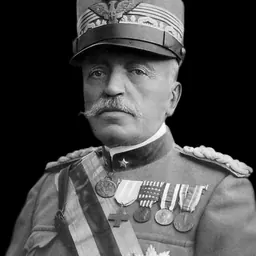
Lived 1864 – 1933 (aged 69). Antonio Miani was an Italian military personnel and soldier.
Antonio Giuseppe Miani was an Italian general who served as an officer in the colonial field, fighting in Eritrea during the Eritrean war and the Abyssinian war, being decorated with three Silver Medals for military valor.
Having returned to his homeland, he carried out garrison duties until 1913, when he was sent to Libya to organize the conquest of the Fezzan region, which he completed by March 1914, being awarded the Knight's Cross of the Military Order of Savoy. This occupation did not last long, as in November a large rebellion broke out which forced the Italian troops to quickly abandon the Fezzan. Sent back to Libya in 1915 with the task of carrying out a colonial police operation in Sirtica, his column was heavily defeated in the Battle of Gasr Bu Hàdi (29 April), with huge losses of men and materials. Made the scapegoat for the defeat, he was sent back to his homeland, being kept aside until his official retirement, which took place on 16 June 1916 . Recalled briefly to service during 1917, taking on the role of commander of the Vallarsa sector, he was relieved shortly thereafter by General Luigi Cadorna, never holding any further military office.
Life He was born in Milan on 31 July 1864, son of Giuseppe and Bianca Consolini.' After attending the technical institute, on 19 December 1881 he enlisted in the Royal Army and began attending the Royal Military Academy of Infantry and Cavalry in Modena as an officer cadet, leaving with the rank of second lieutenant , assigned to the infantry corps, on 23 July 1883, after having attended the weapons and shooting course at the Normal School in Parma. He entered service with the 9th Bersaglieri Regiment stationed in the Milan area, three years later, promoted to lieutenant, he was sent to Eritrea assigned to the local Royal Colonial Troops Corps. Having arrived in Massawa he was immediately added to the expeditionary force, under the command of General Alessandro Asinari di San Marzano , which had the task of avenging the honour of the Italian armies, which had been defeated at Dogali.The expedition was fruitless, because neither Ras Alula nor Negus Johannes IV accepted the fight and retreated to Ethiopia. Once the expeditionary force was disbanded, he was sent on leave to Italy, but returned shortly afterwards to Cologne to take part in the definitive operations for the conquest of Eritrea. Arriving in Tripoli he had some meetings, one with the governor Garioni who warned him of the material impossibility of having reinforcement troops, and one with the Turkish officer Abd el Cader Giami Bey who warned him of the difficulties he would encounter, and of the military power of the tribes to be subjugated. Appointed in the meantime "Government Commissioner in charge of the occupation and government of Fezzan", between the second half of June he planned the military operation, which officially began on 16 July, when he and his troops embarked on three steamers left Tripoli arriving in the waters of Misurata the following day, embarking further troops and supplies of various kinds. Arriving in front of Sirte, on 18 July the landing operations began, and from here he left with his troops on 9 August, entering the desert. The column was made up of 1,100 men (109 nationals, and the rest colonials), 500 family members of the askaris, 10 cannons, 4 machine guns, 4 trucks and 1,765 camels loaded with water, ammunition and other supplies. After 16 days the column reached Socna, 300 km from the sea, occupied some time before by the troops of Captain Antonio Hercolani Gaddi. On 6 December the advance resumed in the direction of Brach, the capital of eastern Sciati, on the 10th he defeated a small group of enemies in Sceb, and on the 13th he defeated the troops of Mohammed ben Abdallah, occupying the castle of the city at 3.30 pm that day. This fact earned him the promotion to colonel for extraordinary merits. On 23 December he left Brach, where he left an occupation contingent, advancing and occupying Agar, and the following day he advanced towards Maharuga where the troops of Mohammed ben Abdallah were waiting for him. In the furious fighting the Libyans left 250 men on the ground, including their leader, while the Italian troops had 15 askaris killed, including their commander Antonio De Dominicis. The occupation of Maharuga, which took place at 5pm on 1 January 1914, concluded the first part of the campaign. Operations resumed on 16 February when 500 men under his command left Brach in the direction of Sebha, which was occupied on 25 February, leaving the next day in the direction of Marzuch which was reached on 3 March. The occupation of the town marked the subjugation of the Fezzan region, For this feat he was awarded the Knight's Cross of the Military Order of Savoy on 5 June 1915. In the following months he was busy solving the logistical, political and organizational problems created in the region by the Italian occupation, but the Arab revolt broke out in October 1914, so much so that he had to order the evacuation of military units from practically all of Fezzan, with some of them forced to transit through Algerian territory, with the benevolence of the French authorities. Once he arrived in Tripoli he was relieved of his command and sent back to his homeland, held in reserve for possible redeployment. In Garioni's place, General Giorgio Cigliana was first appointed, immediately replaced by General Luigi Druetti, who in turn was replaced some time later by General Giulio Cesare Tassoni. The latter decided to maintain the remaining Italian positions at any cost, and in agreement with Minister Ferdinando Martini had him sent back to Libya, employing him in a colonial police operation in Sirtica.
Chosen as a scapegoat, he was placed on official retirement on 16 June 1916, and recalled briefly to service during 1917, taking up the post of commander of the Vallarsa sector. He was dismissed shortly after, never holding any further military office. He spent the rest of his life seeking rehabilitation, calling for the establishment of a special commission of inquiry, particularly hurt by the judgement expressed on him by General Luigi Cadorna , who wrote: Never, I believe, in the colonial history of any country, has such a reckless and ill-timed undertaking been encountered.
Silver Medal of Military Valour — —
Silver Medal of Military Valour 4 January 1896 For the intelligence, composure, and bravery with which he led his company under fire, setting an example of courage and momentum during the assault and pursuit of the enemy.
Silver Medal of Military Valour May 1896 Having initiated combat with determination and serving as an example of courage during the advance and attack against the rebels of Ras Sebat; and, in the engagement of 7 May, having led his company with intelligence and boldness, contributing decisively to the dispersal of a large rebel force at Aga-à and Debre Markos (2 and 7 May 1896).
Officer of the Order of the Crown of Italy — —
Commemorative Medal for the African Campaigns — —
Don’t just read it —
keep it.
Full-length biographies made to live with: read them, listen on the way to work, watch them tonight.
- E-book
- Audio
- Video
Instant download · yours to keep · every purchase keeps this site free
Important facts
People in Antonio Miani's life
Named in this biography and alive at the same time


Related people
Same field, nearest in time





Contemporaries
People whose lives overlapped Antonio Miani's




Frequently asked questions
Who was Antonio Miani?
Italian general (1864–1933)
When was Antonio Miani born?
Antonio Miani was born on 31 July 1864 in Milan.
When did Antonio Miani die?
Antonio Miani died on 8 August 1933 in Domaso.
What was Antonio Miani's occupation?
Antonio Miani was a military personnel and soldier.
What nationality was Antonio Miani?
Antonio Miani was Italian.
Sources & further reading
· DBpedia: Antonio Giuseppe Miani
Cite this page
APA: Biography.guide. (2026). Antonio Miani. https://biography.guide/antonio-miani/
MLA: "Antonio Miani." Biography.guide, https://biography.guide/antonio-miani/.
Chicago: "Antonio Miani." Biography.guide. https://biography.guide/antonio-miani/.
Data last updated: 2026-09-26 · Spot an error? Report a correction.
Page generated 2026-09-27 05:13 UTC