
About Antonio Mancini
Lived 1852 – 1930 (aged 78). Antonio Mancini was an Italian painter and portraitist.
Antonio Mancini (14 November 1852 – 28 December 1930) was an Italian painter.
Biography
Mancini was born in Rome, Papal States, and showed precocious ability as an artist. At the age of twelve, he was admitted to the Institute of Fine Arts in Naples, where he studied under Domenico Morelli (1823–1901), a painter of historical scenes who favoured dramatic chiaroscuro and vigorous brushwork, and Filippo Palizzi. Mancini developed quickly under their guidance, and in 1872, he exhibited two paintings at the Paris Salon.
Mancini worked at the forefront of the Verismo movement, an indigenous Italian response to 19th-century Realist aesthetics. His usual subjects included children of the poor, juvenile circus performers, and musicians he observed in the streets of Naples. His portrait of a young acrobat in Il Saltimbanco (1877–78) captures the fragility of the boy whose impoverished childhood is spent entertaining pedestrian crowds.
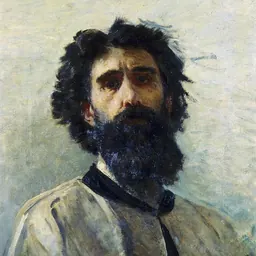
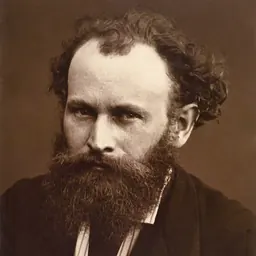
In 1871, two of his works, exhibited at the Neapolitan salon, were purchased by two foreign clients, both painters: Per un fiore (For a Flower) by the Canadian-born American painter François B. De Blois and L'ultima medicina (The Last Medicine!) by the French Felix de Lapommeraye. When in Paris in 1877–78, Mancini met the Impressionist painters Edgar Degas and Édouard Manet. He became friends with John Singer Sargent, who famously pronounced him to be the greatest living painter. His mature works show a brightened palette with a striking impasto technique on canvas and a bold command of pastels on paper.
In 1881, Mancini suffered a disabling mental illness. He settled in Rome in 1883 for twenty years, then moved to Frascati where he lived until 1918. During this period of Mancini's life, he was often destitute and relied on the help of friends and art buyers to survive. After the First World War, his living situation stabilized and he achieved a new level of serenity in his work. Mancini died in Rome in 1930 and was buried in the Basilica Santi Bonifacio e Alessio on the Aventine Hill.
His painting The Poor Schoolboy, exhibited in the Salon of 1876, is in the Musée d'Orsay of Paris. Its realist subject matter and dark palette are typical of his early work. Paintings by Mancini may also be seen in Galleria Nazionale d'Arte Moderna e Contemporanea in Rome, the Museo Civico-Galleria d'Arte Moderna in Turin and De Mesdag Collectie in The Hague. In 1903 he painted the portrait of the American ambassador in Italy George Von Lengerke Meyer: believed to be lost, the painting was discovered in 2023 by Italian art historian Manuel Carrera, who found it in the Navy Art Collections, Washington.
The first exhibition in the U.S. devoted exclusively to Mancini's work was at the Philadelphia Museum of Art, 20 October 2007 – 20 January 2008, a museum which owns fifteen oil paintings and three pastels by Mancini that were a gift of New York City art dealer Vance N. Jordan.
Gallery
Don’t just read it —
keep it.
Full-length biographies made to live with: read them, listen on the way to work, watch them tonight.
- E-book
- Audio
- Video
Instant download · yours to keep · every purchase keeps this site free
Important facts
People in Antonio Mancini's life
Named in this biography and alive at the same time




Related people
Same field, nearest in time
Contemporaries
People whose lives overlapped Antonio Mancini's


Frequently asked questions
Who was Antonio Mancini?
Italian painter (1852-1930)
When was Antonio Mancini born?
Antonio Mancini was born on 14 November 1852 in Albano Laziale, Rome.
When did Antonio Mancini die?
Antonio Mancini died on 28 December 1930 in Rome.
What was Antonio Mancini's occupation?
Antonio Mancini was a painter and portraitist.
What nationality was Antonio Mancini?
Antonio Mancini was Italian.
Sources & further reading
Cite this page
APA: Biography.guide. (2026). Antonio Mancini. https://biography.guide/antonio-mancini/
MLA: "Antonio Mancini." Biography.guide, https://biography.guide/antonio-mancini/.
Chicago: "Antonio Mancini." Biography.guide. https://biography.guide/antonio-mancini/.
Data last updated: 2026-09-20 · Spot an error? Report a correction.
Page generated 2026-09-27 05:33 UTC