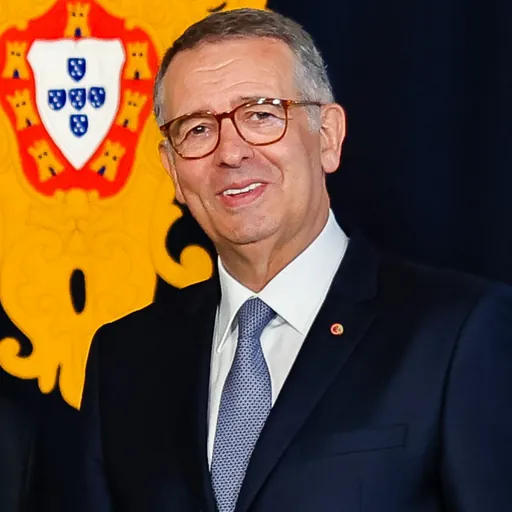
About António José Seguro
Born 1962. António José Seguro is a Portuguese politician.
António José Martins Seguro (born 11 March 1962) is a Portuguese politician who has been the president of Portugal since 2026, having won the 2026 Portuguese presidential election. A member of the Socialist Party (PS), Seguro previously served as secretary-general of the PS from 2011 to 2014, during which time he was also the leader of the opposition.
Early life and education
Seguro was born on 11 March 1962 in Penamacor, the third and youngest son of Domingos Sanches Seguro (1925–2017) and Maria do Céu Martins (1927–2012). The family comprised mostly rural workers from the Beira Baixa region; Seguro's father, Domingos, ran a newsagent's.
His early studies were undertaken in Penamacor in the Preparatory School Ribeiro Sanches and in the Nossa Senhora do Incenso Day School, before he went to Castelo Branco to finish high school in the Industrial and Commercial School. During this time, he was arrested before the Carnation Revolution, while still a minor.
In 1990, Seguro was elected as Secretary.general of the Socialist Youth with 85% of the delegates, succeeding José Apolinário. At the time, the JS was facing financial and mobilization issues. In his first campaign as leader of the JS, in the 1991 legislative election, he organized a groundbreaking campaign, distributing 250,000 condoms. As Secretary-general of the JS, Seguro fought in parliament for the end to the compulsory military service and against the Indonesian occupation of East Timor, which led to his arrest in the Expo '92 in Seville for protesting in front of the Indonesian Pavillion.
After being re-elected in December 1991 in a landslide, despite opposition from two lists headed by Luís Miguel Duarte and Daniel Adrião, Seguro left the leadership of the Socialist Youth in March 1994, being succeeded by Sérgio Sousa Pinto.
Secretary of state, MEP and minister In the lead up to the 1995 legislative election, Seguro was one of the people tasked with organizing Guterres' campaign, alongside Jorge Coelho as the national campaign director. Seguro organized the national caravan that was held following the Estados Gerais, inspired by Clinton-Gore caravan in the 1992 United States presidential election. With the purpose of replacing the party's aesthetic in favour of a more national inspired identity for the campaign, Seguro concieved for this caravan several graphic elements that became strongly associated with António Guterres and the Socialist Party, such as replacing the party flags with the national flag and using the song Conquest of Paradise to replace the party's anthem.
With Seguro as the main candidate from Guarda, the PS won the legislative elections, leaving Guterres to form a government. Seguro then joined the government for the first time as Secretary of State for Youth Affairs and later, in 1997, he became Secretary of State Assistant to the Prime Minister.
Seguro left the government to run in the 1999 European Parliament election, being the second name in a list led by former President Mário Soares. Seguro served as an MEP between July 1999 and July 2001, being an effective member of the Committee on Constitutional Affairs (in these functions he was co-author of the Report on the Treaty of Nice and the Future of the European Union), and was also a substitute for the Commission for Employment and Social Affairs. He was also president of the Delegation for Relations with Central America and Mexico, vice president of the Socialist Group in the European Parliament and president of the Portuguese Socialist delegation.
Seguro resigned as an MEP in July 2001 to serve as Minister in the Cabinet of the Prime Minister, again under António Guterres.
After Ferro Rodrigues' resignation as Secretary-general of PS in 2004, Seguro was considered as a potential candidate for the leadership election, but he was convinced by Jorge Coelho not to run since it was "not his time".
As secretary-general, Seguro decided to abstain in the 2012 State Budget proposed by the Passos Coelho government, citing his decision as a "violent, but constructive abstention", a decision that ended up attracting criticism from inside the PS. Under Seguro's leadership, the Socialist Party managed to achieve one of its best results ever in the 2013 local elections and won the 2014 European Parliament election in Portugal with Francisco Assis as the main candidate, although by a narrow margin. The results of the 2014 elections were considered narrow and insufficient, which motivated the Mayor of Lisbon António Costa to defy Seguro and run for the party leadership. Seguro then retired to private life. Having successfully defended his Master thesis, he started teaching in the Department of International Relations of the Autonomous University of Lisbon.
2026 presidential campaign
In October 2024, then PS leader Pedro Nuno Santos mentioned Seguro as a potential candidate for president from the Socialist Party in the 2026 presidential election. In November 2024, after being mostly out of the spotlight since 2014, Seguro gave an interview to CNN Portugal as he was starting a role as a political commentator on the channel, stating that he was interested in running for president. Seguro then positioned himself as the main candidate from the party in opposition to others like Mário Centeno, António Vitorino and Augusto Santos Silva. He also founded the movement UPortugal, with the intention of promoting a greater participation from the citizens and fighting misinformation. In June 2025, he announced he was running for president, stating that "the country needs change and hope in a better life", defining his candidacy as a progressive alternative to the other conservative candidates, such as Luís Marques Mendes and Henrique Gouveia e Melo.
Seguro launched his campaign on 15 June 2025, in Caldas da Rainha, with the presence of major PS personalities like Francisco Assis, Alberto Martins, Maria de Belém Roseira, João Soares and Álvaro Beleza, saying that, after leaving politics at a time when he could divide the party, he was now returning with the intention to unite the country. In the coming weeks, Seguro gained the support of most of the establishment of the PS, receiving the endorsement of more than half of the party federation chairs and more than 100 incumbent mayors. Despite that, José Luís Carneiro, the leader of PS, said that the party would only officially back any of the presidential candidates after the 12 October local elections.
Seguro received the official support of the Socialist Party on 19 October 2025, with the proposal for his support being written by the Secretary-general José Luís Carneiro and by the party's president Carlos César. Seguro chose scientist Maria do Carmo Fonseca as his national campaign chair, MP Paulo Lopes Silva as his campaign director, and former minister Guilherme d'Oliveira Martins as campaign chair for the Lisbon district. Seguro formalized his candidacy on 15 December 2025, delivering 10,000 signatures to the Constitutional Court.
In the first round of the 2026 presidential election on 18 January, no candidates secured a majority; Seguro won a relative majority of 31%, and André Ventura (leader of the right-wing populist party Chega) came second with 23.5%; the two most-voted candidates faced each other in a second round run-off on 8 February. This was only the second time that a direct Portuguese presidential election was not won on the first ballot, as in the 1986 election. In his first-round victory speech, in Caldas da Rainha Cultural and Congress Centre, a hoarse Seguro underlined the non-partisan nature of his campaign and invited all "democrats, progressives, and humanists" to support him in the second round in order to "defeat extremism and those who sow hatred and division among the Portuguese", distancing himself from his opponent. On the election night and the following day, Seguro received the endorsement of several important figures of the centre-right to right-wing political parties PSD, IL and CDS–PP.
Seguro won the second round by a landslide, beating André Ventura with 66.8% of the votes, being elected President. He won the record of the highest number of votes cast for him in a presidential election, after receiving more than 3.5 million votes. In his victory speech, he promised that things would not be kept the same and that he would be the president of "all, all, all of the Portuguese". Presidency (2026–present)
António José Seguro took office on 9 March 2026, in the Assembly of the Republic, having in attendance King Felipe VI of Spain, president João Lourenço of Angola, president Daniel Chapo of Mozambique, president José Ramos-Horta of Timor-Leste, president José Maria Neves of Cape Verde and president Carlos Vila Nova of São Tomé e Príncipe.
On 2 April 2026, Seguro was present in the solemn ceremony for the 50th anniversary of the 1976 Constitution, where he said that the coutry's problems do not come from the constitution itself, but from its non-compliance, amidst talks about a constitutional review done between PSD, Chega and IL.
As President, Seguro brought back the Open Presidencies (Presidências Abertas) that had been started by Mário Soares, with his first open presidency being in the areas impacted by Storm Kristin in Leiria, Castelo Branco, Coimbra and Santarém.
On 3 May 2026, Seguro promulgated the revised Nationality Law, which doubles the standard naturalisation residency requirement from five to ten years (seven for EU and CPLP nationals). While signing the decree, he stated that a reinforced-value law of such importance "should also be based on greater consensus around its essential principles", and stressed that pending applications must not be adversely affected by the legislative change and that statutory naturalisation timelines must not be undermined by administrative delays of the state. He did not promulgate a separate decree introducing loss of nationality as an accessory criminal penalty, which would be shut down by the Constitutional Court.
Seguro's style as president has been described as different from the previous presidents, being more silent but focused on pointing to the problems and producing documents to register his concerns and orientations about the issues.
State visits
Honours and awards Portuguese orders
Insignia of Office
Foreign orders 1st Class of the (22 July 2026)
Electoral history
Legislative elections YearParty Constituency Position No. Votes % +/− Status Notes 1985PS Lisbon 21 (out of 56) 4th 255,030 -15.95 Not Elected Later joined parliament as an MP. 1991 Porto 9 (out of 37) 2nd 313,893 Elected 1995 Guarda 1 (out of 4) 1st 49,498 Elected 2002 Lisbon 7 (out of 48) 1st 440,790 -4.04 Elected Elected president of the Socialist parliamentary group in 2004. 2005Braga 1 (out of 18) 1st 218,665 Elected 2009 1 (out of 19) 1st 207,695 -3.71 Elected 2011 1 (out of 19) 2nd 159,477 -8.88 Elected Elected Secretary-general of the Socialist Party in 2011.
PS primary election, 2014
Presidential election, 2026
Don’t just read it —
keep it.
Full-length biographies made to live with: read them, listen on the way to work, watch them tonight.
- E-book
- Audio
- Video
Instant download · yours to keep · every purchase keeps this site free
Important facts
People in António José Seguro's life
Named in this biography and alive at the same time





Related people
Same field, nearest in time



Contemporaries
People whose lives overlapped António José Seguro's




Frequently asked questions
Who is António José Seguro?
President of Portugal
When was António José Seguro born?
António José Seguro was born on 11 March 1962 in Penamacor.
What is António José Seguro's occupation?
António José Seguro is a politician.
What nationality is António José Seguro?
António José Seguro is Portuguese.
Sources & further reading
· Wikipedia: António José Seguro
· DBpedia: António José Seguro
Cite this page
APA: Biography.guide. (2026). António José Seguro. https://biography.guide/antonio-jose-seguro/
MLA: "António José Seguro." Biography.guide, https://biography.guide/antonio-jose-seguro/.
Chicago: "António José Seguro." Biography.guide. https://biography.guide/antonio-jose-seguro/.
Data last updated: 2026-09-23 · Spot an error? Report a correction.
Portrait: Wikimedia Commons · author & licence
Page generated 2026-09-27 05:07 UTC