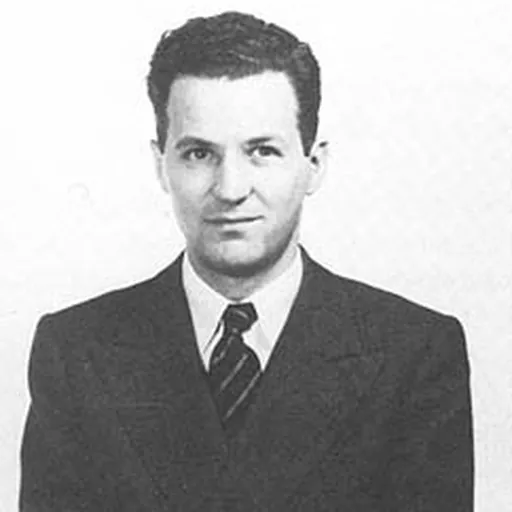
About Antonio Ferri
Lived 1912 – 1975 (aged 63). Antonio Ferri was an Italian military flight engineer, engineer and aerospace engineer.
Antonio Ferri (5 April 1912 – 28 December 1975) was an Italian scientist, prominent in the field of aerodynamics, with a specialization in hypersonic and supersonic flight.
Background Born in 1912 in Norcia, Italy, from 1937 he conducted research in Guidonia Montecelio, where the most prominent and advanced research on high-speed aerodynamics was taking place. In 1938, at the age of 26, he received Italy's highest prize for science, the Premio dell'Accademia d'Italia for science. Among the work he conducted, there were spectacular experiments in 1939–1940 with supersonic wind tunnels.
During World War II, in the period of the Italian Social Republic (or Salò Republic), three days after the Germans occupied Rome on 10 September 1943, Ferri bluffed his way back into the research facility at Guidonia, destroyed the vital equipment and filled a fruit crate with documents of his research before escaping underground. He secluded his wife and family near his home in Fiastra, in the Marche region of the Apennine Mountains (they later were moved on to an Adriatic fishing village), and in October 1943, organized with his brother, Giuseppe Ferri, the Banda Fiastra band of partisans. For the next year, he coordinated attacks of the region's anti-fascist bands using the Valle del Fiastrone (Fiastra Valley) as a safe haven to return to and to receive Allied air drops.
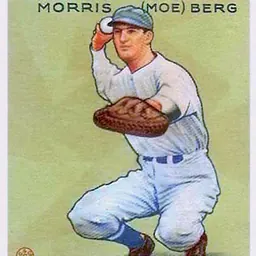
He eventually made his way to Rome after it was liberated by the Allies, where he made contact with OSS agent Moe Berg and began to work with him translating key documents from the trunk, also passing on his knowledge of the achievements of German science during the war. Ferri was granted a patent for the 'Ferri scoop' jet engine inlet, which would be used on the XF-103, F-105, XF8U-3, and SSM-N-9 Regulus II cruise missile. This type of inlet would lay the foundation for the diverterless supersonic inlet.
Ferri died at his home in Woodbury, New York on December 28, 1975.
Don’t just read it —
keep it.
Full-length biographies made to live with: read them, listen on the way to work, watch them tonight.
- E-book
- Audio
- Video
Instant download · yours to keep · every purchase keeps this site free
Important facts
People in Antonio Ferri's life
Named in this biography and alive at the same time
Related people
Same field, nearest in time

Contemporaries
People whose lives overlapped Antonio Ferri's






Frequently asked questions
Who was Antonio Ferri?
Italian scientist
When was Antonio Ferri born?
Antonio Ferri was born on 5 April 1912 in Fiastra, Norcia.
When did Antonio Ferri die?
Antonio Ferri died on 28 December 1975 in Long Island.
What was Antonio Ferri's occupation?
Antonio Ferri was a military flight engineer, engineer and aerospace engineer.
What nationality was Antonio Ferri?
Antonio Ferri was Italian.
Sources & further reading
Cite this page
APA: Biography.guide. (2026). Antonio Ferri. https://biography.guide/antonio-ferri/
MLA: "Antonio Ferri." Biography.guide, https://biography.guide/antonio-ferri/.
Chicago: "Antonio Ferri." Biography.guide. https://biography.guide/antonio-ferri/.
Data last updated: 2026-09-22 · Spot an error? Report a correction.
Portrait: Wikimedia Commons · author & licence
Page generated 2026-09-27 05:04 UTC