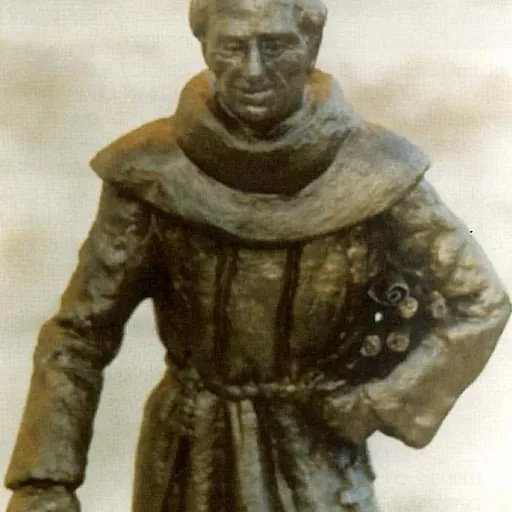
About Antonio de Olivares
Lived 1630 – 1722 (aged 91–92). Antonio de Olivares was a catholic priest, friar, missionary and franciscan.
Antonio de San Buenaventura y Olivares or simply Fray Antonio de Olivares (1630–1722) was a Spanish Franciscan who officiated at the first Catholic Mass celebrated in Texas, and he was known for contributing to the founding of San Antonio and to the prior exploration of the area. He founded, among other missions, the Alamo Mission in San Antonio (better known as simply the Alamo), the Presidio San Antonio de Bexar, and the Acequia Madre de Valero.
Biography
Early career Antonio de San Buenaventura y Olivares was born in Moguer, Andalusia, Spain, in 1630 and studied at the Franciscan convent of San Francisco de Moguer.
In 1665, at the age of thirty-five years old, he went on a religious expedition to the Americas, along with 19 other religious. Once in Americas, in the Convent of Querétaro, he received the training he needed to engage with the natives, in their work of evangelization. It was this monastery from which they went on various expeditions in Texas, since this was a strategically important place for the crown. In 1675 Fray Antonio de Olivares, Fray Francisco Hidalgo, Fray Juan Larios and Fernando del Bosque were sent to explore the region beyond the Rio Grande, to assess the possibility for new settlements in the area.
On January 1, 1699, Olivares was chosen to go along with Marcos de Guereña of the College of Santa Cruz de Querétaro to work in northern Coahuila, in present-day Mexico. There in San Juan Bautista, located in those times on the Río de Sabinas, the priests joined Father Francisco Hidalgo and on January 1, 1700, participated in the founding of Mission San Juan Bautista, located in the present Guerrero, Coahuila.
On March 1, 1700, Olivares founded in the valley of the Circumcision the mission of San Bernardo and Mission San Francisco Solano, from the Rio Grande in Coahuila, Mexico. Today's municipality of Guerrero is the approximate location of the mission. In 1706 he was appointed guardian of the College of Santa Cruz de Querétaro, where he remained three years. In the same letter he stressed that it was necessary that some of these families be skilled in the useful arts and industries, "to teach the Indians all that should be required to be useful and capable citizens." The perseverance of Fray Antonio was answered, as the Viceroyalty gave formal approval for the mission in late 1716, assigning responsibility for its establishment to Martín de Alarcón, the governor of Coahuila y Tejas. He remained at the site of the mission for some time, organizing everything with the Indians, and they constructed a straw structure with branches and mud near the head of the San Antonio River. This mission was called San Antonio de Valero, a name derived from "San Antonio de Padua" and Viceroy of New Spain, Marquess of Valero. The mission was located near a community of Coahuiltecan and was originally inhabited by about four indigenous tribes people converted from Mission San Francisco Solano. 6 miles long, built to irrigate 400 hectares and supply of the inhabitants of the new facilities. It was vital to the missions to be able to divert and control water from the San Antonio River, in order to grow crops and to supply water to the people in the area. This particular aqueduct was the beginning of a much wider water system. Acequia Madre de Valero ran from the area currently known as Brackenridge Park southward to what is now Hemisfair Plaza and South Alamo Street. Part of it that is not viewable by the public runs beneath the Menger Hotel. The aqueduct was restored in 1968 and that year was designated a Recorded Texas Historic Landmark.
Fray Antonio de Olivares was aided by Payaya Indians to build the bridge that connected the Misión de San Antonio de Valero and Presidio San Antonio de Bexar, and the Acequia Madre de Valero.
On May 1, 1718, according to a certified statement Don Martin de Alarcon gave Fray Antonio de Olivares possession of the Misión de San Antonio de Valero, later known as "The Alamo".
On May 5 Presidio San Antonio de Bexar was founded on the west side of the San Antonio River, from which comes the present city of San Antonio, Texas. The event, chaired by Martin de Alarcón, settled around 30 families in the surrounding area.
On July 8, 1718, the first baptism was held at the new Mission San Antonio de Valero, as reflected in the mission's baptismal register.
In 1719, Margil obtained permission from the Marqués de San Miguel de Aguayo to found a second mission at San Antonio, and Father Olivares opposed it. Despite this, the Zacatecan Franciscans founded Mission San José y San Miguel de Aguayo next to the San Antonio River on February 23, 1720.
On September 8, 1720, after suffering a broken leg and worse health, Olivares retired from Mission Valero. He returned to the monastery of Querétaro where he died in 1722.
Don’t just read it —
keep it.
Full-length biographies made to live with: read them, listen on the way to work, watch them tonight.
- E-book
- Audio
- Video
Instant download · yours to keep · every purchase keeps this site free
Important facts
People in Antonio de Olivares's life
Named in this biography and alive at the same time
Related people
Same field, nearest in time


Contemporaries
People whose lives overlapped Antonio de Olivares's





Frequently asked questions
Who was Antonio de Olivares?
Spanish franciscan
When was Antonio de Olivares born?
Antonio de Olivares was born in 1630 in Moguer.
When did Antonio de Olivares die?
Antonio de Olivares died in 1722 in Querétaro.
What was Antonio de Olivares's occupation?
Antonio de Olivares was a catholic priest, friar, missionary and franciscan.
What nationality was Antonio de Olivares?
Antonio de Olivares's recorded nationality: Crown of Castile, Spanish people.
Sources & further reading
· Wikipedia: Antonio de Olivares
· DBpedia: Antonio de Olivares
Cite this page
APA: Biography.guide. (2026). Antonio de Olivares. https://biography.guide/antonio-de-olivares/
MLA: "Antonio de Olivares." Biography.guide, https://biography.guide/antonio-de-olivares/.
Chicago: "Antonio de Olivares." Biography.guide. https://biography.guide/antonio-de-olivares/.
Data last updated: 2026-09-22 · Spot an error? Report a correction.
Portrait: Wikimedia Commons · author & licence
Page generated 2026-09-27 04:58 UTC