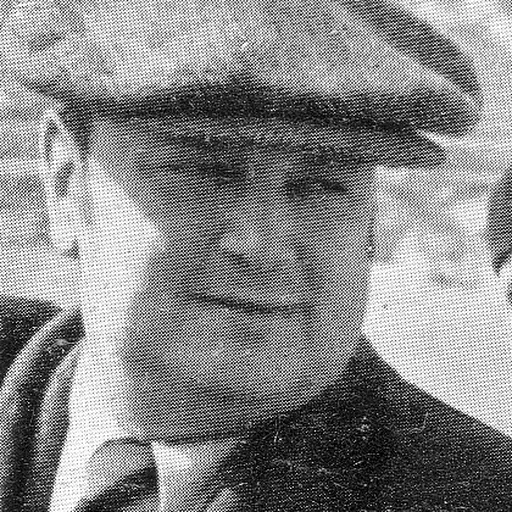
About Antonio Baldini
Lived 1889 – 1962 (aged 73). Antonio Baldini was an Italian journalist, writer, literary critic, essayist and literary criticism.
Antonio Baldini (10 October 1889 – 6 November 1962) was an Italian journalist, literary critic and writer.
Institutions renamed in celebration and commemoration of Baldini include, slightly unusually, a large public library in Rome, the "Biblioteca statale Antonio Baldini".
Biography Provenance and early years Antonio Baldini was born in Rome. Count Gabriele Baldini (1860–1916), his father, was a minor aristocrat, originally from Santarcangelo in Romagna, and employed for many years by the Ministry for Public Works, notably in connection with the administration of contracts for railway development. His mother, born Sofia Alkaique (1861-1929), came from Livorno (Tuscany), possibly having been born into an immigrant family.
He attended a number of schools in Rome, including the prestigious Ennio Quirino Visconti Liceo Ginnasio. He then enrolled to study literature at the Sapienza University of Rome, although he would not complete his studies there and graduate until 1916. By that time he already had become a journalist. Baldini's first published work appeared in 1912 in another literary journal, "Lirica", founded earlier that same year by Arturo Onofri and Umberto Fracchia. These early contributions combined semi-autobiographical confessional aspects ("fatto personale") with a mix of fantasy, reverie and humour. In 1914 they were combined into a single slim volume entitled "Pazienze e impazienze del Maestro Pastoso" (loosely, "Patience and impatience of Mr. Pastry").
In 1915 Baldini became a regular contributor to the Italian right-of-centre irridentist newspaper L'Idea Nazionale which had recently switched from weekly to daily publication. Baldini's articles appeared on the third page, which by tradition in Italian newspapers was less political than the outer pages and a more focused on literature and other arts-related topics. His contributions consisted of a series of "passeggiate" (literally, "gentle recreational walks, seldom undertaken alone, and generally involving mutually agreeable conversation) or "vedute romane" ("vistas of Rome"). Work for L'Idea Nazionale brought Baldini to the notice of a far wider readership. Baldini was a member of the editorial board of the Rome-based magazine La Ronda between 1919 and 1922.
War After Italy entered World War I in May 1915, Baldini joined the army during the summer of 1915, initially as a private soldier, but he was quickly promoted to the rank of an infantry officer. On 3 November 1915 he was badly wounded in the battle for Monte San Michele, in the mountains inland to the north-west of Trieste. His involvement earned him a Silver Medal for Military Valo(u)r. He was then sent back to Rome to recover. For L'Illustrazione Italiana he also sent back from the frontline a series of "dialoghetti" and "storielle" (short dialogues and stories) under the pseudonym "Gatto Lupesco" (loosely, "Wolf-Cat") which enabled him to pull together, in 1918, another book, "Nostro purgatorio", using his experiences as a war correspondent. He continued, in addition, to work with L'Illustrazione Italiana, contributing more "vedute e chronache romane" ("vistas and chronicles of Rome"). Baldini's contributions also appeared, as they had before Italy became engaged in the war-time fighting, in L'Idea Nazionale, consisting of reviews, critical profiles and literary moralisings in varying proportions, but always crisp and razor sharp in their syntax and arguments. A compilation of some of these works was published in two volumes in 1920, entitled respectively "Umori di gioventù" and "Salti di gomitolo". Some selections from these works have also been issued in subsequent publications. There were also fictional pieces, such as the "Fables of Michelaccio" which appeared in instalments starting in 1920, and was then reissued, heavily reworked, as a single volume, in 1924.
Between 1920 and 1922 Baldini was abroad for much of the time, employed as private secretary to General De Marinis, who had been sent to command the Inter-allied governance and plebiscite commission in Upper Silesia. His duties did not preclude continuing with his contributions to the Italian press, and the entire experience was a source of inspiration and insight for future writings. He found and shared food for thought in the marginalia of news stories and unexpected local customs, such as those referenced in a series of articles appeared between 1926 and 1929 in "La Tribuna-L'Idea nazionale" (the title of the former "L'Idea Nazionale", following an acquisition and merger at the end of 1925) using the pseudonym "Melafumo". (Over time "Melafumo" became more than a mere pseudonym emerging as a "younger brother" to "Michelaccio", Baldini's pseudonymous narrator of fiction from earlier works.) Between 1928 and 1943, increasingly, Baldini's journalistic work was giving birth to a succession of books, starting with "La dolce calamita" (1929: retitled and re-issued in 1940 as "Beato fra le donne" / "Blessed between women") and "Amici allo spiedo" (1932: retitled, expanded and re-issued in 1942 as "Buoni incontri d'Italia").
After fascism By January 1945 Baldini had resurfaced and was back at the "Nuova Antologia", where he now served as editor-in-chief and literary director nearly till the end of his life. He resumed his close collaboration with Corriere della Sera, notably with his "Tastiera" ("Keyboard") column, which alternated between the erudite and the whimsical. He also resurrected "Melafumo", using his alter ego to reprise a series of commentaries and confessions for radio audiences, switching back and forth between melancholy memories and contemporary ironies.
He wrote more book as well: "Se rinasco..." (1944), "Fine Ottocento" (1947), "Melafumo" (1950), "Quel caro magon di Lucia" (1956). Meanwhile, during 1950 Baldini was appointed president of the team responsible for organising the 6th "Rome Quadriennale" (major art exhibition), to be held between December 1951 and March 1952 at the Exhibitions Palace in central Rome. It was a position which imposed certain unwelcome constraints in terms of his personal art purchases, and one which he would retain in respect of subsequent Quadrienali for more than a decade. In 1953 he accepted a corresponding membership of the prestigious Accademia dei Lincei.
Qualities conspicuous in what might be termed Baldini's travel writing have also drawn plenty of comment over the years, mostly positive and enthusiastic. In his writing he displays rare harmonious blends of classical and modern prose, of the elevated and the robustly popular, of elegant and rudely unkempt: neologisms and dialect words are incorporated seamlessly and in most cases unnoticed by the reader. His use of full stops / periods reduced over the years, and the prose remained unfashionably light on other forms of punctuation, airy and whimsical but tightly connected in terms of underlying syntactical structure. This stylistic mastery was on display in "La vecchia del Bal Bullier" ("The old woman of the Bullier ballroom") and "Italia di Bonincontro" ("Italy of food encounters"), which – typically for Baldini – identifies an Italy to be loved like a beautiful woman, less for her history and more on account of her physical appearance. In the case of Italy, that drives a preference for the picturesque oddities of some of its out-of-the-way villages and towns, rather than the complex perspectives of the more iconic big cities. La dolce calamita ovvero La donna di nessuno, L'Italiano, Bologna, 1929 Amici allo spiedo, Vallecchi, Florence, 1932 (nuova edizione, Buoni incontri d'Italia, 1942) Ludovico della tranquillità, Zanichelli Editore, Bologna, 1933 (nuova edizione, Ariosto e dintorni, 1958) La vecchia del Bal Bullier, L'Italiano, Bologna, 1934 Italia di Bonincontro, Sansoni, Florence, 1940 Cattedra d'occasione, 1941 Il Sor Pietro, Cosimo Papareschi e Tuttaditutti, Firenze, Le Monnier, 1941 Rugantino, Bompiani, Milan, 1942 Diagonale 1930 Parigi-Ankara. Note di viaggio, Arnoldo Mondadori Editore, Milan, 1943 Se rinasco…, fatti personali, 1944 Fine Ottocento. Carducci, Pascoli, D'Annunzio e minori, Le Monnier, Florence, 1947. Melafumo, Eri, Turin, 1950 (nuova edizione, Il Doppio Melafumo, 1957) Il doppio Melafumo, Eri, Turin, 1955 "Quel caro magon di Lucia", microscopie manzoniane, 1956 Nuovi Racconti italiani (con Luigi Silori), Nuova Accademia, Rome, 1963
Posthumously published Un sogno dentro l’altro, 1965 (a cura del figlio Gabriele) Le scale di servizio. Introduzione al libro e alla lettura, a cura di N. Vian, Milan and Naples, Ricciardi, 1971. Tastiera, 3 voll., 1978–80 (raccolta degli Elzeviro|elzeviri pubblicati sul «Corriere della Sera» a cura di N. Vian).
Don’t just read it —
keep it.
Full-length biographies made to live with: read them, listen on the way to work, watch them tonight.
- E-book
- Audio
- Video
Instant download · yours to keep · every purchase keeps this site free
Important facts
People in Antonio Baldini's life
Named in this biography and alive at the same time



Related people
Same field, nearest in time



Contemporaries
People whose lives overlapped Antonio Baldini's



Frequently asked questions
Who was Antonio Baldini?
Italian writer (1889–1962)
When was Antonio Baldini born?
Antonio Baldini was born on 10 October 1889 in Rome.
When did Antonio Baldini die?
Antonio Baldini died on 6 November 1962 in Rome.
What was Antonio Baldini's occupation?
Antonio Baldini was a journalist, writer, literary critic, essayist and literary criticism.
What nationality was Antonio Baldini?
Antonio Baldini was Italian.
Sources & further reading
Cite this page
APA: Biography.guide. (2026). Antonio Baldini. https://biography.guide/antonio-baldini/
MLA: "Antonio Baldini." Biography.guide, https://biography.guide/antonio-baldini/.
Chicago: "Antonio Baldini." Biography.guide. https://biography.guide/antonio-baldini/.
Data last updated: 2026-09-22 · Spot an error? Report a correction.
Portrait: Wikimedia Commons · author & licence
Page generated 2026-09-27 04:59 UTC