About Anton Antonov-Ovseyenko
Lived 1920 – 2013 (aged 93). Anton Antonov-Ovseyenko was a Russian journalist, historian and writer.
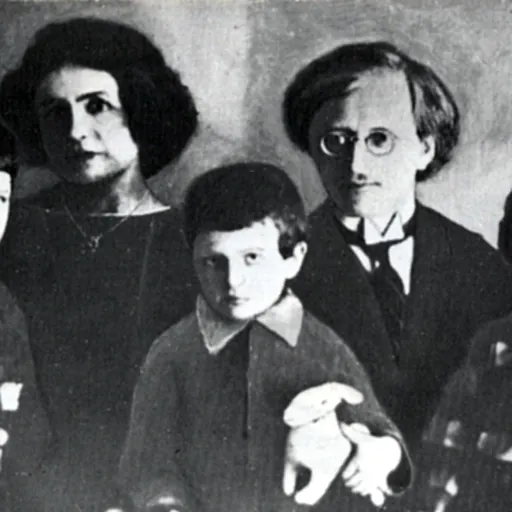
Anton Vladimirovich Antonov-Ovseenko (in centre) as a child with his siblings and parents during their stay in Prague, Czechoslovakia.
Anton Vladimirovich Antonov-Ovseenko (; 23 February 1920 – 9 July 2013) was a Russian historian and writer.
Born on 23 February 1920, he was the son of the Bolshevik military leader Vladimir Antonov-Ovseenko who commanded the assault on the Winter Palace. His mother, Rozaliya Borisovna Katsnelson, was arrested in 1929 as an “enemy of the people” and died by suicide in 1936 while imprisoned in Khanty-Mansiysk. Anton spent his childhood in Pioneer homes. His father was arrested in 1937 and executed in February 1938.
In 1935, Anton joined the historical faculty of the Moscow State Pedagogical Institute. In 1938, he was expelled from Komsomol and the institute wherein, however, he was reinstated in the same year.
He was first arrested in 1940 on charges of complicity in an economic crime and sentenced to one and a half years of imprisonment. On 22 June 1941, he was again convicted on the same charges and sentenced to an additional two years. His third arrest occurred in 1943, when he was accused of counter-revolutionary agitation and sentenced by the Special Council of the NKVD to eight years in labor camps.
From 1953 to 1960, he worked as a cultural organizer at sanatoriums and holiday homes in Yevpatoria, Alupka, and Gagra. He published several books, including In the Name of the Revolution (1965) and V. A. Antonov-Ovseenko (1975), under the pseudonym Anton Rakitin. In 1983, his historical study on Stalin, Portrait of a Tyrant, was published in the United States. In connection with this, in November 1984 he was arrested again, despite being almost blind, charged with anti-Soviet agitation and propaganda, and expelled from Moscow. He returned to Moscow in 1986.
When he died in 2013, he was still working two full days a week to continue documenting what he called "the evils of the Soviet era" and to help with plans for a new, larger space.
He was buried in Moscow at the Novodevichy Cemetery.
Views A consistent anti-Stalinist, Anton regarded Stalin primarily as a “criminal”. He repeatedly advocated for the introduction of a provision in the Criminal Code of the Russian Federation criminalizing the propaganda of Stalinism. He also argued that in the Great Patriotic War the people prevailed in the tragic conflict “not thanks to Stalin, but in spite of him”.
Don’t just read it —
keep it.
Full-length biographies made to live with: read them, listen on the way to work, watch them tonight.
- E-book
- Audio
- Video
Instant download · yours to keep · every purchase keeps this site free
Important facts
People in Anton Antonov-Ovseyenko's life
Named in this biography and alive at the same time
Related people
Same field, nearest in time


Contemporaries
People whose lives overlapped Anton Antonov-Ovseyenko's




Frequently asked questions
Who was Anton Antonov-Ovseyenko?
Russian historian/writer (1920–2013)
When was Anton Antonov-Ovseyenko born?
Anton Antonov-Ovseyenko was born on 23 February 1920 in Moscow.
When did Anton Antonov-Ovseyenko die?
Anton Antonov-Ovseyenko died on 9 July 2013 in Moscow.
What was Anton Antonov-Ovseyenko's occupation?
Anton Antonov-Ovseyenko was a journalist, historian and writer.
What nationality was Anton Antonov-Ovseyenko?
Anton Antonov-Ovseyenko was Russian.
Sources & further reading
· Wikipedia: Anton Antonov-Ovseyenko
· DBpedia: Anton Antonov-Ovseenko
Cite this page
APA: Biography.guide. (2026). Anton Antonov-Ovseyenko. https://biography.guide/anton-antonov-ovseyenko/
MLA: "Anton Antonov-Ovseyenko." Biography.guide, https://biography.guide/anton-antonov-ovseyenko/.
Chicago: "Anton Antonov-Ovseyenko." Biography.guide. https://biography.guide/anton-antonov-ovseyenko/.
Data last updated: 2026-09-21 · Spot an error? Report a correction.
Portrait: Wikimedia Commons · author & licence
Page generated 2026-09-27 05:00 UTC