
Antoine-Roger Bolamba
Democratic Republic of the Congo politician
About Antoine-Roger Bolamba
Lived 1913 – 2002 (aged 88). Antoine-Roger Bolamba was a Congolese journalist, poet, politician and writer.
Antoine-Roger Bolamba, later Bolamba Lokolé J'ongungu (Antoine-Roger Bolamba changed his name to Bolamba Lokolé J'ongungu in 1972 in accordance with President Mobutu Sese Seko's policy of Authenticité.) In the 1980s he served as a councilor of the Union of Zairean Writers and was a member of the Academia Brasileira de Letras. Though by then he had entirely retired from writing, he was still the Congolese writer most famous abroad.
Critical reception of writing According to Congolese literary critic Kadima Nzuji Mukala, Bolamba was one of the "most important and representative" French-language writers in Belgian Africa. However, he posited that, aside from his contributions to journalism, he was "not a very prolific writer". Nzuji Mukala dismissed Premiers Essais as a "clumsy imitation" of French poetry of the 19th century. Other commentators criticised the collection as being a mimicry of the writings of European poets such as Paul Verlaine and Maurice Maeterlinck.
Nzuji Mukala stated that Bolamba's "only intrinsic contribution to the early growth of Congolese literature in French" was Esanzo, praising it as "a highly original achievement". According to V. Klima, K. F. Ruzicka, and P. Zima, "His range of ideas is rather limited. He repeatedly praises his native country's march towards freedom, but presents his ideas in variegated, fantastic images." Senghor wrote that Bolamba's poetry was more focused on articulating imagery than espousing ideas. He considered Bolamba to be a Négritude poet. Klima, Ruzicka, and Zima disagreed, writing "the philosophy and pathos of the Dakar intellectuals are rather remote from Bolamba's way of thinking. He has chosen his own, independent path and only the ideology of post-World War II African nationalism can be said to link him to the Négritude writers." Franco-Senegalese poet David Diop believed Esanzo contained nonpolitical poetry and suggested that Bolamba, though aware of the Négritude movement, avoided engaging the highly politicised style out of "prudence". Guyanese critic Oscar Dathorne praised the lyricism of Esanzo and noted the theme of protest against injustice in the work Chant du soir (Evening Song), but concluded that Bolamba was only "a minor African poet who utilised some of the techniques of the Négritude poets." Africanist scholar Willfried Feuser said, "Bolamba's Chant du soir is quite charming, but...his imagery lacks the power and density of his fellow-Congolese from the Brazzaville side of the river, Felix Gerard Tchicaya U Tam'si." Donald E. Herdeck wrote, "Bolamba's poetry is often slack and full of trite expressions. Though intensely patriotic, his work generally is not impressive, for it offers neither genuine passion nor visions of a convincing reality."
Government and political career Bolamba served as Secretary of State for Information and Cultural Affairs in the first Congolese government (pictured). Bolamba frequently advocated for public discussion of the issues of colonisation in the Congo in his editorials for La Voix du Congolais. In 1947, he encouraged the administration to introduce a "special card" for évolués that would distinguish them from the rest of the Congolese population and grant them some privileges. The colonial administration introduced a carte du mérite civique (civic merit card) the following year, which could be granted to any Congolese who had no criminal record, did not practice polygamy, abandoned traditional religion, and had some degree of education. Cardholders were given an improved legal status and were exempt from certain restrictions on travel into European districts. Bolamba praised the decision and was himself awarded a carte. The Belgian government regarded him as "friendly" towards its administration.
In the 1950s, Bolamba strongly advocated for evolution of the Belgian Congo colony into a Belgo-Congolese community. In 1952, while in Senegal, he joined Liberal International. The following year he traveled to Belgium where he was received by members of the Liberal Party. The trip was limited and largely managed by the government. Bolamba subsequently criticised Belgian travel restrictions for the Congolese, writing, "Nothing should prevent Blacks to work in Belgium, if they wish to...Black parents should have the freedom to let their children be educated in Belgian universities of their choice."
Bolamba became the first African to be appointed assistant private secretary to Belgium's Minister of the Colonies, holding the post from September 1956 until October 1957. (During Bolamba's tenure as assistant private secretary, the deputy editor of La Voix du Congolais assumed most of the editorial responsibilities over the publication.) From 14 April 1963 until 9 July 1964 he served as Minister of Information and Tourism. In February 1966 Bolamba was appointed Head of the Press Office of the Presidency. In May 1969 he was made Head of the Administrative Service of the Presidency. Ten years later he became the director of national press of and adviser to the office of the President-Founder of the Mouvement Populaire de la Révolution.
Later life Antoine-Roger Bolamba changed his name to Bolamba Lokolé J'ongungu in 1972 in accordance with President Mobutu Sese Seko's policy of Authenticité. He died on 9 July 2002 at the Ngaliema Clinic in Kinshasa. On 3 August 2013 Minister of Youth, Sports, Culture and Arts Banza Mukalay hosted a day of tribute in Kinshasa to recognise Bolamba's contributions to Congolese culture.
Don’t just read it —
keep it.
Full-length biographies made to live with: read them, listen on the way to work, watch them tonight.
- E-book
- Audio
- Video
Instant download · yours to keep · every purchase keeps this site free
Important facts
People in Antoine-Roger Bolamba's life
Named in this biography and alive at the same time




Related people
Same field, nearest in time

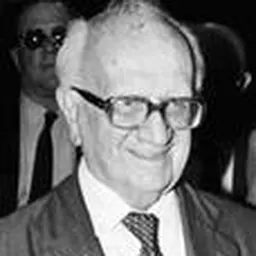


Contemporaries
People whose lives overlapped Antoine-Roger Bolamba's




Frequently asked questions
Who was Antoine-Roger Bolamba?
Democratic Republic of the Congo politician (1913–2002)
When was Antoine-Roger Bolamba born?
Antoine-Roger Bolamba was born on 13 July 1913 in Democratic Republic of the Congo, Boma.
When did Antoine-Roger Bolamba die?
Antoine-Roger Bolamba died on 2 July 2002 in Democratic Republic of the Congo, Kinshasa.
What was Antoine-Roger Bolamba's occupation?
Antoine-Roger Bolamba was a journalist, poet, politician and writer.
What nationality was Antoine-Roger Bolamba?
Antoine-Roger Bolamba was Congolese.
Sources & further reading
· Wikipedia: Antoine-Roger Bolamba
· DBpedia: Antoine-Roger Bolamba
Cite this page
APA: Biography.guide. (2026). Antoine-Roger Bolamba. https://biography.guide/antoine-roger-bolamba/
MLA: "Antoine-Roger Bolamba." Biography.guide, https://biography.guide/antoine-roger-bolamba/.
Chicago: "Antoine-Roger Bolamba." Biography.guide. https://biography.guide/antoine-roger-bolamba/.
Data last updated: 2026-09-20 · Spot an error? Report a correction.
Page generated 2026-09-27 04:59 UTC