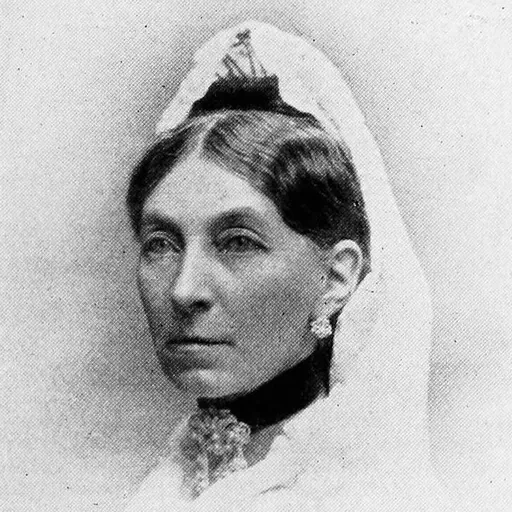
About Annie Rothwell
Lived 1837 – 1927 (aged 90). Annie Rothwell was a British poet, writer and novelist.
Annie Fowler Rothwell Christie (March 31, 1837 – July 2, 1927), born Mary Ann Bessy Fowler and publishing as Annie Rothwell, was a Canadian novelist and poet, active from 1876 to at least 1914. A writer of paeans to colonial forces during the North-West Rebellion and other imperial wars, she was known among contemporary critics mainly as a war poet.
Background
Annie Rothwell lived and worked in a time of significant colonial consolidation and expansion in what is now Canada.
Rothwell's family immigrated from England in the early 1840s during the Great Migration of Canada, and she turned 30 the year Confederation was completed.
Rothwell lived mainly in Kingston, Ontario. The provincial capital for a brief period in the 1840s, Kingston was a significant military city, home to a number of installations including the Kingston Royal Naval Dockyard. It was represented in Parliament by John A. Macdonald, Canada's first prime minister, throughout the 19th century.
Personal life Rothwell was born in London, England. Through her mother, Elizabeth Gale, she was descended from a long line of English soldiers and officials, including Robert Martin Leake, Master of the Report Office, a position (likely a sinecure) in the Court of Chancery; John Leake; and Stephen Leake. Her father was Daniel Fowler, a painter.
The family moved to Canada when Rothwell was four years old.
By 1901 she lived in North Gower; by 1904, in Ottawa proper.
Rothwell is buried at Amherst Island. The anthologies in which Rothwell was featured, Robert Lecker notes, were consciously conceived by their editors as an element of the nation-building project: "all of the nineteenth-century anthologies were eminently political in their drive to value different models of Canadian nationalism as the nature of the country evolved".
In a profile published in 1888, Ethelwyn Wetherald summed up Rothwell's life and work thus:Of this writer of fiction I have heard on good authority that she takes the deepest interest in Canadian politics, that she would prefer to hear good speeches at an election meeting to reading most of the new novels, and would rather witness the movements of a battalion in the drill shed than go to the opera. Love of her adopted country is perhaps her ruling passion, which was fanned to fever height by the North-West Rebellion. … Of the poems signed by Annie Rothwell's name, it may be said that they are born of admiration of some heroic deed, sympathy with some pathetic incident, or expression of some patriotic or other aspiration, shaped in verse of a rhythm and rhyme with which no fault can be found. On December 18, 1889, an ode Rothwell had written in honour of the 50th anniversary of the founding of Queen's University was recited, following a poem Machar had written for the occasion. The poem, in sestains of iambic pentameter, exemplifies several persistent themes in Rothwell's work, including Christian faith and the achievement of lofty "ends":Here Learning, large and gentle, points the wayThrough patient labour and through lofty aimTo ends accomplished and through laurels won.Here, lit by Faith unerring glows the rayThat lights alike the steep ascent to fameAnd cheers the path of duty humbly done. Her preoccupation with military themes caused John D. Logan, a contemporary critic, to anoint her the "supreme artist" of "Canadian martial poetesses". Thomas O'Hagan, another contemporary critic, concurred: " fine spirit of Canadian patriotism permeates all her poetic work. She is perhaps strongest as a writer of war songs".
History Rothwell contributed the poem "In Hospital" to Songs of the Great Dominion, an influential early anthology of Canadian poetry. "In Hospital", written in the voice of a soldier convalescing in a military hospital (probably following the North-West Rebellion), was published under the heading "The Spirit of Canadian History".
As of 1896, Rothwell was a "corresponding member" of the Women's Canadian Historical Society of Toronto, which stated in the preamble to its constitution that, among other purposes for the organization, "an intelligent and self-respecting national pride in Canadian literature needs to be awakened and encouraged". (Rothwell was a presumably a "corresponding member" from Kingston.)
Religion Rothwell was an active member of the Church of England in Canada.
In 1887, Rothwell delivered a lecture on "Modern Missions" to the Women's Auxiliary for the Diocese of Ontario (then, as now, headquartered in Kingston). Her lecture appeared following a paper titled "Work Among the Indians in Dacota", so it is likely that Rothwell's presentation concerned Anglican missionary work in North America among Indigenous peoples. Indeed, the missionary work of the Anglican Church, since the first settler colonists had arrived in what is now Canada, had long been a significant feature of the Canadian colonial project.
As of 1888–90, Rothwell was secretary of the Department of Literature of the Women's Auxiliary for the Diocese of Ontario.
Works Novels and short stories The Lost Lady Braithwaite. A novel, date unknown, serialized in St. James Magazine (a British publication).
Poems Kingston's City Hall and Market Battery, a military fortification in the city centre, 1857. A war poem, apparently about a battle of the Mahdist War.
An ode to Kingston. As evidenced by the magazine in which it appeared, the poem had strong Christian overtones. In an epilogue to the poem, however, Rothwell suggested a more nationalist interpretation. "The past history of Canada," she wrote, "is already recorded in many places in her monuments and the homes of her dead; but there is a fair city towards the sun-setting where the prophecy of her future may be read by those who have eyes and hearts." Three war poems, collected in a contemporary anthology. An ode to the Bay of Quinte.
Don’t just read it —
keep it.
Full-length biographies made to live with: read them, listen on the way to work, watch them tonight.
- E-book
- Audio
- Video
Instant download · yours to keep · every purchase keeps this site free
Important facts
People in Annie Rothwell's life
Named in this biography and alive at the same time



Related people
Same field, nearest in time

Contemporaries
People whose lives overlapped Annie Rothwell's




Frequently asked questions
Who was Annie Rothwell?
British-Canadian poet (1837-1927)
When was Annie Rothwell born?
Annie Rothwell was born on 31 March 1837 in Wanstead.
When did Annie Rothwell die?
Annie Rothwell died on 2 July 1927 in New Liskeard.
What was Annie Rothwell's occupation?
Annie Rothwell was a poet, writer and novelist.
What nationality was Annie Rothwell?
Annie Rothwell was British.
Sources & further reading
Cite this page
APA: Biography.guide. (2026). Annie Rothwell. https://biography.guide/annie-rothwell/
MLA: "Annie Rothwell." Biography.guide, https://biography.guide/annie-rothwell/.
Chicago: "Annie Rothwell." Biography.guide. https://biography.guide/annie-rothwell/.
Data last updated: 2026-09-23 · Spot an error? Report a correction.
Portrait: Wikimedia Commons · author & licence
Page generated 2026-09-27 05:07 UTC