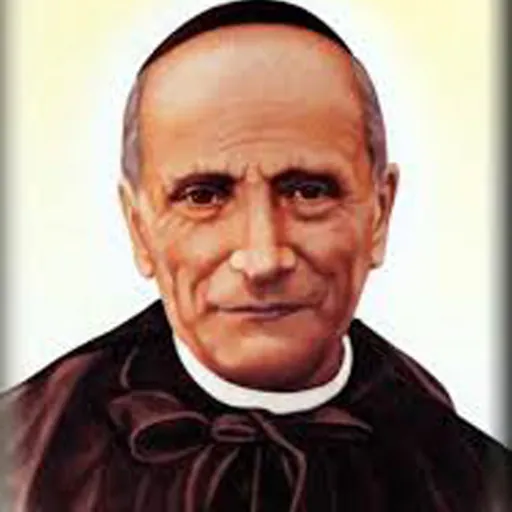
About Annibale Maria di Francia
Lived 1851 – 1927 (aged 75). Annibale Maria di Francia was an Italian catholic priest.
Annibale Maria di Francia, RCJ (or Hannibal Mary di Francia; 5 July 1851 – 1 June 1927) was an Italian Rogationist Father known for founding a series of orphanages, the Rogationists and the Daughters of Divine Zeal. He has been canonised and his feast day is 1 June.
Early life Francia was born on 5 July 1851 in Via Santa Maria delle Trombe, the Portalegni area of Messina. His father Francis was a knight of the Marquises of St. Catherine of Jonio, Papal Vice-Consul and Honorary Captain of the Navy. His mother, Anna Toscano, belonged to the noble family of the Marquises of Montanaro. His brother Francesco was declared Venerable in 2019. The third of four children, Francia lost his father when he was only fifteen months old. This experience would profoundly affect his life and made him deeply empathetic towards orphans. At the age of seven he enrolled in the College of St. Nicholas, run by the Cistercian Fathers. He was a devout child. Here under the guidance of his spiritual director, he was introduced to a devout life and he developed such love for the Eucharist that he was allowed to receive Holy Communion daily, something exceptional in those days.
Education Young Francia proved to be of high intelligence and had a poetic disposition. When he was fifteen years old he continued his studies under the tutelage of the famous Sicilian poet Felice Bisazza. He looked to a brilliant and secure career as a writer and poet but chose the religious life.
He was only seventeen, when as he was at prayer in front of the Blessed Sacrament, he was given the "revelation of Rogate", that is, he deeply felt that vocations in the church only come through prayer. Later on he found in the Gospel the very words of Jesus commanding such prayer: "Beg the harvest master to send out laborers to gather his harvest". (Mt 9:38; Lk 10:2). These words became the main source of inspiration for his life and the charism which led his apostolate.
On 11 July 1909 he wrote to Pope Pius X: "From my youth I have devoted myself to the words of the Gospel: Pray therefore the Lord of the Harvest ... In my charitable institutions, orphans, poor, priests and nuns, all pray incessantly to the loving Hearts of Jesus and Mary, to the Patriarch St. Joseph and to the Apostles, that they may provide the Holy Church with numerous and chosen laborers for the harvest of souls".
When, on 8 December 1869 he was given the clerical garb, he soon began putting his talents to work and became a well received preacher. People, especially the simple and those from the lower classes, loved to listen to him because of the clarity of his sermons.
Because of his intense ardor for Our Lady of Mount Carmel, he sought to enter the Discalced Carmelites. Upon discovering this, Archbishop Giuseppe Guarino discouraged him in his ideas, but encouraged him rather to stay in Avignone to continue working with the poor. For this reason, Francia entered the Carmelite Third Order.
Priesthood Once his theological studies were completed he was ordained a priest on 16 March 1878 in the church of the Spirito Santo. A few months before his ordination, when he was still a deacon, he met a poor blind beggar, Francesco Zancone, who providentially led him to discover a world unknown to him: Le Case Avignone ("The Avignone squatters"), in the outskirts of Messina. It was to be his new field of apostolate. He defined this as the "spirit of a twofold charity: the evangelization of and the care for the poor". Together with the intuition of the "Rogate", this spirit of charity would be the characteristic of his life.
Daughters of Divine Zeal Francia decided to found a new congregation of religious sisters whom he called Daughters of Divine Zeal, patterned after the inspiration of the Rogate – the expression of the zeal burning in the Sacred Heart of Jesus for the glory of the Father and the salvation of souls. The institute was given a one-year trial. During that year, he had as a cooperator for his work, Melanie Calvat. She remained at the institute for one year, from September 1897 to September 1898 – a year which, in the words of Francia, was a year of blessing. The trial period was weathered successfully, having a healthy and vigorous effect on the community, and the women's congregation was put on a safe footing. As soon as the people heard the news of his death they began to say: "Let us go to see the sleeping saint." A few days before the Blessed Virgin Mary was said to have appeared to him and assured him of her protection, a vision to reward his devotion toward her.
Newspapers of the entire region reported with pictures and articles of the funeral and burial. Crowds of thousands came to mourn his death. Local authorities quickly released the permit allowing that his body be buried in the Shrine of the Evangelical Rogation which Di Francia himself had built in Messina and wanted to be dedicated to the Gospel's command: "Pray therefore the Lord of the Harvest to send workers into his harvest."
Beatification and canonisation Many of his contemporaries, and among them Luigi Orione, requested that a formal cause for canonization be promptly started, but World War II put a temporary stop to the undertaking.
On 21 April 1945 the information stage of the process for Canonization began with the Diocesan investigations. All the writings of Di Francia (62 volumes) were examined by a committee of theologians. The process was opened on 14 November 1952, granting Di Francia the title of a Servant of God. In 1979 the Congress of Cardinals voted to begin the formal cause for beatification which began in Messina on 8 March 1980; at the same time the ecclesiastical tribunal set up a committee of historians.
On 21 December 1989 Pope John Paul II promulgated the Decree on the heroic virtue of the Servant of God. On 30 June 1990, the medical commission of the Congregation for the Causes of Saints agreed that the case of Gleida Danese, a Brazilian girl who was doomed to die because of the rupture of the aorta but who suddenly recovered, had no possible medical explanation. Both the commission of theologians and the Congress of Cardinals and Bishops in July 1990 agreed upon the miraculous recovery of the girl and found that it was to be attributed to the intercession of the Hannibal Di Francia. Di Francia was beatified on 7 October 1990 by Pope John Paul II. He was canonised on 16 May 2004 by Pope John Paul II.
At present time the religious families founded by Di Francia are present in the five continents of the world. In the spirit of their founder, they dedicate themselves to a variety of apostolates. They work in institutions for orphans and abandoned children, schools for the deaf and blind, homes for the aged and pregnant girls, educational institutions and vocational schools, missions and parishes, religious printing houses and vocation centers which promote the ideals of Rogate.
On 7 July 2010 Benedict XVI blessed a marble statue of St. Hannibal Mary di Francia. The statue is positioned in an external niche of the Vatican Basilica near the Arch of the Bells.
Don’t just read it —
keep it.
Full-length biographies made to live with: read them, listen on the way to work, watch them tonight.
- E-book
- Audio
- Video
Instant download · yours to keep · every purchase keeps this site free
Important facts
People in Annibale Maria di Francia's life
Named in this biography and alive at the same time


Related people
Same field, nearest in time

Contemporaries
People whose lives overlapped Annibale Maria di Francia's


Frequently asked questions
Who was Annibale Maria di Francia?
founder of the Roagationist Fathers (1851–1927)
When was Annibale Maria di Francia born?
Annibale Maria di Francia was born on 5 July 1851 in Messina.
When did Annibale Maria di Francia die?
Annibale Maria di Francia died on 1 June 1927 in Messina.
What was Annibale Maria di Francia's occupation?
Annibale Maria di Francia was a catholic priest.
What nationality was Annibale Maria di Francia?
Annibale Maria di Francia was Italian.
Sources & further reading
· Wikipedia: Annibale Maria di Francia
· DBpedia: Annibale Maria di Francia
Cite this page
APA: Biography.guide. (2026). Annibale Maria di Francia. https://biography.guide/annibale-maria-di-francia/
MLA: "Annibale Maria di Francia." Biography.guide, https://biography.guide/annibale-maria-di-francia/.
Chicago: "Annibale Maria di Francia." Biography.guide. https://biography.guide/annibale-maria-di-francia/.
Data last updated: 2026-09-24 · Spot an error? Report a correction.
Portrait: Wikimedia Commons · author & licence
Page generated 2026-09-27 05:08 UTC