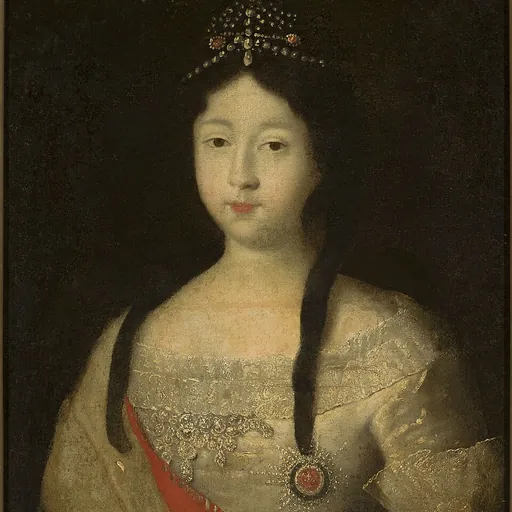
Anna Petrovna of Russia
Elder daughter of Emperor Peter I of Russia and Catherine I of Russia
About Anna Petrovna of Russia
Lived 1708 – 1728 (aged 20). Anna Petrovna of Russia was a Russian aristocrat.
Grand Duchess Anna Petrovna of Russia (; – ) was the eldest daughter of Emperor Peter I of Russia and Empress Catherine I. Her younger sister, Empress Elizabeth, ruled between 1741 and 1762. While a potential heir in the reign of her nephew Peter II, she never acceded to the throne due to political reasons. However, her son Peter III became Emperor in 1762, succeeding Elizabeth. She was Duchess Consort of Holstein-Gottorp by marriage. She was born in Moscow and died in Kiel in her youth at the age of 20.
Early life
Born in Moscow, Russia, on 27 January 1708, Anna Petrovna was the fourth child of the future Catherine I of Russia and Peter the Great. Anna developed into an intelligent, well-read girl who spoke four foreign languages – French, German, Italian and Swedish.
On 22 November 1724, the marriage contract was signed between Karl Friedrich and Peter. By this contract, Anna and Karl Friedrich renounced all rights and claims to the crown of the Russian Empire on behalf of themselves and their descendants. However a secret clause allowed the Emperor to name a successor out of any issue from the marriage. As a result of this clause, the Emperor secured the right to name any of his descendants as his successor on the Russian throne.
A few months thereafter, by January 1725, Peter the Great fell mortally ill. As the story goes, on his deathbed he managed to spell the words: to give all..., but could not continue further and sent for Anna to dictate his last will to her. By the time the princess arrived, the Emperor could not pronounce a single word. Based on the story, some historians speculated that Peter's wish was to leave the throne to Anna, but this is not confirmed.
Catherine I
After the accession of her mother Catherine I, a grand wedding was held for Anna in Trinity Cathedral, Saint Petersburg on 21 May 1725. The wedding party then crossed the River Neva to the Summer Garden, where Mikhail Zemtsov had designed a special banqueting hall for the occasion.
The tables were set with all sorts of delicacies, including enormous pies. When the orchestra began to play, male and female dwarves jumped out of the pies and began to dance on the tables. Each toast was accompanied by cannon fire from a nearby yacht and the guards regiments positioned on Tsaritsa Meadow. The following day, everyone was invited to Peterhof, where the banqueting and dancing continued in the Upper Palace.
Carl Friedrich and Anna spent the next two years in Saint Petersburg. Catherine I made her son-in-law a lieutenant colonel of the Preobrazhensky Regiment and a member of the Supreme Privy Council. He began to play an important role in the life of the Russian Empire and foreign diplomats predicted that the empress would name Anna as her successor.
The Duke was admitted into the newly established Supreme Secret Council and exerted a moderate influence on Russian politics. Catherine I's death in 1727 made his position precarious, as the power shifted to the hands of Alexander Menshikov, who aspired to marry the young emperor, Peter II, to his own daughter, Maria Menshikov. A quarrel between the Duke and Menshikov resulted in the former's withdrawing to Holstein on 25 July 1727.
Before her departure for Holstein, Anna was asked to sign a receipt for all the money awarded to her as her dowry. For a long time, the document was not accepted by the government, because it gave the old title of Peter's daughter – Tsesarevna (crown princess of Russia). Now, she was not the Crown Princess.
Kiel On 25 July 1727, Anna and her husband left Saint Petersburg for Kiel. When they arrived in the capital of Holstein, the duke underwent a personality change. Merry and gallant in Saint Petersburg, he was now a rude, drunken boor. He spent his time in the rowdy company of friends and other women, leaving his wife, now pregnant, entirely on her own.
In Kiel, Anna would spend her days writing long, tearful letters to her sister Elizabeth. Semyon Mordvinov, a lieutenant in the Russian navy, remembers Anna crying bitterly when she gave him her mail to take back to Russia. In one such letter to Elizabeth, she writes: "Not a day passes without my weeping for you, my dear sister!”
Death
On 21 February 1728, Anna gave birth in Kiel Castle to a son named Carl Peter Ulrich, the future Peter III of Russia. Peter would found the House of Holstein-Gottorp-Romanov that would go on to rule Russia until the early 20th-century. A few days after his birth, the barely twenty-year-old duchess caught puerperal fever and died on 4 March 1728. In memory of his wife, Karl Friedrich founded the Order of St Anna, which subsequently became a Russian decoration.
Before her death, Anna Petrovna had asked to be buried alongside her father in Saint Petersburg. Two ships, the Raphael and the Cruiser, were dispatched to Kiel for Anna's body. The coffin was transported up the River Neva on a galley, with long black crêpe hanging overboard, trailing in the water. On 12 November 1728, Anna was laid to rest next to her parents in the still unfinished St Peter and St Paul Cathedral.
Issue Through her marriage with the Duke Karl Friedrich, she had one son Prince Peter Feodorovich, Hereditary Duke of Holstein-Gottorp (21 February 1728 – 17 July 1762). In 1739, Peter's father died, and he became The Duke of Holstein-Gottorp as Karl Peter Ulrich. He could thus be considered the heir to both thrones (Russia and Sweden). After the death of his aunt, Elizabeth of Russia, he ruled over the Russian Empire as Peter III, Emperor and Autocrat of All the Russias and was the husband of Catherine the Great of Russia. Through him, Anna became ancestress to all subsequent rulers of Russia except Catherine the Great (her daughter-in-law).
Legacy The Order of Saint Anna (Russian: Орден святой Анны) was a Holstein and then Russian order of chivalry established by Anna's husband on 14 February 1735, in honour of Anna. The motto of the Order was "Amantibus Justitiam, Pietatem, Fidem" ("To those who Love Justice, Piety and Fidelity"). Its festival day was 3 February.
Gallery
Ancestry
Don’t just read it —
keep it.
Full-length biographies made to live with: read them, listen on the way to work, watch them tonight.
- E-book
- Audio
- Video
Instant download · yours to keep · every purchase keeps this site free
Important facts
Family & relationships
People in Anna Petrovna of Russia's life
Named in this biography and alive at the same time

Related people
Same field, nearest in time
Contemporaries
People whose lives overlapped Anna Petrovna of Russia's

Frequently asked questions
Who was Anna Petrovna of Russia?
elder daughter of Emperor Peter I of Russia and Catherine I of Russia
When was Anna Petrovna of Russia born?
Anna Petrovna of Russia was born on 27 February 1708 in Moscow.
When did Anna Petrovna of Russia die?
Anna Petrovna of Russia died on 4 May 1728 in Kiel.
What was Anna Petrovna of Russia's occupation?
Anna Petrovna of Russia was an aristocrat.
What nationality was Anna Petrovna of Russia?
Anna Petrovna of Russia was Russian.
Sources & further reading
· Wikipedia: Anna Petrovna of Russia
· DBpedia: Grand Duchess Anna Petrovna of Russia
Cite this page
APA: Biography.guide. (2026). Anna Petrovna of Russia. https://biography.guide/anna-petrovna-of-russia/
MLA: "Anna Petrovna of Russia." Biography.guide, https://biography.guide/anna-petrovna-of-russia/.
Chicago: "Anna Petrovna of Russia." Biography.guide. https://biography.guide/anna-petrovna-of-russia/.
Data last updated: 2026-09-27 · Spot an error? Report a correction.
Portrait: Wikimedia Commons · author & licence
Page generated 2026-10-04 12:16 UTC