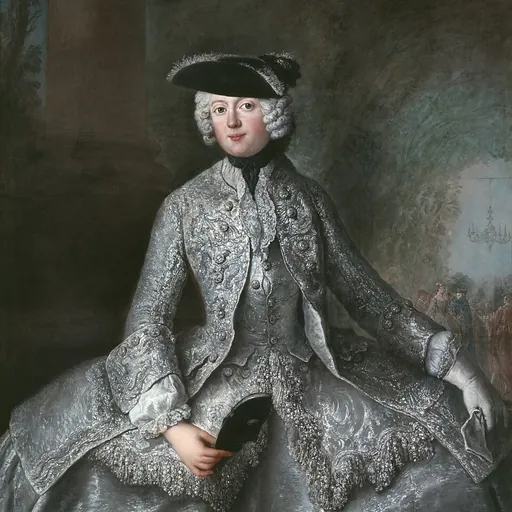
Anna Amalia of Prussia, Abbess of Quedlinburg
German princess-abbess and composer
About Anna Amalia of Prussia, Abbess of Quedlinburg
Lived 1723 – 1787 (aged 63). Anna Amalia of Prussia, Abbess of Quedlinburg was a German composer, autobiographer, patron of the arts and abbess, known for Composition (music) and Curator.
Princess Anna Amalia of Prussia (9 November 1723 – 30 March 1787) was an early modern German composer and music curator who served as princess-abbess of Quedlinburg. She was a princess of Prussia as the daughter of Frederick William I of Prussia and the sister of Frederick the Great.
Early life (1723–1755) alt=A throne room with a middle-aged lady in a silver dress standing in the middle, facin a man in a gilded red coat. Between them is a little girl in a light blue dress and a boy. Behind the lady stand five young girls, descending in height towards the edge of the canvas. Many courtiers are standing in the background. 1729 painting by Antoine Pesne showing the visit of Augustus II the Strong (1670–1733), Elector of Saxony and King of Poland. Amalia's mother stands in the center, her sisters on the queen's right and a 6-year-old Amalia on the left, in light blue. Princess Anna Amalia of Prussia was born on 9 November 1723 in Berlin, Kingdom of Prussia as the 12th child and 7th daughter of King Frederick William I (1688–1740) and his wife, born Princess Sophia Dorothea of Hanover (1687–1757). She had 13 siblings, 10 of whom survived infancy, including the future Frederick the Great (1712–1786). The Prussian royal children were raised in Berlin, where they lived in the Royal Palace (Königliches Schloss; today Berlin Palace/Berliner Schloss), but they also regularly spent time in the king's favourite residence, a jagdschloss ("hunting lodge") in Königs Wusterhausen.
Amalia was musically inclined, just like Crown Prince Frederick, but her formal instruction was only possible after the death of their abusive father who considered music to be decadent. Frederick William had an unpredictable temper, often dragging her across a room by her hair in a rage. Amalia's childhood was overshadowed by her father: described as an uneducated, unpolished and spartan soldier, he was an alcoholic whose favourite hobby was smoking pipes with commoners, an extremely pious and narrow-minded Calvinist who loved his wife and was faithful to her, but behaved violently towards his whole family, courtiers, and anyone who upset him.
He preferred a simple life and only enjoyed German food and culture, detesting everything French. He thought that women were for breeding only and have to be completely submissive to their husbands. On the other hand, Queen Sophia Dorothea was a well-educated and ambitious woman who enjoyed theatre and balls and loved French culture and fashion. She entrusted the care of her children to a French staff, to which the king could not object as French was the language of international diplomacy. Music became Amalia's secret consolation. She was first taught by Crown Prince Frederic with the support of their mother, and learned to play the harpsichord, the flute, and the violin.
The king was especially cruel to the crown prince as he considered his passion for music, literature and French culture unmanly. After many beatings and much humiliation, Frederick attempted to flee to their mother's family in England in 1730, but was captured and court-martialed. For her part in the escape attempt, the king almost beat his eldest daughter Princess Wilhelmine (1709–1758) to death. Amalia was 7 years old at the time. In May 1740, Frederick William I died and Amalia's eldest brother succeeded him as Frederick II.
Suggested marriage (1743–1744) After Prince Adolf Frederick of Holstein-Gottorp (1710–1771) was elected heir of the childless king of Sweden, Frederick I in 1743, Prussia, Russia, and Sweden pursued an alliance. A marriage was suggested between the new Swedish crown prince and either Amalia or her elder sister Louisa Ulrika (1720–1782). Their brother King Frederick thought that Louisa Ulrika was too ambitious to be a good queen in a relatively powerless monarchy as Sweden was then in the Age of Liberty (1720–1772), a period of parliamentary governance. He described Amalia as mild and good-hearted and thus more suitable for the role. It has been suggested that he believed that Amalia would be easier to control as a Prussian agent in the Swedish court. However, the Swedish envoy preferred Louisa Ulrika, and she was married by proxy in July 1744.
Abbess, composer, and music curator (1755–1787) alt=An old lady's face and upper body from profile. She had a big nose and start facial features. Her hair is braided under a cap with a black veil on top. In 1755, after the death of the previous abbess, Duchess Marie Elisabeth of Schleswig-Holstein-Gottorp (1678–1755), Amalia was elected princess-abbess of the Free Secular Imperial Abbey of Quedlinburg (German: Kaiserlich Freie Weltliche Reichsstift Quedlinburg), which made her a wealthy and influential woman with the right to sit and speak in the Imperial Diet. She spent most of her time in Berlin and devoted herself to music, becoming known as a patron and composer. In 1758, she started studying music theory and composition from Johann Kirnberger(1721–1783), a student of Johann Sebastian Bach.
She achieved modest fame and is most known for her chamber music, including trios, marches, cantatas, songs, and fugues. Her favourite among her own compositions was the passion cantata Der Tod Jesu ("The Death of Jesus"), based on a poem by Karl Wilhelm Ramler. Only a few of her works have survived and she may have destroyed many of her own compositions, as she described herself as very timid and self-critical. More compositions by her may surface as a result of the 2000 discovery of the archives of the Sing-Akademie zu Berlin in Kyiv which had been lost since World War II.
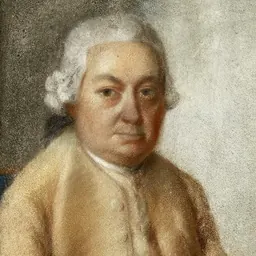
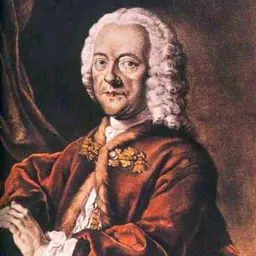
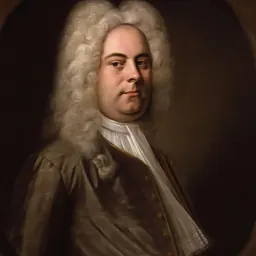
Amalia also collected music, preserving over 600 volumes by Johann Sebastian Bach, George Frideric Handel, Georg Philipp Telemann, Carl Heinrich Graun and Carl Philipp Emanuel Bach, among others. Her library was split between East Germany and West Germany after World War II and reunited after the German reunification of 1990. Today it is housed in the Berlin State Library.
Princess-abbess Anna Amalia died on 30 March 1787 at the age of 63 and was buried in Berlin Cathedral. She was succeeded by her niece, Princess Sophia Albertina of Sweden (1753–1829).
Selected compositions
Sonata in F Major (for Flute and Basso Continuo) (1771) I. Adagio, II. Allegretto, III. Allegro ma non troppo
Her flute sonata is Amalia's best-known composition. It has a duration of about 11 minutes.
Ancestry
Don’t just read it —
keep it.
Full-length biographies made to live with: read them, listen on the way to work, watch them tonight.
- E-book
- Audio
- Video
Instant download · yours to keep · every purchase keeps this site free
Important facts
Family & relationships
People in Anna Amalia of Prussia, Abbess of Quedlinburg's life
Named in this biography and alive at the same time
Related people
Same field, nearest in time
Contemporaries
People whose lives overlapped Anna Amalia of Prussia, Abbess of Quedlinburg's

Frequently asked questions
Who was Anna Amalia of Prussia, Abbess of Quedlinburg?
German princess-abbess and composer (1723-1787)
When was Anna Amalia of Prussia, Abbess of Quedlinburg born?
Anna Amalia of Prussia, Abbess of Quedlinburg was born on 9 November 1723 in Berlin.
When did Anna Amalia of Prussia, Abbess of Quedlinburg die?
Anna Amalia of Prussia, Abbess of Quedlinburg died on 30 March 1787 in Berlin.
What was Anna Amalia of Prussia, Abbess of Quedlinburg's occupation?
Anna Amalia of Prussia, Abbess of Quedlinburg was a composer, autobiographer, patron of the arts and abbess.
What was Anna Amalia of Prussia, Abbess of Quedlinburg known for?
Anna Amalia of Prussia, Abbess of Quedlinburg was known for Composition (music) and Curator.
What nationality was Anna Amalia of Prussia, Abbess of Quedlinburg?
Anna Amalia of Prussia, Abbess of Quedlinburg was German.
Sources & further reading
· Wikipedia: Anna Amalia of Prussia, Abbess of Quedlinburg
· DBpedia: Anna Amalia, Abbess of Quedlinburg
Cite this page
APA: Biography.guide. (2026). Anna Amalia of Prussia, Abbess of Quedlinburg. https://biography.guide/anna-amalia-of-prussia-abbess-of-quedlinburg/
MLA: "Anna Amalia of Prussia, Abbess of Quedlinburg." Biography.guide, https://biography.guide/anna-amalia-of-prussia-abbess-of-quedlinburg/.
Chicago: "Anna Amalia of Prussia, Abbess of Quedlinburg." Biography.guide. https://biography.guide/anna-amalia-of-prussia-abbess-of-quedlinburg/.
Data last updated: 2026-09-27 · Spot an error? Report a correction.
Portrait: Wikimedia Commons · author & licence
Page generated 2026-10-05 02:16 UTC