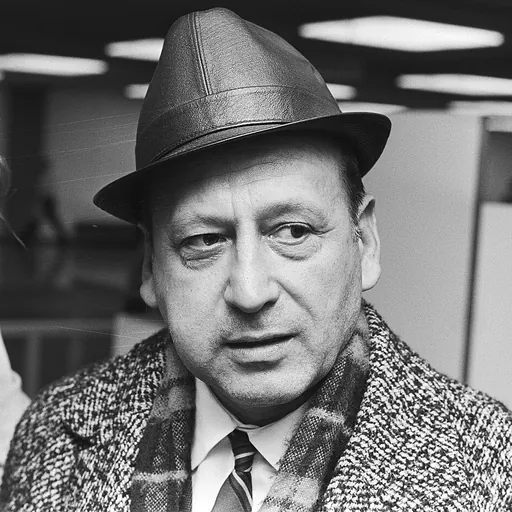
Angelo Niculescu
Romanian footballer and manager
About Angelo Niculescu
Lived 1921 – 2015 (aged 93). Angelo Niculescu was a Romanian association football player and association football coach.
Angelo Niculescu (1 October 1921 – 20 June 2015) was a Romanian football player and manager. He is best remembered in Romania for being the national team's coach during the 1970 World Cup. Niculescu is also credited with inventing the "temporizare" ("delaying") tactics. This strategy involved the team maintaining possession of the ball within its own half, with players exchanging numerous short passes across the field. The goal was to disrupt opponents' patience and force them to press high. This approach is often considered an early form of tiki-taka. Using these tactics, Niculescu qualified Romania for a World Cup after more than 30 years and secured a notable win against Czechoslovakia.
Playing career Niculescu was born on 1 October 1921 in Craiova, Romania and began playing football in 1937 at age 15 in Divizia B at local club Rovine Grivița. In 1939 he moved to play for neighboring team, FC Craiova with whom he won the 1942–43 championship which was not recognized by the Romanian Football Federation because the teams from Transylvania were unable to participate as the territory was annexed to Hungary due to the Second Vienna Award. During World War II his career was interrupted for a while as he was called by the Romanian Army to fight on the Eastern Front. In 1945, Niculescu joined Carmen București where he stayed two years.
Managerial career
"He was an innovator of football. A fair guy, severe enough, a man of justice. The most important thing was that he formed people. Valuable people of Romanian football." — Mircea Sandu, former Sportul Studențesc București player talking about Angelo Niculescu Afterwards, he led Dinamo to win its first Divizia A title in 1955. He guided the team in the first European match of a Romanian team in the 1956–57 European Cup in the 3–1 victory against Galatasaray, helping Dinamo reach the next phase of the competition where they were eliminated by CDNA Sofia. Niculescu left Dinamo in 1957 and had two short experiences at Steaua București and Tractorul Brașov. He has a total of 16 matches in European competitions, all with The Red Dogs, resulting in 10 victories and 6 losses. One of his most important European victories was the historical 2–1 over Helenio Herrera's Inter Milan in the 1965–66 European Cup edition, the Italians being the winners of the previous two seasons of the competition. Niculescu said after the game:"I am happy that Herrera's "concrete" was broken by the movement on the field of our players. With fair refereeing we would have won even more clearly". He guided the national team through the successful 1970 World Cup qualifiers where they earned first place in a group composed of Greece, Switzerland and Portugal. Thus they qualified for the final tournament after a 32-year absence. He also guided the national team during the 1972 Euro qualifiers where they earned first place in a group with Czechoslovakia, Wales and Finland, thereby reaching the quarter-finals.
Sportul Studențesc and Politehnica Timișoara In 1973, Niculescu went to coach Sportul Studențesc București until 1977.
Club Africain After the 1989 Romanian Revolution, he went to work as technical director in Tunisia at Club Africain, bringing Ilie Balaci as head coach. In their single season at the club, they won the CAF Champions League, Tunisian League and the Tunisian Cup.
Writing Niculescu started writing chronicles, comments and match analysis in 1958 as a journalist for the "Sportul popular" newspaper. Fotbal. Metode si mijloace de antrenament (Football. Training methods and means) - co-written with Ion V. Ionescu (1972) Corabia cu 11 pasageri (The ship with 11 passengers) (1974)
Personal life He had four brothers and one of them, Jean Niculescu, was a footballer at Olympia București. The president of FIFA, Joseph Blatter said: "Please accept my condolences for the passing of former player and coach Angelo Niculescu. He will be remembered for his contribution to Romanian football, especially as the inventor of the tiki-taka style of play."
Honours Manager Dinamo București Divizia A: 1955, 1964–65 Cupa României runner-up: 1954
Don’t just read it —
keep it.
Full-length biographies made to live with: read them, listen on the way to work, watch them tonight.
- E-book
- Audio
- Video
Instant download · yours to keep · every purchase keeps this site free
Important facts
People in Angelo Niculescu's life
Named in this biography and alive at the same time



Related people
Same field, nearest in time



Contemporaries
People whose lives overlapped Angelo Niculescu's





Frequently asked questions
Who was Angelo Niculescu?
Romanian footballer and manager (1921-2015)
When was Angelo Niculescu born?
Angelo Niculescu was born on 1 October 1921 in Craiova.
When did Angelo Niculescu die?
Angelo Niculescu died on 20 June 2015 in Bucharest.
What was Angelo Niculescu's occupation?
Angelo Niculescu was an association football player and association football coach.
What nationality was Angelo Niculescu?
Angelo Niculescu was Romanian.
Sources & further reading
Cite this page
APA: Biography.guide. (2026). Angelo Niculescu. https://biography.guide/angelo-niculescu/
MLA: "Angelo Niculescu." Biography.guide, https://biography.guide/angelo-niculescu/.
Chicago: "Angelo Niculescu." Biography.guide. https://biography.guide/angelo-niculescu/.
Data last updated: 2026-09-20 · Spot an error? Report a correction.
Page generated 2026-09-27 05:10 UTC