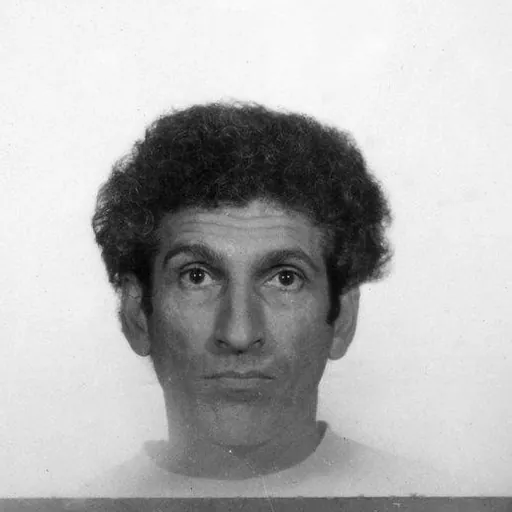
About Angelo Buono
Lived 1934 – 2002 (aged 67). Angelo Buono was an American criminal and serial killer.
Angelo Anthony Buono Jr. (; October 5, 1934 – September 21, 2002) was an American serial killer, kidnapper and rapist who, together with his adopted cousin Kenneth Bianchi, raped and murdered ten young women and girls between October 1977 and February 1978 in Los Angeles, California in what became known as the Hillside Strangler murders, as the victims were usually strangled to death and dumped on a hillside. In November 1983, after a two-year long trial, Buono was convicted of 9 counts of murder and subsequently sentenced to life imprisonment.
Although Buono began killing in 1977, he previously had a lengthy rap sheet of convictions, ranging from failure to pay child support to car theft. As a teenager, Buono began blaming his mother for his parents' divorce, and calling her demeaning names such as "whore", and idolized rapist Caryl Chessman. He also boasted to his friends about raping and sodomizing girls. He dropped out of school at age 16. Buono's adoptive cousin, 24-year-old Kenneth Bianchi moved in with him. Bianchi was a criminal himself, having been arrested numerous times, mostly for petty theft. Cindy Lee Hudspeth, age 20 – February 16, 1978
Both Buono and Bianchi would sexually abuse their victims before strangling them. They experimented with other methods of killing, such as lethal injection, electric shock, and carbon monoxide poisoning. Even while committing the murders, Bianchi applied for a job with the Los Angeles Police Department (LAPD) and had even been taken for several rides with police officers while they were searching for the Hillside Strangler.
Arrest, trial and conviction In January 1979, Bianchi was arrested in connection with the murders of two women in Bellingham, Washington. After pleading guilty, Bianchi was quickly linked to the Hillside Strangler murders in California. In order to avoid the death penalty, Bianchi named Buono as the other perpetrator in the Hillside Strangler case and agreed to testify against him. On October 22, 1979, Buono was arrested at his upholstery shop in Glendale and charged with 24 felonies, including murder, sodomy and rape. One day, an inmate had asked Buono why he killed all those girls, to which he reportedly replied: "They were no good. They deserved to die. It had to be done. But I only killed a couple of 'em. I ain't worried."
The preliminary hearing on Buono lasted for 10 months. The legal case against Buono was based largely upon Bianchi's testimony. After Bianchi made repeated self-contradictory statements in order to diminish his own credibility as a witness to have the case against Buono dismissed, Jury selection for Buono's trial was completed in the spring of 1982. In June 1982, Bianchi took the stand and, once again, purposely made contradictory statements. In fact, one of the prosecutors warned the jury to "expect some lies" during Bianchi's testimony. The prosecutors played Bianchi's taped confession to the jury. Throughout the trial, the jurors were taken on a series of excursions to the sites where the victims were abducted or dumped, including the exact spot where the bodies of Sonja Johnson and Dolores Cepeda were discovered. The jury was also shown the graphic photos of the murdered women's corpses. During the trial, the defense attorneys called ten character witnesses for Buono, including his older sister, who testified that Buono was a "non-violent person" who cared for their cancer-stricken mother the same year that the killings had occurred. The prosecutors, in turn, called one of Buono's boyhood friends, who testified that Buono "talked about rape all the time." He died of a heart attack on September 21, 2002, in his jail cell while incarcerated at Calipatria State Prison. His body was cremated.
In 2007, Buono's grandson, Christopher Buono, committed suicide shortly after shooting his grandmother, Mary Castillo, in the head. Castillo was at one time married to Buono, and had five children with him, including Chris' father. Chris Buono was unaware of his grandfather's true identity until 2005.
Media In the 1989 film The Case of the Hillside Stranglers, Buono was portrayed by actor Dennis Farina. In the 2004 film The Hillside Strangler, Buono was portrayed by actor Nicholas Turturro and in Rampage: The Hillside Strangler Murders (2006), he was played by Tomas Arana.
Don’t just read it —
keep it.
Full-length biographies made to live with: read them, listen on the way to work, watch them tonight.
- E-book
- Audio
- Video
Instant download · yours to keep · every purchase keeps this site free
Important facts
People in Angelo Buono's life
Named in this biography and alive at the same time






Related people
Same field, nearest in time
Contemporaries
People whose lives overlapped Angelo Buono's




Frequently asked questions
Who was Angelo Buono?
American serial killer (1934-2002)
When was Angelo Buono born?
Angelo Buono was born on 5 October 1934 in Rochester.
When did Angelo Buono die?
Angelo Buono died on 21 September 2002 in Calipatria.
What was Angelo Buono's occupation?
Angelo Buono was a criminal and serial killer.
What nationality was Angelo Buono?
Angelo Buono was American.
Sources & further reading
Cite this page
APA: Biography.guide. (2026). Angelo Buono. https://biography.guide/angelo-buono/
MLA: "Angelo Buono." Biography.guide, https://biography.guide/angelo-buono/.
Chicago: "Angelo Buono." Biography.guide. https://biography.guide/angelo-buono/.
Data last updated: 2026-09-22 · Spot an error? Report a correction.
Portrait: Wikimedia Commons · author & licence
Page generated 2026-09-27 05:04 UTC