About Anestos Delias
Lived 1912 – 1944 (aged 32). Anestos Delias was a Greek singer, composer, songwriter and musician.
Anestis Delias (; 1912 – 31 July 1944) was a Greek bouzouki player, composer and singer of rebetiko. Delias was from a musical family of Smyrna in Anatolia, who arrived on the Greek mainland as a young refugee during the Greco-Turkish war. He became an accomplished player of the bouzouki and joined with other musicians in the refugee suburbs of Athens and Piraeus, creating music in the 1930s that exemplifies the genre known as Piraeus rebetiko. Delias played on early rebetiko recordings, including songs of his own composition released under his name. He became addicted to heroin and died of starvation, aggravated by his drug dependency, during the Nazi occupation of Greece. Despite his short life, Anestis Delias was an important figure and an influential exponent of the Piraeus-style of rebetiko.
Biography
Early life
Delias was born Anastasios Delios (Αναστάσιος Δέλιoς) in 1912 in Smyrna, on the Aegean coast of Anatolia. His father, Panagiotis Delios, was a shoemaker by profession and was a well-known professional musician in Asia Minor. The Delios family had a significant musical heritage; like his father before him, Panagiotis Delios played the santouri and his brother Michalis (Delias' uncle) played the violin. Delias' mother, Photina, was also a singer. Panagiotis Delios was known as 'Μαύρη Γάτα' ('Black Cat'), an epithet later given to Anestis Delias by his fellow musicians.
In July 1922, young Anestis, aged about ten years, arrived at the port of Piraeus in Greece with his pregnant mother and younger sister, refugees from the final stages of the Greco-Turkish war. His father had remained in Smyrna and was killed that year during the destruction and atrocities that occurred when the Turkish forces captured the city. The family settled at Drapetsona, one of the refugee neighbourhoods of Piraeus (on the northern side of the inlet), and Delias' sister Eleni was born soon afterwards. By 1928 the population of Athens almost doubled as a result of the mass movement of Christian refugees from Asia Minor to the Greek mainland, with the result that the city was surrounded by encampments and shanty towns such as Drapetsona and Kokkinia, with a largely impoverished population mostly speaking Turkish as their first language.
As the only son of the family, Anestis worked in many different jobs to support his widowed mother and two younger sisters. In the inter-war years in Greece, the bouzouki was an instrument of low social standing, which was embraced by the new generation of musicians based in the urban refugee suburbs.
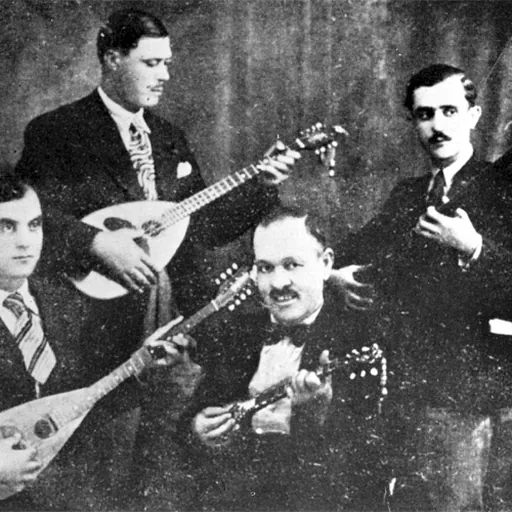
Musical career Members of The Famous Quartet of Pireaus, (l. to r.) Stratos Pagioumtzis, Markos Vamvakaris, Yiorgos Batis and Anestis Delias.
By the early 1930s, Anestis Delias had become known as a proficient player of the bouzouki and baglamas. In about 1933, he joined with fellow musicians Yiorgos Batis, Stratos Pagioumtzis and Markos Vamvakaris, to form the first professional rebetiko orchestra called I Tetras i Xakousti tou Peiraios (, literally The Famous Quartet of Piraeus). Delias was the youngest member of the quartet. Both he and Payoumtzis were refugees from Asia Minor and Vamvakaris had moved to Piraeus from the island of Syros. Batis was the oldest of the group and the instigator for the formation of the ensemble. In 1934 the quartet gave its first professional performance at Sarantopoulos' tavern in Drapetsona. This quartet, and the recordings and subsequent careers of its individual members, influenced subsequent generations of musicians and composers.
Individual members of The Famous Quartet of Piraeus began recording songs from late 1932, with recording sessions which often included one or more of the other members of the quartet, as well as other rebetiko musicians. In 1933, Batis released a song he had written called "Spanish zeïbekáno (Quietly into a boat)" ["Ζεϊμπεκάνο Σπανιόλο (Ζούλα σε μια βάρκα μπήκα)"]. From acknowledgements between the musicians during the song, heard on the live studio recording, those playing on the record can be identified as Pagioumtzis (vocalist), Delias (bouzouki), Vamvakaris (bouzouki) and Batis (baglamas).
The early recordings by the members of The Famous Quartet of Piraeus, while dominated by the sounds of fretted instruments (the bouzouki and the baglamas), nevertheless "bear a distinct imprint of eastern modality and language" revealing the influence of the Anatolian refugees on the music. In acknowledgements and greetings between the musicians on the recorded songs, Delias was sometimes referred to as 'Anestaki' (Ανεστάκι), an affectionate version of Anestis (literally 'little Anestis'). He was also referred to as 'Artemis' (Αρτέμης) or 'Black Cat' ('Μαύρη Γάτα'), in both song lyrics and musicians’ acknowledgements. Piraeus rebetiko borrowed themes from the underworld (prison life, disdain of the police, use of hashish) which appealed to groups of the lower socio-economic strata and became popular in Greece as recordings became available during the 1930s.
Heroin addiction and death
By 1938, when Delias’ recording activities ceased, he had become addicted to heroin (an addiction that possibly began as early as 1935). In 1938, he was sentenced to eighteen months’ exile on the island of Ios because of his heroin use, as part of the Metaxas regime's policy of expelling drug addicts from urban centres to designated provincial areas. While on Ios Delias met up with Michalis Yenitsaris, his friend and a fellow rebetis, who had been exiled for a year on the island after being deemed to be ‘Δημόσιο Επικίνδυνο’ (a danger to the public). The island held a large number of exiled drug addicts and, according to Yenitsaris' account, during Delias' banishment on Ios he continued to use heroin.
After his release from Ios in about mid- to late-1939, Delias' lived with a prostitute named Koula Skoularikou, who was also a heroin addict. Various of Delias' friends and fellow musicians have described his unsuccessful attempts to work as a musician and to end his drug dependency. Delias' failure to give up heroin led to "his gradual, tragic decline".
The date of Delias' death has been the subject of speculation. Some sources claim he died in 1941 (the year of the beginning of the 'Great Famine' in Greece during the Axis occupation). By that year, Delias was living with, and being cared for, by his old friend and fellow musician, Stratos Pagioumtzis, and Stratos' wife Zoe. In early February 1944, Delias was admitted to the Dromokaiteion Psychiatric Hospital, in the suburb of Haidari (west of central Athens), with Pagioumtzis listed as his guardian on the admission form. When he was released after several weeks on February 28, Delias refused to return to the Pagioumtzis household and probably died several months later. Some sources specify the date of Delias' death as 31 July 1944. It is generally agreed that Anestis Delias died of starvation, aggravated by his addiction to heroin. Most accounts claim his dead body was found on the street and was picked up by a municipal cart responsible for clearing the streets of corpses during the occupation by the Axis powers.
Assessment of Delias' legacy
Delias was a figure largely forgotten in the decades after his death, during a period when the 'Greekness' of the 1930s rebetika was being questioned, with commentators challenging the genre's contribution to modern Greek culture and identity because of its low-class origins and distinct Oriental elements and influences. The revival of rebetiko, which began in the 1960s, gathered pace in the mid-1970s after the collapse of the Greek military junta, leading to a more positive reassessment of the legacy of inter-war rebetiko and its leading exponents. A focus on rebetiko history and its sociological and cultural importance led to an intensified interest in the biographies of the rebétes musicians. The sources for determining the details of Delias' life are few. Primary sources include recorded songs, advertisements and a small number of photographs. However, most of the information comes from recorded interviews of his friends, fellow musicians and family members, which began to be published in magazines and newspapers in the 1970s. Historians of rebetika also recorded interviews with rebétes, providing commentary and additional information about Delias' life.
Despina Michael, in her examination of the depiction of Delias in the popular imagination, asserts that the paucity of firm evidence about Delias' life "has stimulated the mythopoetic tendencies of his various biographers" in their attempts to give "the shadowy figure of Delias substance and form". The bare outline of his "inherently tragic story" has been shaped to fit certain archetypal narratives, such as the victim unable to save himself, innocence succumbing to evil, or a symbol of lost youth. As a musician who died young, there is the added dimension of the tragic artist, overwhelmed by self-destruction and the wasted potential of the music he might have created. These factors have combined to give the present-day image of Delias many enduring qualities and a particular mythic potency.
Discography
Original recordings The following are the recordings released under Anestis Delias' name; each release was made up of two songs, one on each side of a 78 rpm gramophone record:
"Το χαρέμι στο χαμάμ (Μες στης πόλης το χαμάμ)" ["The harem in the hamám (In the city’s hamám)"] b/w "Το σακάκι" ("The jacket") – Columbia (Greece) DG-6165 : CG-1308 / CG-1309 (1935). "Ο πόνος του πρεζάκια" ("The pain of the junkie") b/w "Ο Νίκος ο Τρελάκιας" ("Níkos the Crazy") – Columbia (Greece) DG-6185 : CG-1348 / CG-1349 (January 1936). "Το κουτσαβάκι (Βρε μάγκα, το μαχαίρι σου)" ["The koutsaváki (Hey mágka, your knife)"] b/w "Σούρα και μαστούρα" ("Drunk and stoned") – His Master's Voice (Greece) AO-2307 : OGA-334 / OGA-335 (1936). "Αθηναίισσα" ("Athenaiissa") b/w "Ραστ Νεβά μανές (Μόνον εγώ γεννήθηκα αμαρτωλός)" "Rast Neva manés (I alone was born a sinner)" [Stratos Pagioumtzis (vocals)] – His Master's Voice (Greece) AO-2375 : OGA-498 / OGA-499 (1937). "Ουσάκ (Το Τραγούδι Της Ξενιτειάς)" ["Uşşâk (The song of the foreigner)"] [Stratos Pagioumtzis (vocals)] b/w "Τον άντρα σου κι εμένα" ("Your husband and me") – Columbia (Greece) DG-6282 : CG-1546 / CG-1547 (1937).
Don’t just read it —
keep it.
Full-length biographies made to live with: read them, listen on the way to work, watch them tonight.
- E-book
- Audio
- Video
Instant download · yours to keep · every purchase keeps this site free
Important facts
People in Anestos Delias's life
Named in this biography and alive at the same time


Related people
Same field, nearest in time



Contemporaries
People whose lives overlapped Anestos Delias's





Frequently asked questions
Who was Anestos Delias?
Greek musical artist (1912–1944)
When was Anestos Delias born?
Anestos Delias was born on 4 March 1912 in İzmir.
When did Anestos Delias die?
Anestos Delias died on 31 July 1944 in Athens.
What was Anestos Delias's occupation?
Anestos Delias was a singer, composer, songwriter and musician.
What nationality was Anestos Delias?
Anestos Delias was Greek.
Sources & further reading
Cite this page
APA: Biography.guide. (2026). Anestos Delias. https://biography.guide/anestos-delias/
MLA: "Anestos Delias." Biography.guide, https://biography.guide/anestos-delias/.
Chicago: "Anestos Delias." Biography.guide. https://biography.guide/anestos-delias/.
Data last updated: 2026-09-21 · Spot an error? Report a correction.
Portrait: Wikimedia Commons · author & licence
Page generated 2026-09-27 05:01 UTC