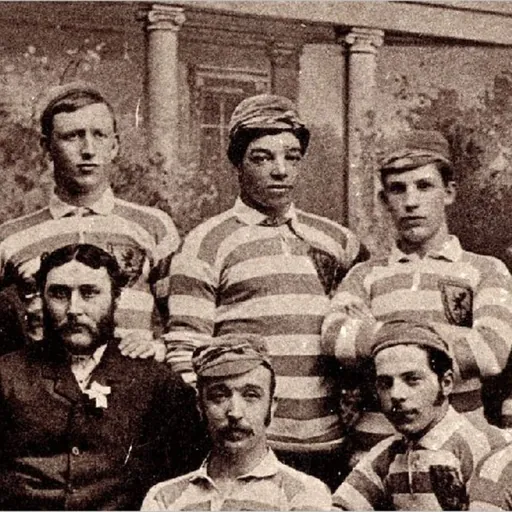
About Andrew Watson
Lived 1857 – 1921 (aged 63). Andrew Watson was a British association football player, physicist, engineer and mathematician.
Early life and education Watson was the son of a wealthy Scottish sugar planter Peter Miller Watson (1805–1869) (the son of James Watson, of Crantit, Orkney, Scotland) and a local British Guianese woman named Hannah Rose. He came to Britain with his father, and his older sister Annetta, and they inherited a substantial amount when their father died in London in 1869.
He was educated at Heath Grammar School in Halifax, West Yorkshire and then from 1871 at King's College School, in Wimbledon, London, where records show he excelled at sports including football. He later studied natural philosophy, mathematics and engineering at the University of Glasgow when he was 19, where his love of football blossomed. He played in the full-back position, on either the right or the left flank.
Early life, marriages, children Watson left Glasgow University after one year, and in 1877, became a partner in Watson, Miller, and Baird, a wholesale warehouse business in Glasgow. In November 1877, he married Jessie Nimmo Armour (1860–1882), the daughter of John Armour, a cabinet-maker. and likely also related to the 21st-century English poet Malik Al Nasir through his mother.
Football career Club career After first playing for Maxwell in 1876, Watson signed for local side Parkgrove, where he was additionally their match secretary,
Watson also took part in athletics competitions, winning the high jump on several occasions.
On 14 February 1880, Watson was selected to represent Glasgow against Sheffield at Bramall Lane, an annual fixture played between 1874 and 1960; Glasgow won 1–0. He was also selected for a tour to Canada in the summer of 1880 which was cancelled after the death of William Dick, secretary of the Scottish Football Association. He also played for other amateur English clubs, including Pilgrims, Brentwood, and London Caledonians. As written in the minutes, before one match where Watson was injured and unable to play, an SFA vice-president said if Watson had been fit he would have happily drugged a fellow Scottish international to give Watson his place. He played his last match for Queen's Park in 1886.
Paul McDonald, writing for the BBC, noted: "Payments to players had been made legal in England in 1885 and professional footballers were paid decent salaries for that time. Ironically, this attracted many Scottish players southwards to ply their trade in England, whereas in Scotland the game remained, in theory anyway, an amateur game until 1893."
Professionalism In 1886 and 1887, the English club Bootle advertised for players in Scotland, as the Scotch Professors innovation of the modern passing game took hold in England. Several Scottish players were enticed to relocate by the offer:- Tom Veitch (Dumbarton), Campbell (Moffat), Frank Woods (Moffat), Robert Anderson (Dumbarton), Billy Hastings (Airdrieonians) among others. It was later found by a SFA committee investigating a Scottish player, Robert Calderwood, who returned north - he obtained a new job in Cowlairs offering 30 shillings per week, and subsequently turned out for Cowlairs F.C. - that he received a wage of 26 shillings per week from Bootle F.C.. The SFA found Calderwood guilty of professionalism and he was banned for two years, but they found that Cowlairs F.C. played the player unknowingly and they were merely ordered to replay a match against Third Lanark.
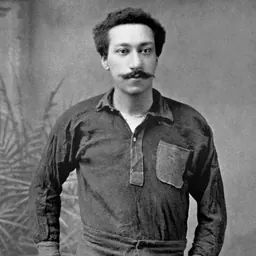
Watson also signed for Merseyside club Bootle in 1887. This means that Watson's professional career would predate the professional career of Arthur Wharton, who was previously considered to be the first black footballer to play professionally.
When Bootle was drawn with a Smethwick side Great Bridge Unity F.C., the Midlands club received a telegram from a 'Smith of Oakfield' who stated that Bootle's Watson and another Scottish player Robert Anderson were being paid – and as such should be ineligible for their tie. both players moved on from the club shortly after signing and moved on to Everton, who at the time were Bootle's main rivals in Merseyside.
The club was found guilty by the FA but the punishment was lenient – they had that same season closed Anfield for a month when Everton similarly paid players – and Bootle escaped with a mere caution.
The payment of Watson, Anderson, Calderwood and others at the club also explains the investigations of the local Bootle newspaper into the club's finances. Around the start of the 1887–88 season, The Bootle Times was asking questions into the club's finances, trying to work out who was getting what. It also, in passing, takes a dig at Bootle F.C.'s reliance on Scottish players by its phrasing of 'own local club, if indeed we may call it that', hinting that the newspaper suspected the payments made to the club's Scottish players were indeed where the club's financial surplus went. The payments to Scotch Professors around Merseyside would have been common knowledge.
The Saturday 1 October 1887 edition noted:
QUESTIONS WHICH REQUIRE ANSWERS. In Bootle and other places the football season has commenced in right earnest. Our own local club, if indeed we may call it that, has started has well; 9 games have already played which have proved to be of the most interesting character to those who taken interest in such pastimes. [...] First and foremost comes the "profit and loss account" of the club in question, and this is a very interesting item. Saturday after Saturday the ground is simply crowded with spectators, all of whom, with the exception of the subscribers, pay 3d. gate money. Last Saturday week, taking the figure from a Liverpool contemporary, we find that upwards of 5,000 persons on the field, and last Saturday there must have at least 4,000. Bring them together and we have 9,000 people upon the football field in two weeks. Nine thousand people at 3d. per head, would bring a gate of over £112. £112 to be raised in a fortnight by one club is no small sum, and it augurs well for the popularity of the game in Bootle, and the result of this season's play. [...] If, for the sake of argument, we place the length of the football season at eight months, and consider that the "gates" will average 1,000 persons each week, we shall thus conclude that at least £800 - £1000 will be taken in one year. Of course this money is not all clear profit. From it has to be deducted travelling and various other expenses incidental to a club of the standing of the Bootle Football Club; but we venture to assert that after all claims have been met a large surplus must remain. What, then, we require to know, is Where does this surplus go? If it were possible to obtain a balance sheet of the club, it would not be necessary to ask these questions. We have applied for a balance sheet upon more than one occasion, but the request has been met by one excuse or another, to the effect that no balance sheet was printed.
The 15 October 1887 edition of The Bootle Times notes: "the questions asked of us a fortnight ago with reference to the working and management of the club have not been answered."
International career Watson won three international caps for Scotland. Scotland won 6–1, which (as of 2024) is still a record home defeat for England. A few days later, Scotland played Wales and won 5–1, Watson captaining Scotland again.
Watson's last cap came against England in Glasgow on 11 March 1882. This was a 5–1 victory again to Scotland. Watson moved to London in the summer of 1882, which effectively ended his international career as the SFA only picked players based in Scotland at this time. He also became the first non-white player to score for the Scotland senior team (Scotland 4x1 Trinidad & Tobago).
Later life and tributes Watson retired to London in around 1910 and died of pneumonia at 88 Forest Road, Kew, in 1921.
In 1926, the sportswriter "Tityrus" (the pseudonym of J. A. H. Catton, editor of the Athletic News) named Andrew Watson as left-back in his all-time Scotland team. A mural of Watson was painted on the side of a cafe in Shawlands, south Glasgow in 2020, and he also features prominently in the First Hampden Mural at Hampden Bowling Club.
In 2025, a plaque honouring Watson was revealed outside of The Crossley Heath School, the amalgamation of Heath Grammar School, his former high school, and Crossley and Porter School. This plaque was unveiled by Viv Anderson, who was the first black player for the England national football team.
Honours Queen's Park Scottish Cup: 1880–81, 1881–82, 1885–86 Glasgow Merchants Charity Cup: 1879–80, 1880–81, 1883–84
Don’t just read it —
keep it.
Full-length biographies made to live with: read them, listen on the way to work, watch them tonight.
- E-book
- Audio
- Video
Instant download · yours to keep · every purchase keeps this site free
Important facts
People in Andrew Watson's life
Named in this biography and alive at the same time



Related people
Same field, nearest in time
Contemporaries
People whose lives overlapped Andrew Watson's



Frequently asked questions
Who was Andrew Watson?
Scottish footballer (1857-1921)
When was Andrew Watson born?
Andrew Watson was born on 18 May 1857 in Georgetown.
When did Andrew Watson die?
Andrew Watson died on 8 March 1921 in Forest Road.
What was Andrew Watson's occupation?
Andrew Watson was an association football player, physicist, engineer and mathematician.
What nationality was Andrew Watson?
Andrew Watson was British.
Sources & further reading
· DBpedia: Andrew Watson (footballer, born 1856)
Cite this page
APA: Biography.guide. (2026). Andrew Watson. https://biography.guide/andrew-watson-association-football-player-1857/
MLA: "Andrew Watson." Biography.guide, https://biography.guide/andrew-watson-association-football-player-1857/.
Chicago: "Andrew Watson." Biography.guide. https://biography.guide/andrew-watson-association-football-player-1857/.
Data last updated: 2026-09-30 · Spot an error? Report a correction.
Portrait: Wikimedia Commons · author & licence
Page generated 2026-10-04 14:22 UTC