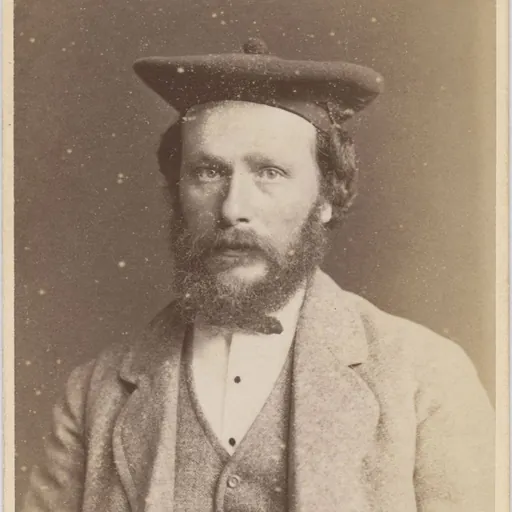
About Andrew Pettigrew
Lived 1833 – 1903 (aged 69–70). Andrew Pettigrew was an American landscape architect.
Andrew Pettigrew (11 August 1833 – 26 April 1903) was a Scottish landscape gardener. Much of his career was spent as head gardener to John Crichton-Stuart, 3rd Marquess of Bute, firstly at Dumfries House and then at Bute's Welsh estate centred on Cardiff Castle. His three sons, William Wallace, Hugh Allan and Andrew Alexander, also became landscape gardeners, with William and Andrew both serving as the city's superintendent of parks. Collectively they created many of Cardiff's most notable parks, including Bute Park, Cathays Park, Llandaff and Pontcanna Fields, and Roath Park. The Glamorgan Archives, which holds the records of Cardiff County Borough Council containing materials relating to the development of the city's parks, describes them as "the family who landscaped Cardiff".
Life and career
Pettigrew was born in Ayrshire, Scotland in 1833 to shoemaker William and Elizabeth née Kennedy. In 1866 he was engaged by John Crichton-Stuart, 3rd Marquess of Bute, beginning a collaboration that lasted until Bute's death in 1900. Pettigrew began working at Dumfries House in Ayrshire, before transferring to the Bute estate in South Wales in 1873. In 1865 Bute had met the architect William Burges and the pair began a partnership which transformed Cardiff Castle, Bute's base in the city, into "the skyline of the capital of Wales. The dream of one great patron and one great architect [became] the symbol of a whole nation". Pettigrew was closely involved with this work, laying out Bute Park which became the private park of the castle,
In an innovative step, Bute determined to introduce commercial grape vines at Castell Coch in 1873. He sent Pettigrew to France to study vineyards there and together they planted a vineyard below the castle. By 1887, the output was 3,000 bottles of sweet white wine of reasonable quality. In 2024, a ten-year tree planting project, Coed Caerdydd, saw the reintroduction of a variety of fruit trees originally introduced by Pettigrew into the Cardiff landscape. Species included the Gabalfa Apple, which was previously thought to have been extinct.
Pettigrew also undertook work at Sophia Gardens, at Roath Park, and on Pontcanna Fields and at Cathays Park, then both part of the castle's private grounds. In these two spaces, he planted wide avenues of lime and elm trees, which survive. His son, Andrew Alexander, wrote of Bute's last visit to Cardiff, shortly before his death in 1900 when the Cathays site had just been sold to Cardiff Corporation for development as the city's civic centre. Walking in the park with Pettigrew, Bute commented on the avenues of trees; "There, Pettigrew, there’s something that will stand as our monument, yours and mine for many generations after we have departed”. Pettigrew is also commemorated at the West Lodge, the southern entrance to Bute Park designed by Alexander Roos, where the cafe is named the Pettigrew Tea Rooms in his honour. Another modern tribute is contained in the People's Door entrance to the park. Created in 2011 by the architect Michael Davies, the door includes nine panels featuring people, events and structures related to the area. Pettigrew is celebrated by a portrait in the panel in the top-right corner. Another panel depicts the demolished Swiss Bridge. The Glamorgan Archives, holders of the records of Cardiff County Borough Council which has materials relating to the development of the city's parks, describes Pettigrew and his sons as "the family who landscaped Cardiff". He was succeeded in this role by his brother, Andrew Alexander, when he took up the post of Chief Parks Officer at Manchester in 1915. While at Manchester, he undertook an important study on the impact of air pollution on city-centre parks, focussing on Philips Park, located in the most-polluted part of the city. He returned to the Cardiff role on Andrew's premature death in 1932. During his retirement he wrote an influential book on the management of public spaces, Municipal parks: layout, management and administration, together with a short treatise on the organisation of a public parks department, which he dedicated to Andrew Alexander. On his second retirement, he returned to Worthing on the Sussex coast, where he died in 1947.
Andrew Alexander Pettigrew (1875–1936) The youngest son, Andrew Alexander trained with his father, during which time he travelled to China and Japan to study horticulture and flora, and at Kew. He worked with his brother Hugh at St Fagans, before succeeding to the post of head gardener to Lord Plymouth at Hewell Grange, where he remained from 1900 to 1915. He then returned to Cardiff to take up the Chief Parks Officer role vacated by his eldest brother William and continued in this post until his death from cancer in 1936. During his tenure, he wrote a seven-volume study, The Public Parks and Recreation Grounds of Cardiff. The work was never published, but is held in the Cardiff City archives and is an important source on the history of Cardiff's parks.
Gallery
Don’t just read it —
keep it.
Full-length biographies made to live with: read them, listen on the way to work, watch them tonight.
- E-book
- Audio
- Video
Instant download · yours to keep · every purchase keeps this site free
Important facts
People in Andrew Pettigrew's life
Named in this biography and alive at the same time


Related people
Same field, nearest in time




Contemporaries
People whose lives overlapped Andrew Pettigrew's


Frequently asked questions
Who was Andrew Pettigrew?
Scottish landscape gardener (1833 – 1903)
When was Andrew Pettigrew born?
Andrew Pettigrew was born in 1833.
When did Andrew Pettigrew die?
Andrew Pettigrew died in 1903.
What was Andrew Pettigrew's occupation?
Andrew Pettigrew was a landscape architect.
What nationality was Andrew Pettigrew?
Andrew Pettigrew was American.
Sources & further reading
· DBpedia: Andrew Pettigrew (landscape gardener)
Cite this page
APA: Biography.guide. (2026). Andrew Pettigrew. https://biography.guide/andrew-pettigrew/
MLA: "Andrew Pettigrew." Biography.guide, https://biography.guide/andrew-pettigrew/.
Chicago: "Andrew Pettigrew." Biography.guide. https://biography.guide/andrew-pettigrew/.
Data last updated: 2026-09-23 · Spot an error? Report a correction.
Portrait: Wikimedia Commons · author & licence
Page generated 2026-09-27 05:05 UTC