
About Andrés Quintana Roo
Lived 1787 – 1851 (aged 63). Andrés Quintana Roo was a Mexican politician, writer, lawyer, journalist, minister and poet.
Andrés Eligio Quintana Roo (30 November 1787 – 15 April 1851) was a Mexican liberal politician, lawyer, and writer. He was the husband of fellow independence activist Leona Vicario.
Quintana Roo was one of the most influential men in the Mexican War of Independence and served as a member of the Congress of Chilpancingo, where he presided over the National Constituent Congress, which drafted the Mexican Declaration of Independence in 1813. He served multiple terms in the Chamber of Deputies, serving as its president twice. Quintana Roo also served as a member of the Mexican Supreme Court. He edited and founded many newspapers, including El Ilustrador Americano ("The American Illustrator"), El Semanario Patriótico Americano ("The American Patriot Weekly"), and El Federalista Mexicano ("The Mexican Federalist"). The Mexican state of Quintana Roo was named in his honor.
Early life Quintana Roo was born to Don José Matías Quintana and Doña María Ana Roo de Quintana, descendants of Canarians who settled in the Yucatán Peninsula. They were married on 20 June 1786 in Mérida. His paternal grandparents were Gregorio Quintana from Galicia and Martina Tomasa de Campo from Campeche. On his mother's side, his grandparents were Antonio Roo y Font from Tenerife and Leonarda Rodríguez de la Gala, also from Campeche.
Sanjuanistas
In 1805, the elder Quintana became part of a group known as the Sanjuanistas. The group met to discuss social and political issues, in particular the slavery of the indigenous population. The group took their name from their meeting place, the Ermita de San Juan Bautista (Hermitage of Saint John the Baptist) where the group leader, José María Velázquez, was a priest.
In 1808, the Napoleonic Army invaded Spain and overthrew the Bourbon dynasty. In 1810 in Cádiz, Spain — one of the last cities free from the French armies — an assembly (cortes) of the Spanish peninsular and overseas provinces met to discuss the future of the Spanish Empire without a monarch. This was the political climate the Sanjuanistas found themselves in.
In March 1812, the Cortes of Cádiz issued a new Spanish constitution. In July, Miguel González Lastiri, Yucatán's representative at the Cortes, arrived with seven copies of the new constitution, one of which fell into the hands of the Sanjuanistas. Having read the document, they quickly became its promoters and opened their group to anyone who wanted to join. By October, the Sanjuanistas had pressured the hesitant governor of Yucatán, Manuel Artanza y Barrial, to enforce the new constitution.
Los Guadalupes
As a lawyer, one of Ignacio López Rayón's great gifts was organization. After the defeat of Hidalgo, he gave structure to the army under the auspices of the Junta de Zitácuaro, one of the first governing bodies in Mexico not to recognize the authority of the Viceroyalty of New Spain. In addition to military and administrative organization, López Rayón organized a group of spies and propagandists which came to be known as Los Guadalupes. They took their name from the Virgin of Guadalupe to juxtapose themselves from the Spaniards who venerated the Virgin of the Remedies. In order to protect their identities, Los Guadalupes would use various pseudonyms in their communications.
Very few people are known for certain to have been in this group, but it is likely they centred their operations in Mexico City, and most of them were lawyers. Still, they were a diverse group that included women, priests, and nobles as well. They maintained regular communication with López Rayón, sent him current newspapers and publications from Spain and the U.S., and weapons, money, and men. Perhaps most importantly, they set up a line of communication between López Rayón and José María Morelos y Pavón.
Andrés Quintana Roo and Leona Vicario were married soon after in Tlalpujahua.
Following these defeats, Quintana Roo and the Congress were forced to relocate frequently. On 22 October 1814, in the city of Apatzingán, the Congress issued the Decreto Constitucional para la Libertad de la America Mexicana ("Constitutional Decree for the Liberty of Mexican America"), better known as the Constitution of Apatzingán, drafted by Quintana Roo, Carlos María de Bustamonte, and José Manuel de Herrera.
In May 1814, Fernando VII had regained his throne and abolished the liberal Constitution of Cádiz. With the defeat of the French forces in Spain, Fernando was free to send more soldiers to Mexico, and so Iturbide redoubled his efforts against Morelos and the Congress. Much of the territory that had been won by Morelos was lost, and the Congress was kept always on the move. In July 1815 Oaxaca and Acapulco fell to José Gabriel de Armijo. In late September, the Congress agreed to move to Tehuacán, Puebla, guarded by the armies of Morelos and Nicolás Bravo.
En route to Tehuacán, on 5 November, the caravan was intercepted by royal soldiers commanded by Manuel de la Concha. Morelos covered the retreat of the Congress and was captured, taken to Mexico City, and executed on 22 December. Though the Congress reached Tehuacán, it was dissolved shortly after.
Amnesty While the bulk of the deputies of the Congress of Chilpancingo fled to Tehuacán, Andrés Quintana Roo and Leona Vicario remained in Michoacán. They had been offered amnesties by different parties during the collapse of the Congress but they had steadfastly refused. They spent most of 1816 on the run. They were aided in their flight by a transition of Viceroys. Félix María Calleja del Rey had been judged too harsh and dictatorial in his rule, and the much more temperate Juan Ruiz de Apodaca was sent to replace him. Apodaca ended the practice of summary executions and showed leniency to insurgent leaders who surrendered themselves. Still, Quintana Roo would not accept a pardon.
On 3 January 1817, hidden in a cave in Achipixtla, Quintana Roo's wife gave birth to their first child, Genoveva. Now with a child, their flight became more difficult, but they persisted for another year until in March 1818 they were found by two former soldiers of the insurgency. Vicario acquiesced to be taken, and Quintana Roo negotiated his surrender shortly after, fearing for his wife's safety.
While the insurgents celebrated this change in circumstances, just as they had done in 1812, the conservative forces that had been putting down the insurgencies viewed the changes as a threat to their power.
The new plan of the Conspiracy was to declare the independence of New Spain and establish an absolute monarchy. To achieve their ends, in November 1820 they convinced Apodaca to put Agustín de Iturbide in charge of the royal armies. According to the plan, Iturbide would then take over the country, declare independence from Spain, and invite Fernando VII or another European noble to rule over Mexico. All this to prevent the installation of a parliament which would limit the power of the church and the elites.
Following the union of the two armies, Iturbide's plan, now endorsed by Guerrero, was published to the public as the Plan of Iguala, and it established three guarantees for the people:
the exclusivity of the Catholic religion independence from Spain political equality among all Mexicans
Because of this, Iturbide's army came to be known as the Ejército Trigarante (Army of the Three Guarantees).
Throughout the spring and summer of 1821, the Army of the Three Guarantees liberated the provinces of Mexico, suffering few defeats. In May, Apodaca (no longer viceroy after the revolution but Jefe Political Superior [Superior Political Chief]) was replaced with Juan O'Donojú who arrived in Mexico in early August. He met with Iturbide on 24 August 1821 and signed the Treaty of Córdoba establishing the independence of Mexico.
As the Junta Instituyente was debating the reestablishment of the congress, in February 1823 Quintana Roo submitted an opinion to Francisco de Paula Alvarez (Iturbide's personal secretary) that the reconstituted congress should not have any restrictions placed upon it or the laws it could execute, including the existence of the monarchy. The letter was published publicly, and Quintana Roo was fired two days later. Iturbide would abdicate his crown before the end of March. In 1830, he also served as president of the Chamber of Deputies.
Bustamante Presidency
In January 1830, the presidency of Vicente Guerrero (who had been appointed president extra-legally) was usurped by Anastasio Bustamante, the same man who had intercepted the letters of Leona Vicario in 1813. Soon, senators loyal to Bustamante proposed laws that would remove the legal and moral authority of Guerrero to govern. The Senate refused to act on these propositions, and so it was passed to the Chamber of Deputies, which formed a four-man commission, which included Quintana Roo, to resolve the issue. The Chamber's commission agreed that Guerrero lacked the legal and moral authority to govern, but Quintana Roo made a point to say that "if his election was not constitutional, neither, and by logical consequence, was that of Bustamante," since neither man had won an election.
Bustamante's popularity began to wane after he captured and executed Guerrero (despite having already orchestrated the Camera of Deputies to declare him morally unfit to govern). A revolt began in January 1832 to remove Bustamante from power and replace him with Manuel Gómez Pedraza, who had been the legitimate winner of the election against which Guerrero revolted. The rebels offered command of their army to Santa Anna, which he accepted. The revolt was short and successful; by December, Bustamante had resigned, and Gómez Pedraza had assumed power. Gómez Pedraza was a polarizing figure. When he called congress into session in 1833, too few representatives showed up, and he formed a private council, of which Quintana Roo was a secretary, to conduct the business of congress until elections could be held in March.
Santa Anna Presidency
Three months later, elections were held in which Santa Anna won the presidency, although he would frequently hand executive duties to his vice president, Valentín Gómez Farías. After the election and the exile of Bustamante, Quintana Roo rejoined the Camera of Deputies. In October of that year he said, "Political discussions...must be entirely alien to the chair of the Holy Spirit and the character of a religion such as Christianity, whose fundamental basis is to dispense with governments."
In 1838, in the midst of the Pastry War with France, Quintana Roo entrusted a letter to former Academía de Letrán member and current Minister of the Exterior Joaquín Pesado, to be delivered to his former enemy and current president (returned from exile) Anastasio Bustamante to offer a monthly stipend of 500 pesos to support the war effort. Though Bustamante refused the money, he published the letter sent by Quintana Roo in a newspaper as an example of patriotism. His remains lie next to those of his wife, Leona, in the mausoleum of the Column of Independence in Mexico City.
Legacy Quintana Roo's name lives on in Mexican geography with the state of Quintana Roo in the Yucatán Peninsula. The name of Cancún's soccer stadium bears his name.
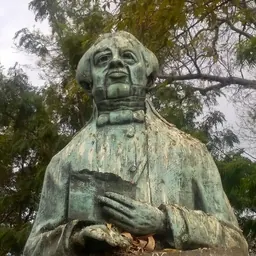
Statues and busts of Quintana Roo can be found around the country. There are statues in Mérida, Yucatán; Chetumal, Quintana Roo; Solidaridad, Quintana Roo; Paseo de la Reforma, Mexico City; and busts on Isla Mujeres and Cozumel, Quintana Roo.
His name was given to a public library in Mexico City. Numerous roads and schools have been named for him throughout Mexico. He was featured on the MXP$20,000 and MXN$20 bills.
Don’t just read it —
keep it.
Full-length biographies made to live with: read them, listen on the way to work, watch them tonight.
- E-book
- Audio
- Video
Instant download · yours to keep · every purchase keeps this site free
Important facts
Family & relationships
People in Andrés Quintana Roo's life
Named in this biography and alive at the same time


Related people
Same field, nearest in time



Contemporaries
People whose lives overlapped Andrés Quintana Roo's


Frequently asked questions
Who was Andrés Quintana Roo?
Mexican politician (1787-1851)
When was Andrés Quintana Roo born?
Andrés Quintana Roo was born on 30 November 1787 in Mérida.
When did Andrés Quintana Roo die?
Andrés Quintana Roo died on 15 April 1851 in Mexico City.
What was Andrés Quintana Roo's occupation?
Andrés Quintana Roo was a politician, writer, lawyer, journalist, minister and poet.
What nationality was Andrés Quintana Roo?
Andrés Quintana Roo was Mexican.
Sources & further reading
· Wikipedia: Andrés Quintana Roo
· DBpedia: Andrés Quintana Roo
Cite this page
APA: Biography.guide. (2026). Andrés Quintana Roo. https://biography.guide/andres-quintana-roo/
MLA: "Andrés Quintana Roo." Biography.guide, https://biography.guide/andres-quintana-roo/.
Chicago: "Andrés Quintana Roo." Biography.guide. https://biography.guide/andres-quintana-roo/.
Data last updated: 2026-09-20 · Spot an error? Report a correction.
Page generated 2026-09-27 05:27 UTC