
About Andrei Snezhnevsky
Lived 1904 – 1987 (aged 83). Andrei Snezhnevsky was a Russian psychiatrist and university teacher, known for Pavlovian session, Political abuse of psychiatry in the Soviet Union and Sluggish schizophrenia.
Andrei Vladimirovich Snezhnevsky (; – 12 July 1987) was a Soviet psychiatrist whose name was lent to the unbridled broadening of the diagnostic borders of schizophrenia in the Soviet Union. He coined the term sluggish schizophrenia, an embodiment of history of repressive psychiatry, and a direct participant in psychiatric repression against dissidents.
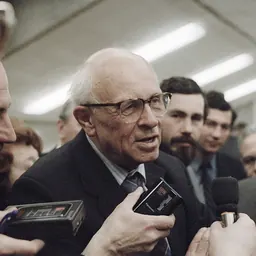
He was an academician of the USSR Academy of Medical Sciences, the director of the Serbsky Institute for Forensic Psychiatry (1950–1951), Despite his power and virtual monopolies on textbooks and conferences, some prominent Soviet doctors were unwilling to accept Snezhnevsky's methods, such as Iosif Polishchuk in Kyiv, and Fyodor Detengof in Dushanbe. He was charged with cynically developing a system of diagnosis which could be bent for political purposes Some of Snezhnevsky's employees say that one day in a selected auditorium, when discussing the situation in the country, he also gave the diagnosis of sluggish schizophrenia to Andrei Sakharov in absentia. As Oleh Wolansky noted, professor Snezhnevsky did not hesitate to act against principles of the Hippocratic Oath. On the covert orders of the KGB, thousands of social and political reformers—Soviet "dissidents"—were incarcerated in mental hospitals after being labelled with diagnoses of "sluggish schizophrenia", a disease fabricated by Snezhnevsky and "Moscow school" of psychiatry. The belief that career development depended on loyalty to the Party and that the Party and its interests were cardinal can partly explain why Snezhnevsky, who earnestly defended the rights of his patients at the frontline hospital during the massive destruction of World War II, also employed his scientific regalia and academic title to legitimate the psychiatric confinement of dissenters. However, Alexander Tiganov, a pupil of Snezhnevsky and full member of the Russian Academy of Medical Sciences, believes his teacher was honest in his diagnosing dissenters. In 2011, Tiganov said it was rumored that Snezhnevsky took pity on dissenters and gave them a diagnosis required for placing in a special hospital to save them from a prison, but it was not true, he honestly did his medical duty.
Discredit at the Royal College In 1980, the Special Committee on the Political Abuse of Psychiatry, established by the Royal College of Psychiatrists in 1978, charged Snezhnevsky with involvement in the abuse and recommended that Snezhnevsky, who had been honoured as a Corresponding Fellow of the Royal College of Psychiatrists, be invited to attend the college's Court of Electors to answer criticisms because he was responsible for the compulsory detention of celebrated dissident, Leonid Plyushch. Instead Snezhnevsky chose to resign his Fellowship. a concept long attributed to Snezhnevky but in fact introduced by John Hughlings Jackson and John Russell Reynolds. The concept came to be increasingly used in schizophrenia research and classification since the 1970s, citing his colleague I.F. Ovchinnikov that the symptoms appear to exist "as if on two levels".
The American Psychiatric Association at its annual meeting held in San Francisco in 1970 honored Snezhnevsky by naming him a "distinguished fellow" for his "outstanding contribution to psychiatry and related sciences."
Snezhnevsky created his own school in psychiatry. The disciples of his school are Ruben Nadzharov, Taksiarkhis Papadopulos, Gregory Rotstein, Moisey Vrono, Marat Vartanyan, Nikolay Zharikov, Anatoly Anufriev, Nikolay Shumsky, Alexander Tiganov, Irina Shakhmatova-Pavlova, Anatoly Smulevich. Doctors who wished to gain more knowledge were unable to do so, because all textbooks and handbooks on psychiatry described only the views of Snezhnevsky's school.
According to Moscow psychiatrist Alexander Danilin, the so-called "nosological" approach in the Moscow psychiatric school established by Snezhnevsky boiled down to the ability to make a single diagnosis, schizophrenia. Such psychiatry, said Danilin, is not science but a system of opinions to which people by the thousands fell victim. Millions of lives were disabled by virtue of the concept "sluggish schizophrenia" introduced by Snezhnevsky, whom Danilin called a state criminal. However, the founder of the Moscow Helsinki Group Yuri Orlov has the opinion that Snezhnevsky did not willingly participate in the political abuse of psychiatry, and that the real criminal was Georgy Morozov, the director of the Serbsky Institute, who collaborated with the KGB since his students days.
St Petersburg academic psychiatrist professor Yuri Nuller notes that the concept of Snezhnevsky's school allowed psychiatrists to consider, for example, schizoid psychopathy and even schizoid character traits as early, delayed in their development, stages of the inevitable progredient process, rather than as personality traits inherent to the individual, the dynamics of which might depend on various external factors. disregarded the findings of the World Psychiatric Association and the later avowal of Soviet psychiatrists themselves and instead claimed that there were no political abuses of psychiatry in the Soviet Union. He asserted that Snezhnevsky was wrongly condemned by critics and argued that it was time for psychiatry in the Western countries to reconsider the accounts of political abuse of psychiatry in the USSR in the hope of discovering that Soviet psychiatrists were more deserving of sympathy than condemnation.
Helen Lavretsky supposes that a totalitarian regime, the lack of a democratic tradition in Russia, and oppression and "extermination" of the best psychiatrists during the 1930–50 period prepared the ground for the abuse of psychiatry and Russian-Soviet concept of schizophrenia.
Awards He was honored with the title of a Hero of Socialist Labour, two Orders of Lenin, four Orders of the Red Banner of Labour, and the USSR State Prize.
Death Having learnt of his diagnosis of lung cancer and facing his death within a few years, Snezhnevsky started lamenting over his making a lot of blunders at the Pavlovian session and departed from his indisputable tone as to his own concept.
Don’t just read it —
keep it.
Full-length biographies made to live with: read them, listen on the way to work, watch them tonight.
- E-book
- Audio
- Video
Instant download · yours to keep · every purchase keeps this site free
Important facts
People in Andrei Snezhnevsky's life
Named in this biography and alive at the same time




Related people
Same field, nearest in time



Contemporaries
People whose lives overlapped Andrei Snezhnevsky's


Frequently asked questions
Who was Andrei Snezhnevsky?
soviet psychiatrist (1904–1987)
When was Andrei Snezhnevsky born?
Andrei Snezhnevsky was born on 7 May 1904 in Kostroma.
When did Andrei Snezhnevsky die?
Andrei Snezhnevsky died on 12 July 1987 in Moscow.
What was Andrei Snezhnevsky's occupation?
Andrei Snezhnevsky was a psychiatrist and university teacher.
What was Andrei Snezhnevsky known for?
Andrei Snezhnevsky was known for Pavlovian session, Political abuse of psychiatry in the Soviet Union, Sluggish schizophrenia and Struggle against political abuse of psychiatry in the Soviet Union.
What nationality was Andrei Snezhnevsky?
Andrei Snezhnevsky was Russian.
Sources & further reading
· Wikipedia: Andrei Snezhnevsky
Cite this page
APA: Biography.guide. (2026). Andrei Snezhnevsky. https://biography.guide/andrei-snezhnevsky/
MLA: "Andrei Snezhnevsky." Biography.guide, https://biography.guide/andrei-snezhnevsky/.
Chicago: "Andrei Snezhnevsky." Biography.guide. https://biography.guide/andrei-snezhnevsky/.
Data last updated: 2026-09-20 · Spot an error? Report a correction.
Page generated 2026-09-27 05:05 UTC