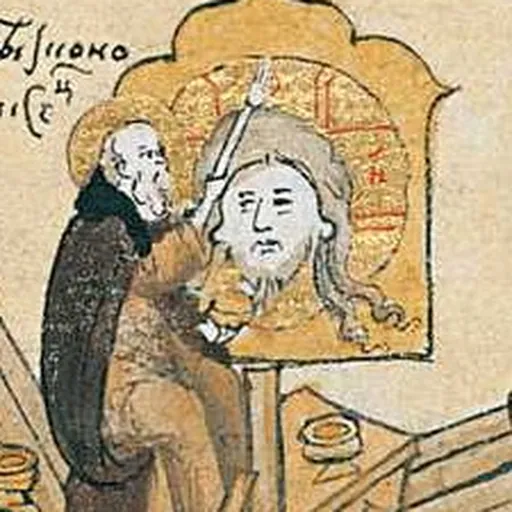
About Andrei Rublev
Lived 1360 – 1428 (aged 67–68). Andrei Rublev was a Russian painter, iconographer, illuminator and monk.
Andrei Rublev (, ; ) was a Russian artist considered to be one of the greatest medieval Russian painters of Orthodox Christian icons and frescoes. He is revered as a saint in the Eastern Orthodox Church, and his feast day is 29 January.
Early life Little information survives about his life; even where he was born is unknown. He probably lived in the Trinity Lavra of St. Sergius, near Moscow, under Nikon of Radonezh, who became hegumen after the death of Sergius of Radonezh in 1392. The first mention of Rublev is in 1405, when he decorated icons and frescos for the Cathedral of the Annunciation of the Moscow Kremlin, in company with Theophanes the Greek and Prokhor of Gorodets. His name was the last of the list of masters, as the junior both by rank and by age. Theophanes was an important Byzantine master, who moved to Russia and is considered to have trained Rublev.
Career Chronicles tell us that together with Daniel Chorny he painted the Dormition Cathedral, Vladimir in 1408 as well as the Trinity Cathedral in the Trinity Lavra of St. Sergius between 1425 and 1427. After Daniel's death, Andrei came to Moscow's Andronikov Monastery where he painted his last work, the frescoes of the Saviour Cathedral. He is also believed to have painted at least one of the miniatures in the Khitrovo Gospels.
The only work authenticated as entirely his is the icon of the Trinity (c. 1410). It is based on an earlier icon known as the "Hospitality of Abraham" (illustrating ). Rublev removed the figures of Abraham and Sarah from the scene, and through a subtle use of composition and symbolism changed the subject to focus on the Mystery of the Trinity. On 22 June 2024, the icon was returned to the Holy Trinity Lavra of St. Sergius and installed to its original position on the iconostasis of Holy Trinity Cathedral.
In Rublev's art two traditions are combined: the highest asceticism and the classic harmony of Byzantine mannerism. The characters of his paintings are always peaceful and calm. After some time his art came to be perceived as the ideal of Eastern Church painting and of Orthodox iconography.
Death and legacy Rublev died at Andronikov Monastery between 1427 and 1430. Rublev's work influenced many artists including Dionisy. The Stoglavi Sobor (1551) promulgated Rublev's icon style as a model for church painting. Since 1959, the Andrei Rublev Museum at the Andronikov Monastery has displayed his and related art.
The Russian Orthodox Church canonized Rublev as a saint in 1988, celebrating his feast day on 29 January and/or on 4 July.
In 1966, Andrei Tarkovsky made a film Andrei Rublev, loosely based on the artist's life. This became the first (and perhaps only) film produced in the Soviet era to treat the artist as a world-historic figure and Christianity as an axiom of Russia's historical identity, during a turbulent period in the history of Russia.
Historian Serge Aleksandrovich Zenkovsky wrote that the names of Andrei Rublev, Epiphanius the Wise, Sergius of Radonezh and Stephen of Perm "signify the Russian spiritual and cultural revival of the late fourteenth and early fifteenth centuries".
Veneration
29 January – commemoration of his death anniversary (Greek Orthodox Church) 12/13 June – feast day, Synaxis of All of Andronikov Monastery (with Andronicus, Sabbas, Alexander, Abbots of Moscow and Daniel the Black, the icon painter) 4 July – main feast day from the list of "Russian saints of Moscow and Vladimir" by Nikodim (Kononov) 6 July – Synaxis of All Saints of Radonezh Synaxis of all saints of Moscow – a movable holiday on the Sunday before 26 August (ROC)
Selected works
Don’t just read it —
keep it.
Full-length biographies made to live with: read them, listen on the way to work, watch them tonight.
- E-book
- Audio
- Video
Instant download · yours to keep · every purchase keeps this site free
Important facts
more
Andrei Rubljoff, Andrey Rublyov, Andreas Rubleff, Andrei Rubljow, Andreĭ Rublev, Andreï Roublev, Andrej Rubljoff, Andréj Rubljów, Andrej Riublev, Andrej Rubljow, Andrej Rubljov, Andre Roublov, Andreev RublevPeople in Andrei Rublev's life
Named in this biography and alive at the same time


Related people
Same field, nearest in time



Contemporaries
People whose lives overlapped Andrei Rublev's


Frequently asked questions
Who was Andrei Rublev?
medieval Russian artist (1360s-1428)
When was Andrei Rublev born?
Andrei Rublev was born in 1360 in Grand Principality of Moscow.
When did Andrei Rublev die?
Andrei Rublev died on 17 October 1428 in Andronikov Monastery.
What was Andrei Rublev's occupation?
Andrei Rublev was a painter, iconographer, illuminator and monk.
What nationality was Andrei Rublev?
Andrei Rublev was Russian.
Sources & further reading
Cite this page
APA: Biography.guide. (2026). Andrei Rublev. https://biography.guide/andrei-rublev/
MLA: "Andrei Rublev." Biography.guide, https://biography.guide/andrei-rublev/.
Chicago: "Andrei Rublev." Biography.guide. https://biography.guide/andrei-rublev/.
Data last updated: 2026-09-20 · Spot an error? Report a correction.
Page generated 2026-09-27 05:10 UTC