
Andreas Papadakis
British academic and publisher
About Andreas Papadakis
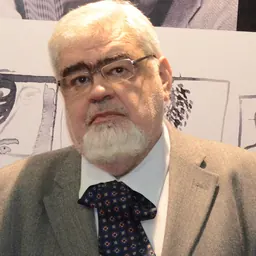
Lived 1938 – 2008 (aged 69). Andreas Papadakis was a British art historian, architectural historian and publisher.
Andreas Constantine Papadakis FLS (17 June 1938 – 10 June 2008) was a Cypriot-born British academic, entrepreneur and leading figure in the field of architectural publishing. He opened the Academy Bookshop in Holland Street, Kensington, in 1964 and moved into publishing as Academy Editions in 1968. From then until 1990, when he sold the company to VCH Germany (now part of John Wiley) he published more than a thousand titles mainly on art, architecture and the decorative arts. He was the first to publish (in the US - Rizzoli and latter St. Martin's Press) many international architects in the Architectural Monographs series, which included Alvar Aalto (No 4), Michael Graves (No 5), Edwin Lutyens (No 6), John Soane (No 8), Terry Farrell (No 9), Richard Rogers (No 10), Mies van der Rohe (No 11), Hassan Fathy (No 13), Tadao Ando (No 14), Daniel Libeskind (No 16), etc.; and Victor Arwas's Art Deco, first published in 1980, remains the standard work on the subject.
Early life Papadakis was born in Nicosia, Cyprus on 17 June 1938 and relocated to London in 1956. He obtained a DIC from Imperial College and a PhD from Brunel University. In 1964 he bought a house in Holland Street, Kensington without realising that the shop (then a dry cleaners) on the ground floor could not be used for residential purposes. The controversy increased with the publication of Charles Jencks's The Language of Post-Modern Architecture in 1977, which was in its sixth edition by the time he sold Academy in 1990.
Both Architectural Design and Academy Editions continued to publish Post-Modern, Classical and Deconstructivist projects throughout the 1980s while Papadakis himself actively fostered the pluralist debate through seminars, conferences and exhibitions at the Polytechnic of Central London, the Architectural Association, the RIBA, the German Architecture Museum in Frankfurt, and through his Academy Forums at the Tate Gallery and the Royal Academy of Arts, where he also founded the annual Architecture Lecture.
Papadakis Publisher and restoration projects In 1997, Papadakis founded a new publishing house, Papadakis Publisher, with his daughter Alexandra. In addition to books on architecture and the decorative arts the company broadened its scope to include books on natural science, including the acclaimed series Pollen, Seeds and Fruit in association with the Royal Botanic Gardens, Kew, leading to his election as a fellow of the Linnean Society. Pollen and Seeds were awarded a joint gold medal by the American Independent Publishers' Association in 2006 as Outstanding Books of the Year, and his first science book Why the Lion Grew its Mane was long-listed by the Royal Society in 2007. In 1987 Papadakis bought Church Island in the Thames and commissioned Dr. Basil Al Bayati, an architect whose books Architect and Recent Works he had published, to design a house for him. "For his luxury mansion on his Greek-island-in-the-Thames, the great man chose not Michael Graves, one of the deconstructivists or even CZWG, but pragmatic classicist Basil Al Bayati, whom he instructed to design a country house in the English turn-of-the-century manner." The plan of the house is based on multiple units of structural geometrical forms and utilises extensive brickwork in a postmodern, art & craft style. It was "designed in a vernacular manner, using building materials similar to those traditionally used in the area."
In 1988, Church Island House was exhibited at the German Architecture Museum in Frankfurt in an exhibition titled the Architecture of Pluralism that included work by James Gowan, Terry Farrell, Charles Jencks and some twenty other internationally recognised architects.
In 2007 he purchased Monkey Island Hotel in Bray, Berkshire, but died a few months afterwards. Alexandra Papadakis continued to run the hotel until it was sold in 2015.
Don’t just read it —
keep it.
Full-length biographies made to live with: read them, listen on the way to work, watch them tonight.
- E-book
- Audio
- Video
Instant download · yours to keep · every purchase keeps this site free
Important facts
People in Andreas Papadakis's life
Named in this biography and alive at the same time







Related people
Same field, nearest in time

Contemporaries
People whose lives overlapped Andreas Papadakis's



Frequently asked questions
Who was Andreas Papadakis?
British academic and publisher (1938–2008)
When was Andreas Papadakis born?
Andreas Papadakis was born on 17 June 1938 in Nicosia.
When did Andreas Papadakis die?
Andreas Papadakis died on 10 June 2008.
What was Andreas Papadakis's occupation?
Andreas Papadakis was an art historian, architectural historian and publisher.
What nationality was Andreas Papadakis?
Andreas Papadakis was British.
Sources & further reading
· Wikipedia: Andreas Papadakis
Cite this page
APA: Biography.guide. (2026). Andreas Papadakis. https://biography.guide/andreas-papadakis/
MLA: "Andreas Papadakis." Biography.guide, https://biography.guide/andreas-papadakis/.
Chicago: "Andreas Papadakis." Biography.guide. https://biography.guide/andreas-papadakis/.
Data last updated: 2026-09-20 · Spot an error? Report a correction.
Page generated 2026-09-27 05:08 UTC