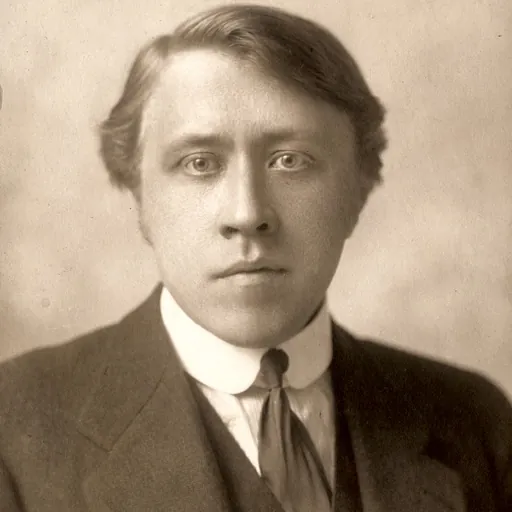
About André Caplet
Lived 1878 – 1925 (aged 46). André Caplet was a French conductor and composer.
André Léon Caplet (; 23 November 1878 – 22 April 1925) was a French composer and conductor of classical music. He was a friend of Claude Debussy who orchestrated several of his compositions, as well as arrangements of several of them for different instruments.
Early life André Caplet was born in Le Havre on 23 November 1878, the youngest of seven children born to a Norman family of modest means. He began studying piano and violin when a child and by the age of 13 performed in the orchestra of the Grand Théâtre there. He entered the Paris Conservatory in 1896 and won several prizes. While a student he supported himself first by playing in dance orchestras in the evening and then by conducting, where had immediate success. After a stint as assistant conductor of the Orchestre Colonne, in 1899 he took over the musical direction at the Théâtre de l'Odéon.
Until the end of 1905, Caplet lived at the French Academy in Rome with the financial support the prize provided, though he took leave for long periods to attend performances in Berlin, Dresden, Hamburg. He secured the appointment through one of its co-founders, the impresario Henry Russell, whose wife Nina became a friend of Caplet during his time in Rome. He accepted the position to enhance his reputation as a conductor and to introduce contemporary French repertoire to the United States; for example, Debussy's L'enfant prodigue, the Children's Corner, Pelléas et Mélisande, and the incidental music to Le Martyre de saint Sébastien. Raoul Laparra's Habañera; Saint-Saens' Samson et Dalila; Louis Aubert's La Forêt Bleue; Humperdinck's Hansel and Gretel; Wagner's Tristan und Isolde and Die Meistersinger. In addition to operas he led the Verdi Requiem and incidental music to stage performances: Bizet's music for Daudet's L'Arlésienne and Fauré's music for Maeterlinck's Pelléas.
World War I At the end of 1914, after he had completed two movements of a work that became Les Prières, Caplet enlisted in the French army and saw combat in the trenches at Verdun. He was wounded in May 1915 and was later promoted to sergeant. In 1917 he completed the third movement and the work premiered that same year in the small church of Ham, Picardy, accompanied by the distant sounds of artillery. His service ended in 1919. On 4 June of that year he married Geneviève Perruchon, a general's daughter who followed his work as a composer closely. They had a son in 1920. (One of Caplet's students there was Albert Stoessel.)
Work with Debussy
He became a close friend of Claude Debussy, sometimes serving as translator, and he orchestrated and wrote parts for Debussy's Le Martyre de saint Sébastien. He also collaborated with Debussy in the orchestration of La boîte à joujoux. In 1911, Caplet prepared an orchestration of Debussy's Children's Corner, which, along with his orchestration of Clair de lune from the Suite bergamasque is probably the most widely performed and recorded example of his work.
While Debussy was traveling Europe seeking commissions, Caplet, "The Angel of Corrections" as Debussy called him, would complete orchestrations, make arrangements, and correct proofs. Debussy wrote often to Caplet while working on musical adaptations of The Fall of the House of Usher and The Devil in the Belfry bewailing his inability to properly compose new music.
Death In 1925, Caplet caught a cold and, given how his lungs had been weakened when he was gassed during his military service, developed pleurisy, which proved fatal. He died in Neuilly-sur-Seine (Hauts-de-Seine), a suburb of Paris, on 22 April 1925 at the age of 46. He was buried in Montmartre Cemetery.
His widow conducted many concerts of his music.
In 1926, the sculptor Jacques Zwobada, a native of Neuilly, was commissioned to create a monument to Caplet. This was one of Zwobada's earliest works after he graduated from the École des Beaux-Arts.
Works For voice Voice and piano Viens! ... Une flûte invisible, (Hugo), August 1900 Myrrha, (text by Fernand Beissier) Green, (Verlaine), 1902 Il était une fois, (Richepin), January 1903 Poème de mai (Tu nous souriais), (A. Silvestre), 1902 Dans la fontaine, (P. Gravollet), 1903 Papillons, (P. Gravollet), February 1903 Le Livre rose, (P.J. Pain), 1898–1901 1. Le livre ou je veux lire 2. Premier prix 3. Les pleurs de bébé 4. Le furet du bois, mesdames Chanson d'automne, (A. Silvestre), 1900 Paroles à l'absente, G. Jean-Aubry, 1908 1. Préludes 2. Ce sable fin et fuyant 3. Angoise Les Prières, 1914–1917, (also for harp and string quartet) 1. Oraison dominicale 2. Salutation angélique 3. Symbole des apôtres Le vieux coffret, (R. de Gourmont), 1914–1917 1. Songe 2. Berceuse 3. In una selva oscura 4. Forêt En regardant ces belles fleurs, (C. d'Orleans), October 1914 Nuit d'automne, (H. de Regnier), 9 March 1915 Prière normande, (J. Hebertot), 1916 Solitude, (J. Ochse), 1915 Quand reverrai-je, hélas!..., (J. du Bellay), 27 August 1916, (published by Lyra with harp accompaniment) La croix douloureuse, (R.P. Lacordaire), for the armed forces Détresse!..., (H. Charasson), 9 November 1918 Trois Fables, (La Fontaine), 1919 1. Le corbeau et le renard 2. La cigale et la fourmi 3. Le loup et l'agneau Le Pain quotidien, (15 exercises), 1920 Cinq Ballades françaises, (P. Fort) 1920 1.) Cloche d'aube 2. La ronde 3. Notre chaumière en Yveline 4. Songe d'une nuit d'été 5. L'adieu en barque L'hymne à la naissance du matin, (reduction, P. Fort), November 1920 La cloche felée, (C. Baudelaire), January 1922 La mort des pauvres, (C. Baudelaire), June 1922 Le miroir de Jésus, (reduction) (H. Gheon), Summer 1923 La part à Dieu, (chanson populaire), 1925
Voice and organ Pie Jesu, March 1919 Panis angelicus, 21 June 1919 Pater noster, November 1919 Tu es sacerdos, 27 July 1920 Les prières, 1914-1917
Voice and flute Corbeille de fruits, (R. Tagore), September 1924 Écoute mon coeur, 19 September 1924
Voice and harp Sonnet: "Doux fut le trait", (Ronsard), 8 April 1924, published by Lyra with Quand reverrai-je ...
Voice and orchestra Myrrha, scène lyrique, (1er Grand Prix de Rome), (F. Beissier), 1901 Il était une fois, (J. Richepin) Paroles a l'absente, (G. Jean-Aubry), 1908 1. Préludes 2. Angoisse Le vieux Coffret, (R. de Gourmont) La croix douloureuse, (R.P. LaCordaire) Détresse!..., (H. Carasson) Hymne à la naissance du matin, (P. Fort), November 1920 Les prières (voice, harp, string quartet) (see under voice and piano)
A cappella chorus Messe à trois voix, 1919-1920 1. Kyrie eleison 2. Gloria 3. Sanctus 4. Agnus Dei 5. O Salutaris Inscriptions champêtres, (R. de Gourmont), August 1914
Mixed chorus and orchestra Été, (V. Hugo), 1899 Paques citadines, (C. Spinelli), 1900 (published 1920)
Orchestral works Suite d'orchestre (sur des mélodies populaires persanes), 1900 Légende (suite symphonique pour harpe chromatique, alto saxophone et instruments à cordes), 1905 (precursor to Conte Fantastique) Étude symphonique Le masque de la mort rouge pour harpe chromatique principale, 1908 Marche solennelle pour le centenaire de la Villa Medicis, 1903 Salammbô, (poème symphonique) 1902 Marche heroïque de la Ve Division, pour musique militaire, 1917 Epiphanie, fresque musicale pour violoncelle principal et orchestre, 1923
Chamber music Small ensembles Quintette pour piano, flûte, hautbois, clarinette et basson, 1898 1. Allegro 2. Adagio 3. Scherzo 4. Finale Suite persane for double quintet (2 flûtes, 2 hautbois, 2 clarinettes, 2 bassons, and 2 cors), 1900, original version, also for orchestra 1. Scharki, (allegretto) 2. Nihavend, (andantino) 3. Iskia Samaisi, (vivo) Septuor, pour quatour a cordes et 3 voix feminines, 1909 Sonate pour piano, voix, violoncelle, 1919 Conte fantastique or The Masque of the Red Death d'après Poe pour harpe à pedales et quatour à cordes, (published 1924) Le miroir de Jésus pour voix principale, 3 voix accompagnantes, quatour a cordes et harpe, (original version: Été), 1923 Sonata da chiesa pour violon et orgue, 1924 1. Quiet 2. Interieur 3. Alleluia Impressions d’automne – Elégie pour alto saxophone, hautbois, 2 clarinettes, basson, harpe, orgue et 2 violoncelles, 1905
Cello and piano Élegie, 1903 Allegresse, 1903 Épiphanie Improvisations
Flute and piano Rêverie et Petite valse, 1897 dedicated to Barrère and incorporated as Nos. 2 and 5 in Feuillets d'album Feuillets d'album, 1901 Viens! Une flûte invisible, 1900, voice, flute, piano
Piano, two hands Menuet dans le style ancien, 1897 Deux pièces, 1900
Piano, four hands Prelude, 1899 Do, Re, Mi, Fa, Sol (petites pièces faciles), 1901 Un tas de petites choses, 1919
Harp solo Deux Divertissements (1. à la française, 2. à l'espagnole'), 1924, published 1925, Durand
Arrangements of works by Debussy For various numbers of pianos and players Images 1. Rondes de Printemps 2. Gigues 3. Ibéria La Mer Le martyre de Saint Sébastien, voix et piano La mer, 2 pianos, 6 hands
For orchestra Children's Corner (1911) Pagodes Clair de lune from Suite bergamasque Le martyre de Saint Sébastien, Fragments symphoniques (1911)
Other arrangements Chabrier's Danse villageoise for seven winds
Don’t just read it —
keep it.
Full-length biographies made to live with: read them, listen on the way to work, watch them tonight.
- E-book
- Audio
- Video
Instant download · yours to keep · every purchase keeps this site free
Important facts
People in André Caplet's life
Named in this biography and alive at the same time

Related people
Same field, nearest in time


Contemporaries
People whose lives overlapped André Caplet's




Frequently asked questions
Who was André Caplet?
French composer (1878–1925)
When was André Caplet born?
André Caplet was born on 23 November 1878 in Rue Robert de la Villehervé.
When did André Caplet die?
André Caplet died on 22 April 1925 in Boulevard d'Inkermann.
What was André Caplet's occupation?
André Caplet was a conductor and composer.
What nationality was André Caplet?
André Caplet was French.
Sources & further reading
Cite this page
APA: Biography.guide. (2026). André Caplet. https://biography.guide/andre-caplet/
MLA: "André Caplet." Biography.guide, https://biography.guide/andre-caplet/.
Chicago: "André Caplet." Biography.guide. https://biography.guide/andre-caplet/.
Data last updated: 2026-09-22 · Spot an error? Report a correction.
Portrait: Wikimedia Commons · author & licence
Page generated 2026-09-27 05:03 UTC