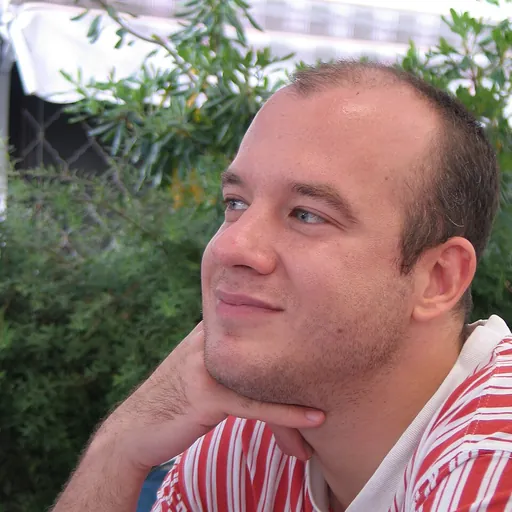
About András Gerevich
Born 1976. András Gerevich is a Hungarian poet, screenwriter, literary translator, writer, journalist and translator.
András Tibor Gerevich (; born 4 December 1976 His first book of translation (Strange Fruit), an anthology of translation of Seamus Heaney's poems was published in 1997. He has also translated work of poets like Frank O'Hara, Charles Bernstein, and Jericho Brown into Hungarian. He is openly gay and is often described as the “first openly gay poet in Hungary”.
Life and career Gerevich was born in Budapest, Hungary on 4 December 1976. He grew up in Budapest, Dublin and Vienna. He graduated with a major in English Language and Literature and a minor in Aesthetics from ELTE School of English and American Studies. Later he studied Creative Writing at Dartmouth College, in the a United States, on a Fulbright Scholarship. He received his third degree in screenwriting from the National Film and Television School (NFTS) in the UK.
In 2004, he was an assistant producer for the radio program Poetry by Post for the BBC World Service in London. He edited the literary journals Kalligram, Chroma and contributed to Clamantis: The MALS Journal. He has also written articles for magazines like Magyar Narancs, Élet és Irodalom, and PRAE. In 2026, during the spring semester, Gerevich served as a Fulbright visiting professor of poetry at the Guarini School of Graduate and Advanced Studies, Dartmouth College.
Gerevich's first book of Poetry (Handing Over the Leash) was first Published in 1997. Since then four more volumes of his poetry has been published. In 2010, his poems were part of Arc Publications' English-Hungarian bilingual anthology ″New Order: Hungarian Poets of the Post 1989 Generation″, which was edited by George Szirtes. In 2017, Andrew Fentham received the Stephen Spender Prize for the translation of his poem " (Balaton Accident)" into English. Gerevich himself has translated many English poems and books into Hungarian. His first book of translation (Strange Fruit), an anthology of translation of Seamus Heaney's poems was published in 1997. His other translations include, The Man in the High Castle by Philip K. Dick and Catching the Big Fish by David Lynch. Imre Payer of PRAE, praised "intentional free verse form" and "metaphor-less verse speech" in his poetry. He further wrote, "The emphasis on visuality and new sensibility is also proven by the fact that András Gerevich is especially good at composition. He knows and has mastered classical topical and acoustic tech very well."
His poetry features homoerotic themes. He also wrote homoerotic poetry under several pseudonyms for magazines like Mások. Norman Jope of Tears in the Fence, wrote, "Gerevich, who apparently divides his time between Budapest and the English-speaking world, is much more than a poet of political protest alone - his work, on the whole, is characterized by a direct sensuality that you don't have to be gay to enjoy This defiant celebration of gayness is a perfect riposte to the family fascists, as in 'Marmaris.' On the other hand, writing about family matters doesn't necessarily make one a purveyor of so-called 'family values'." Gerevich in an interview, said, “All my love poems have been written to men. Only in Hungarian, the pronouns do not have genders like in most languages. The third person singular is neutral; there is no difference between he and she.“
Szilárd Borbély in his review of Gerevich's second book (Men, 2005) for Élet és Irodalom, wrote, "András Gerevich's second volume is about love between men in such a way that it also hides the code of autobiographical speech in the pieces of the volume. He also strongly stylizes, that is, he searches for a literary form, writes poems, but in a way that moves on the border of personal and allegorical translatability. In his stylized poetic language, which moves on the border between prose and lyric, the speaking minds speak in a language of omissions broken into stanzas. It becomes a true lyric by unraveling deep trauma through a system of symbols."
His 2009 collection of poems, Friends , garnered critical acclaim. Viktória Radics in her review of Barátok, wrote, “András Gerevich, who until now attracted attention with his openness about sex between men in poetry, has now crossed the line of breaking the taboo. These current poems are shockingly good not because they write about the strange erotic-sexual experiences and bizarreness of gay relationships, but because they touch on the height and depth of love, sometimes even capture it.“ in the poems the homosexual theme is objectified in such a way that the experience material of the lyrical self holds exciting possibilities even for the reader who is not familiar with the homosexual experience.“
His 2022 poetry collection (Breathing Exercises) was described as a “shift from the theme of sex and physicality to ecopoetry and biopoetics.“ However, László Bedecs in his review in Jelenkor, wrote that "the title (and the titular poem) is still a cry" and "the intimate sphere just mentioned becomes more and more narrow due to external pressure". He further wrote that "if Gerevich's feelings are branded as something from which the children must be protected, i.e. as something bad, threatening, then it is no wonder that in the poem also cries out for space and air. Or you do breathing exercises to help you calm down. This, too, makes this volume a part of today's political discourse."
Works
Don’t just read it —
keep it.
Full-length biographies made to live with: read them, listen on the way to work, watch them tonight.
- E-book
- Audio
- Video
Instant download · yours to keep · every purchase keeps this site free
Important facts
People in András Gerevich's life
Named in this biography and alive at the same time





Related people
Same field, nearest in time



Contemporaries
People whose lives overlapped András Gerevich's



Frequently asked questions
Who is András Gerevich?
Hungarian poet, screenwriter
When was András Gerevich born?
András Gerevich was born on 4 December 1976 in Budapest.
What is András Gerevich's occupation?
András Gerevich is a poet, screenwriter, literary translator, writer, journalist and translator.
What nationality is András Gerevich?
András Gerevich is Hungarian.
Sources & further reading
Cite this page
APA: Biography.guide. (2026). András Gerevich. https://biography.guide/andras-gerevich/
MLA: "András Gerevich." Biography.guide, https://biography.guide/andras-gerevich/.
Chicago: "András Gerevich." Biography.guide. https://biography.guide/andras-gerevich/.
Data last updated: 2026-09-21 · Spot an error? Report a correction.
Portrait: Wikimedia Commons · author & licence
Page generated 2026-09-27 05:00 UTC