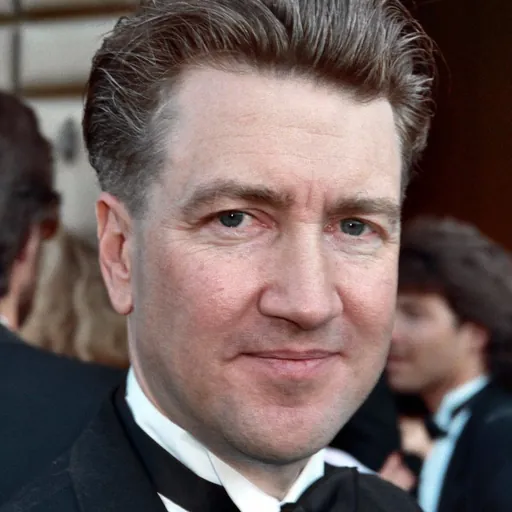
About David Lynch
Lived 1946 – 2025 (aged 78). David Lynch was an American film director, actor, composer, voice actor, painter and film editor.
David Keith Lynch (January 20, 1946 – January 16, 2025) was an American filmmaker and artist. He is widely regarded as one of the greatest and most influential filmmakers in the history of cinema, with his films often characterized by a distinctive surrealist sensibility that gave rise to the adjective "Lynchian". He is often credited with bringing surrealism and experimentalism to mainstream media in the late 20th century. He also co-wrote (with Robert Engels) and directed its film prequel Twin Peaks: Fire Walk with Me. He directed music videos for Donovan, Interpol, Chris Isaak, X Japan, Moby, and Nine Inch Nails, and commercials for Dior, Gucci, Yves Saint Laurent, Jil Sander, Calvin Klein, the PlayStation 2, and the New York City Department of Sanitation. His acting roles included Gordon Cole on Twin Peaks, the voice of Gus on the animated sitcom The Cleveland Show (2010–2013), Jack Dahl on the sitcom Louie (2012), Howard in the drama film Lucky (2017), and film director John Ford in Steven Spielberg's drama film The Fabelmans (2022).
Lynch also worked as an animator, author, cartoonist, furniture designer, musician, sound designer, editor, photographer, and sculptor. A longtime practitioner of Transcendental Meditation, he founded the David Lynch Foundation to fund meditation lessons for at-risk populations. Lynch was a lifelong chain smoker whose emphysema was exacerbated when he was evacuated from his home in Los Angeles due to the January 2025 Southern California wildfires. He died at his daughter Jennifer's home soon thereafter.
Early life and education
quote=My childhood was elegant homes, tree-lined streets, the milkman, building backyard forts, droning airplanes, blue skies, picket fences, green grass, cherry trees. Middle America as it's supposed to be. But on the cherry tree there's this pitch oozing outsome black, some yellow, and millions of red ants crawling all over it. I discovered that if one looks a little closer at this beautiful world, there are always red ants underneath. Because I grew up in a perfect world, other things were a contrast. — the son of English-language tutor Edwina "Sunny" Lynch (née Sundholm) and USDA research scientist Donald Walton Lynch. Lynch was also of German descent through his mother, as well as of English, Irish and Scottish descent through his father. He recalled of his father, "He would drive me through the woods in his green Forest Service truck, over dirt roads, through the most beautiful forests where the trees are very tall and shafts of sunlight come down and in the mountain streams the rainbow trout leap out and their little trout sides catch glimpses of light. Then my father would drop me in the woods and go off. It was a weird, comforting feeling being in the woods." He was raised Presbyterian.
The family often moved around according to where the USDA assigned Lynch's father. When Lynch was two months old, they moved to Sandpoint, Idaho, where his brother John was born two years later; they then moved to Spokane, Washington, where his sister Martha was born. The family subsequently lived in Durham, North Carolina; Boise, Idaho; and Alexandria, Virginia.
At Francis C. Hammond High School in Alexandria, Lynch did not excel academically and had little interest in schoolwork, but was popular with other students. After leaving, he decided that he wanted to study painting in college, which he began at the Corcoran School of the Arts and Design in Washington, D.C. In 1964, he transferred to the School of the Museum of Fine Arts in Boston, where his roommate was future musician Peter Wolf. He dropped out after a year, later saying he "was not inspired at all in that place". He then traveled around Europe with his friend Jack Fisk, who was similarly unhappy with his studies; the two hoped to train at the school of Austrian painter Oskar Kokoschka. But upon reaching Salzburg, they found that Kokoschka was not available; having planned to spend three years in Europe, they found themselves disillusioned and returned to the U.S. after just two weeks. In Philadelphia, Lynch began a relationship with a fellow student, Peggy Reavey, whom he married in 1967. The next year, their daughter Jennifer was born. Peggy later said Lynch "definitely was a reluctant father, but a very loving one. Hey, I was pregnant when we got married. We were both reluctant." which at the time he felt was a lot of money, to produce Six Men Getting Sick. This led to a commission from one of his fellow students, the wealthy H. Barton Wasserman, who offered him $1,000 to create a film installation in his home. Spending $478 of that on the second-hand Bolex camera "of [his] dreams", Lynch produced a new animated short but, upon getting the film developed, realized that the result was a blurred, frameless print. He later said, "So I called up [Wasserman] and said, 'Bart, the film is a disaster. The camera was broken and what I've done hasn't turned out.' And he said, 'Don't worry, David, take the rest of the money and make something else for me. Just give me a print.' End of story." where he began studying filmmaking at the AFI Conservatory, a place he later called "completely chaotic and disorganized, which was great ... you quickly learned that if you were going to get something done, you would have to do it yourself. They wanted to let people do their thing." Not long into Eraserheads production, Lynch and Peggy amicably separated and divorced, and he began living full-time on set. In 1977, Lynch married Jack Fisk's sister Mary Fisk. Lynch tried to get it entered into the Cannes Film Festival, but while some reviewers liked it, others felt it was awful, and it was not selected for screening. Reviewers from the New York Film Festival also rejected it, but it screened at the Los Angeles Film Festival, where Ben Barenholtz, the distributor of the Elgin Theater, heard about it. Stanley Kubrick said it was one of his all-time favorite films. Isabella Rossellini and Kyle MacLachlan in a publicity still for Blue Velvet (1986). Lynch was still contractually obligated to produce two other projects for De Laurentiis, the first a planned sequel to Dune, which due to the film's failure never went beyond the script stage.
Blue Velvet was a critical and commercial success, winning the National Society of Film Critics Award for Best Film and earning Lynch his second Academy Award nomination for Best Director. David Thomson recalls seeing it for the first time: "The occasion stood as the last moment of transcendence I had felt at the movies—until The Piano. What I mean by that is a kind of passionate involvement with both the story and the making of a film, so that I was simultaneously moved by the enactment on the screen and by discovering that a new director had made the medium alive and dangerous again."
1987–1997: Established career
Lynch met television producer Mark Frost and they started working together on a biopic of Marilyn Monroe based on Anthony Summers's book The Goddess: The Secret Lives of Marilyn Monroe, but it never got off the ground. A second season of 22 episodes went into production, but ABC executives believed that public interest in the show was declining. The network insisted that Lynch and Frost reveal the identity of Laura's killer prematurely, which Lynch grudgingly agreed to do, After identifying the murderer and moving from Thursday to Saturday night, Twin Peaks continued for several more episodes, but was canceled after a ratings drop. Lynch, who disliked the direction that writers and directors took in the later episodes, directed the final episode. He ended it with a cliffhanger, of which he later said, "That's not the ending. That's the ending that people were stuck with."
1990 was Lynch's annus mirabilis: Wild at Heart won the Palme d'Or at Cannes, and the television series Twin Peaks was proving a smash hit with audiences across the world. The musical/performance piece Industrial Symphony No. 1, which Lynch had staged with Angelo Badalamenti at the Brooklyn Academy of music, had spawned the album Floating into the Night and launched singer Julee Cruise. Five one-man exhibitions between 1989 and 1991 emphasized Lynch's roots in fine art and painting, and a rash of ads (including a teaser trailer for Michael Jackson's 'Dangerous' tour) confirmed the demand for the Lynch touch ... In an unlikely scenario for the maker of Eraserhead, Lynch had become an influential and fashionable brand name. — Christopher Rodley Calling its plot a "strange blend" of "a road picture, a love story, a psychological drama and a violent comedy", Lynch departed substantially from the novel, changing the ending and incorporating numerous references to The Wizard of Oz. When it won the prize, audience members booed Lynch and the film.
After Wild at Hearts success, Lynch returned to the world of the canceled Twin Peaks, this time without Frost, to make a film that was primarily a prequel but also in part a sequel. Lynch said, "I liked the idea of the story going back and forth in time."
Meanwhile, Lynch worked on some new television shows. He and Frost created the comedy series On the Air (1992), which was canceled after three episodes aired, and he and Montgomery created the three-episode HBO miniseries Hotel Room (1993) about events that happen in one hotel room on different dates.
After his unsuccessful TV ventures, Lynch returned to film. In 1997, he released the non-linear noiresque Lost Highway, which was co-written by Barry Gifford and stars Bill Pullman and Patricia Arquette. The film failed commercially and received a mixed response from critics. Lynch purchased several properties in the Hollywood Hills, subsequently forming the David Lynch Compound, in the early 1990s. The site became his primary residence; it housed an editing bay, recording studio, and was the filming location for several of his films. Lynch then began work on a film from a script by Mary Sweeney and John E. Roach, The Straight Story, based on the true story of Alvin Straight (Richard Farnsworth), an elderly man from Laurens, Iowa, who goes on a 300-mile journey to visit his sick brother (Harry Dean Stanton) in Mount Zion, Wisconsin, by riding lawnmower. Asked why he chose this script, Lynch said, "that's what I fell in love with next", and expressed his admiration of Straight, describing him as "like James Dean, except he's old". It was named one of the best films of the year by The New York Times; Janet Maslin wrote: "Somehow it took David Lynch to lead audiences past the ultimate frontier: into a G-rated parable of spirituality and decency, seen from the unfashionable vantage point of old age. Mr. Lynch accomplished the unthinkable by putting Richard Farnsworth, in a devastatingly real and rock-solid performance, on a lawnmower at five miles per hour and still building enough drama and emotion for a great chase. Burned out on the surreal and the grotesque, Mr. Lynch faced down inevitable realities about aging and conscience."
alt=Four people stand beside each other facing off-camera, from left to right: a blonde woman wearing a tan dress suit, a man with salt-and-pepper hair wearing a blazer over white shirt and slacks, a brunette wearing red pants and a black top, and a dark-haired man wearing a black leather jacket over black clothes. In 1999, Lynch approached ABC again with ideas for a television drama. The network gave Lynch the go-ahead to shoot a two-hour pilot for the series Mulholland Drive, but disputes over content and running time led to the project being shelved indefinitely. With $7 million from the French production company StudioCanal, Lynch completed the pilot as a film, Mulholland Drive. The film, a nonlinear surrealist tale of Hollywood's dark side, stars Naomi Watts, Laura Harring, and Justin Theroux. It performed relatively well at the box office worldwide and was a critical success, earning Lynch Best Director at the 2001 Cannes Film Festival (shared with Joel Coen for The Man Who Wasn't There) and Best Director from the New York Film Critics Association. He also received his third Academy Award nomination for Best Director. In 2016, the film was named the best film of the 21st century in a BBC poll of 177 film critics from 36 countries. Roger Ebert, who had dismissed much of Lynch's earlier work, wrote: "At last his experiment doesn't shatter the test tubes. The movie is a surrealist dreamscape in the form of a Hollywood film noir, and the less sense it makes, the more we can't stop watching it."
With the rising popularity of the Internet, Lynch decided to use it as a distribution channel, releasing several new series he had created exclusively on his website, davidlynch.com, which went online on December 10, 2001. In 2002, he created a series of online shorts, DumbLand. Intentionally crude in content and execution, the eight-episode series was later released on DVD. The same year, Lynch released a surreal sitcom, Rabbits, about a family of humanoid rabbits. Later, he made his experiments with Digital Video available in the form of the Japanese-style horror short Darkened Room. In 2006, Lynch's feature film Inland Empire was released. At three hours, it is his longest film. Like Mulholland Drive and Lost Highway, it lacks a traditional narrative structure. It stars Laura Dern, Harry Dean Stanton, and Justin Theroux, with cameos by Naomi Watts and Laura Harring as the voices of Suzie and Jane Rabbit, and a performance by Jeremy Irons. Lynch called Inland Empire "a mystery about a woman in trouble". In an effort to promote it, he made appearances with a cow and a placard bearing the slogan "Without cheese there would be no Inland Empire".
In 2009, Lynch produced a documentary Web series directed by his son Austin Lynch and friend Jason S., Interview Project. Interested in working with Werner Herzog, in 2009 Lynch collaborated on Herzog's film My Son, My Son, What Have Ye Done. With a nonstandard narrative, the film is based on a true story of an actor who committed matricide while acting in a production of the Oresteia, and stars Grace Zabriskie. In 2009, Lynch had plans to direct a documentary on Maharishi Mahesh Yogi consisting of interviews with people who knew him, but nothing came of it.
2010–2019: Later work and return to television In 2010, Lynch began making guest appearances on the Family Guy spin-off The Cleveland Show as Gus the Bartender. He had been convinced to appear in the show by its lead actor, Mike Henry, a fan of Lynch who felt that his life had changed after he saw Wild at Heart. Lady Blue Shanghai is a 16-minute promotional film written, directed and edited by Lynch for Dior. It was released on the Internet in May 2010.
Lynch directed a concert by English new wave band Duran Duran on March 23, 2011. The concert was streamed live on YouTube from the Mayan Theater in Los Angeles as the kickoff to the second season of Unstaged: An Original Series from American Express. "The idea is to try and create on the fly, layers of images permeating Duran Duran on the stage," Lynch said. "A world of experimentation and hopefully some happy accidents". The animated short I Touch a Red Button Man, a collaboration between Lynch and the band Interpol, played in the background during Interpol's concert at the Coachella Valley Music and Arts Festival in April 2011. The short, which features Interpol's song "Lights", was later made available online.
It was believed that Lynch was going to retire from the film industry; according to Abel Ferrara, Lynch "doesn't even want to make films any more. I've talked to him about it, OK? I can tell when he talks about it." But in a June 2012 interview, Lynch said he lacked the inspiration to start a new movie project, but "If I got an idea that I fell in love with, I'd go to work tomorrow". In September 2012, he appeared in the three-part "Late Show" arc on FX's Louie as Jack Dahl. In November 2012, Lynch hinted at plans for a new film while attending Plus Camerimage in Bydgoszcz, Poland, saying, "something is coming up. It will happen but I don't know exactly when". At Plus Camerimage, Lynch received a lifetime achievement award and the Key to the City from Bydgoszcz's mayor, Rafał Bruski. In a January 2013 interview, Laura Dern confirmed that she and Lynch were planning a new project, and The New York Times later reported that Lynch was working on the script. Idem Paris, a short documentary film about the lithographic process, was released online in February 2013. On June 28, 2013, a video Lynch directed for the Nine Inch Nails song "Came Back Haunted" was released. He also did photography for the Dumb Numbers's self-titled album released in August 2013.
On October 6, 2014, Lynch confirmed via Twitter that he and Frost would start shooting a new, nine-episode season of Twin Peaks in 2015, with the episodes expected to air in 2016 on Showtime. Lynch and Frost wrote all the episodes. On April 5, 2015, Lynch announced via Twitter that the project was still alive, but he was no longer going to direct because the budget was too low for what he wanted to do. On May 15, 2015, he said via Twitter that he would return to the revival, having sorted out his issues with Showtime. Showtime CEO David Nevins confirmed this, announcing that Lynch would direct every episode of the revival and that the original nine episodes had been extended to 18. Filming was completed by April 2016. The two-episode premiere aired on May 21, 2017.
While doing press for Twin Peaks, Lynch was again asked if he had retired from film and seemed to confirm that he had made his last feature film, responding, "Things changed a lot ... So many films were not doing well at the box office, even though they might have been great films and the things that were doing well at the box office weren't the things that I would want to do". Lynch later said that this statement had been misconstrued: "I did not say I quit cinema, simply that nobody knows what the future holds."
2020–2025: Final years and return to weather reports
Lynch, who had uploaded daily videos of himself giving weather reports on his now-defunct website in the 2000s, returned to doing so in early 2020 due to being unable to leave his Los Angeles home during the COVID-19 pandemic. He also started two new online series: What is David Lynch Working on Today?, which detailed him making collages, and Today's Number Is..., in which he picked a random number between 1 and 10 each day from a jar containing 10 numbered ping-pong balls. In one of his weather reports, he detailed a vivid dream he had, in which he was a German soldier being shot by an American soldier on D-Day. Most of his weather reports featured him saying he was "thinking about" songs by artists such as the Beatles, the Everly Brothers, the Platters, and the Rolling Stones. He posted his final weather report on December 16, 2022, and confirmed in April 2023 that none of the three series would return: "Now I can sleep longer in the morning. I had to get up very early to consult the real weather bulletin. In two years I have not missed a single one."
In June 2020, Lynch re-released his web series Rabbits (2002) on YouTube. On July 17, his online merchandise shop began selling face masks with his artwork printed on them. He was cast in Steven Spielberg's semi-autobiographical film The Fabelmans (2022), playing a role Variety called "a closely guarded secret". Lynch was revealed to be playing director John Ford, whom the young Spielberg had once met in an encounter he considered formative. Lynch and the cast were nominated for the Screen Actors Guild Award for Outstanding Performance by a Cast in a Motion Picture. Film critic J. Hoberman wrote, "Mr. Lynch never made a conventional, crowd-pleasing Hollywood movie. But in 2022, he agreed to a cameo in one: Mr. Spielberg's autobiographical feature The Fabelmans, where the enigmatic if not eldritch Mr. Lynch was cast as John Ford, the maker of Westerns and the grand old curmudgeon of American cinema. It was a sentimental gesture that one can only call Lynchian."
The Angriest Dog in the World In 1983, Lynch began writing and drawing a comic strip, The Angriest Dog in the World, that featured unchanging graphics of a tethered dog so angry it could not move, alongside cryptic philosophical references. It was published from 1983 to 1992 in The Village Voice, Creative Loafing, and other tabloid and alternative publications. Throughout his career he lamented what he called the "celebrity painter" problem, which relegated his artwork to the status of a hobby, "like golfing".
Of his aesthetic and approach, he said: "all my paintings are organic, violent comedies. They have to be violently done and primitive and crude, and to achieve that I try to let nature paint more than I paint." Lynch's alma mater, the Pennsylvania Academy of the Fine Arts, presented the first U.S. museum exhibition of his visual art, titled "The Unified Field", which was on view from September 12, 2014, to January 11, 2015, in the Historic Landmark Building designed by Frank Furness and George Hewitt. Robert Cozzolino curated the exhibition in close collaboration with Lynch. During its opening week, Lynch traveled to Philadelphia to participate in several public events and film screenings, organized collaboratively by Cozzolino and local partners in the city. Lynch also participated in a private conversation and Q&A with PAFA students. The exhibition featured the first presentation of Six Men Getting Sick (Six Times) with its original sculpted "screen" since he debuted it as a PAFA student in 1967. It was given its own gallery several feet from where it was first shown, as his submission for a student experimental painting competition. Cozzolino acquired it for PAFA after the exhibition from artist and gallery owner Roger LaPelle, for whom Lynch had worked as a printer when he was living in Philadelphia. In his essay for the exhibition catalogue, Cozzolino calls the piece "a hybrid artwork rather than 'the first film.' Lynch, with the help of longtime friend and fellow PAFA student Jack Fisk, cast his body into a massive three-dimensional screen onto which this animated loop was aimed. The piece was an integrated painting, film, sculpture, installation, and sound piece that set the tone for the kind of work Lynch would pursue—not film alone, but a unified vision of multisensory experience working together." At the time of the exhibition, Lynch was represented by Kayne Griffin Corcoran in Los Angeles, and began exhibiting his paintings, drawings, and photography with the gallery in 2011.
Lynch considered the 20th-century Irish-born British artist Francis Bacon his "number one kinda hero painter", saying, "Normally I only like a couple of years of a painter's work, but I like everything of Bacon's. The guy, you know, had the stuff."
Music
Lynch was involved in several music projects, many of them related to his films, including sound design for some of his films (sometimes alongside collaborators Alan Splet, Dean Hurley, and Angelo Badalamenti ). His album genres included experimental rock, ambient soundscapes and, most recently, avant-garde electropop music. He produced and wrote lyrics for Julee Cruise's first two albums, Floating into the Night (1989) and The Voice of Love (1993), in collaboration with Badalamenti, who wrote the music and also produced. In 1991, Lynch directed a 30-second teaser trailer for Michael Jackson's album Dangerous at Jackson's request. He also worked on the 1998 Jocelyn Montgomery album Lux Vivens (Living Light), The Music of Hildegard von Bingen. Lynch wrote music for Wild at Heart, Twin Peaks: Fire Walk with Me, Mulholland Drive, and Rabbits. In 2001, he released BlueBob, a blues album performed by Lynch and John Neff. The album is notable for Lynch's unusual guitar playing style. He plays "upside down and backwards, like a lap guitar", and relies heavily on effects pedals. Lynch wrote several pieces for Inland Empire, including two songs, "Ghost of Love" and "Walkin' on the Sky", in which he made his public debut as a singer. In 2009, his book-CD set Dark Night of the Soul was released. In 2008, he started his own record label, David Lynch MC, which first released Fox Bat Strategy: A Tribute to Dave Jaurequi in early 2009.
In November 2010, Lynch released two electropop music singles, "Good Day Today" and "I Know", on the independent British label Sunday Best Recordings. Of the songs, he said: "I was just sitting and these notes came and then I went down and started working with Dean [Hurley] and then these few notes, 'I want to have a good day, today' came and the song was built around that." The singles were followed by an album, Crazy Clown Time, which was released in November 2011 and described as an "electronic blues album". The songs were sung by Lynch, with guest vocals on one track by Karen O of Yeah Yeah Yeahs, and composed and performed by Lynch and Hurley.
On September 29, 2011, Lynch released This Train with vocalist and longtime musical collaborator Chrystabell on the La Rose Noire label. Lynch's second studio album, The Big Dream, was released in 2013 and included the single "I'm Waiting Here", with Swedish singer-songwriter Lykke Li. The Big Dreams release was preceded by TBD716, an enigmatic 43-second video featured on Lynch's YouTube and Vine accounts. For Record Store Day 2014, Lynch released The Big Dream Remix EP, which featured four songs from his album remixed by various artists. This included the track "Are You Sure" remixed by the band Bastille, which is known to have been inspired by Lynch's work for its songs and videos, especially the song "Laura Palmer".
In November 2018, a collaborative album by Lynch and Badalamenti, Thought Gang, was released on vinyl and compact disc. The album was recorded around 1993 but not released at the time. Two tracks from it appear on the soundtrack for Twin Peaks: Fire Walk with Me and three others were used for Twin Peaks: The Return. In May 2019, Lynch provided guest vocals on the track "Fire is Coming" by Flying Lotus. He also co-wrote the track that appears on Flying Lotus's album Flamagra. A video accompanying the song was released on April 17, 2019. In May 2021, Lynch produced a track, "I Am the Shaman", by Scottish artist Donovan. The song was released on May 10, Donovan's 75th birthday. Lynch also directed the accompanying video.
In August 2024, Lynch released his final album, Cellophane Memories, a collaboration between him and Chrystabell. He also directed videos for two tracks on the album, "Sublime Eternal Love" and "The Answers to the Questions".
Design Lynch designed and constructed furniture for his 1997 film Lost Highway, including the small table in the Madison house and the VCR case. Several scenes in the film were shot inside his Los Angeles home, known as the David Lynch Compound, which was designed by Lloyd Wright. Lynch and Wright's son Eric Lloyd Wright collaborated on the design and construction of several buildings on the property. In April 1997, Lynch presented a furniture collection at the Milan Furniture Fair. "Design and music, art and architecture—they all belong together", he said.
Working with designer Raphael Navot, architectural agency Enia, and light designer Thierry Dreyfus, Lynch conceived and designed a Paris nightclub, Silencio. It opened in October 2011 and is a private members' club, but is free to the public after midnight. Patrons have access to concerts, films, and other performances by artists and guests. Inspired by the club of the same name in Mulholland Drive, the underground space has a series of rooms, each dedicated to a certain purpose or atmosphere. "Silencio is something dear to me. I wanted to create an intimate space where all the arts could come together. There won't be a Warhol-like guru, but it will be open to celebrated artists of all disciplines to come here to program or create what they want."
Literature In 2006, Lynch wrote a short book, Catching the Big Fish: Meditation, Consciousness, and Creativity, which describes his creative processes, stories from his career, and the benefits he realized from his practice of Transcendental Meditation. He describes the metaphor behind the title in the introduction:
The book weaves a nonlinear autobiography with descriptions of Lynch's experiences during Transcendental Meditation. Lynch also narrated it in an audiobook.
Working with Kristine McKenna, Lynch published a biography-memoir hybrid, Room to Dream, in June 2018.
Website Lynch designed his personal website, a site exclusive to paying members, where he posted short videos, his absurdist series Dumbland, interviews, and other items. The site also featured a daily weather report where Lynch gave a brief description of the weather in Los Angeles, where he resided. He continued to broadcast this report (usually no longer than 30 seconds) on his personal YouTube channel, DAVID LYNCH THEATER, along with "TODAY'S NUMBER", where he drew a random number between one and ten out of a bingo cage. Lynch also created a short film, "Rabbits", for his website.
Lynch was a coffee drinker and had his own line of special organic blends available for purchase on his website and at Whole Foods. Called "David Lynch Signature Cup", the coffee has been advertised via flyers included with several Lynch-related DVD releases, including Inland Empire and the Gold Box edition of Twin Peaks. The brand's tagline is "It's all in the beans ... and I'm just full of beans", a line Justin Theroux's character says in Inland Empire.
Personal life Marriages, relationships, and children Lynch with Isabella Rossellini at the 1990 Cannes Film Festival. Lynch had several long-term relationships. In January 1968, he married Peggy Reavey, They filed for divorce in 1974. In June 1977, Lynch married Mary Fisk, with whom he had one child, Austin Jack Lynch, in 1982. They separated in 1985 and divorced in 1987. Sweeney also worked as Lynch's producer and co-wrote and produced The Straight Story. The two married in May 2006, but filed for divorce that June. In 2009, Lynch married actress Emily Stofle, Stofle filed for divorce in 2023. A divorce settlement agreement was reached on December 20, 2024, but the court had not issued a final divorce decree at the time of Lynch's death.
Political and public views
Lynch was present with other Boy Scouts outside the White House at the inauguration of President John F. Kennedy, which took place on Lynch's 15th birthday. In 2025, Lynch's daughter, Jennifer Lynch, said her father regretted signing the petition after she confronted him about it.
Lynch said he was "not a political person" and knew little about politics. Describing his political philosophy in 2006, he said, "at that time [the 1990s], I thought of myself as a libertarian. I believed in next to zero government. And I still would lean toward no government and not so many rules, except for traffic lights and things like this. I really believe in traffic regulations." He continued: "I'm a Democrat now. And I've always been a Democrat, really. But I don't like the Democrats a lot, either, because I'm a smoker, and I think a lot of the Democrats have come up with these rules for non-smoking."
In the 2016 U.S. presidential election, Lynch endorsed Bernie Sanders, whom he described as "for the people". He voted for Sanders in the 2016 Democratic primaries and for Libertarian nominee Gary Johnson in the general election. In a June 2018 interview with The Guardian, Lynch said that Donald Trump could go down as "one of the greatest presidents in history because he has disrupted the [country] so much. No one is able to counter this guy in an intelligent way." He added: "Our so-called leaders can't take the country forward, can't get anything done. Like children, they are. Trump has shown all this." Lynch later wrote on Facebook that his words were taken out of context, saying that Trump would "not have a chance to go down in history as a great president" if he continued on the course of "causing suffering and division" and advising him to "treat all the people as you would like to be treated".
In one of his weather report videos in 2020, Lynch expressed support for Black Lives Matter protests after the murder of George Floyd. In a 2022 weather report, he condemned the 2022 Russian invasion of Ukraine and addressed Russian president Vladimir Putin directly, telling him there was "no room for this kind of absurdity anymore" and that Putin would reap what he had sown, lifetime after lifetime.
Transcendental Meditation
Lynch advocated Transcendental Meditation as a spiritual practice. He was initiated into Transcendental Meditation in July 1973, and practiced the technique consistently thereafter. Lynch said he met Maharishi Mahesh Yogi, the founder of the TM movement, for the first time in 1975 at the Spiritual Regeneration Movement center in Los Angeles. He became close with the Maharishi during a month-long "Millionaire's Enlightenment Course" held in 2003, the fee for which was $1 million.
In July 2005, Lynch launched the David Lynch Foundation for Consciousness-Based Education and Peace, established to help finance scholarships for students in middle and high schools who are interested in learning Transcendental Meditation and to fund research on the technique and its effects on learning. Together with John Hagelin and Fred Travis, a brain researcher from Maharishi University of Management (MUM), Lynch promoted his vision on college campuses with a tour that began in September 2005. Lynch was on MUM's board of trustees and hosted an annual "David Lynch Weekend for World Peace and Meditation" there, beginning in 2005. The foundation has also funded meditation lessons for veterans and other "at-risk" populations.
Lynch was working for the building and establishment of seven buildings in which 8,000 salaried people would practice advanced meditation techniques, "pumping peace for the world". He estimated the cost at US$7 billion. As of December 2005, he had spent $400,000 of his money and raised $1 million in donations. In 2009, Lynch went to India to film interviews with people who knew the Maharishi as part of a biographical documentary.
Lynch dedicating his book Catching the Big Fish in Paris on the occasion of his World Tour in 2007.
In 2009, Lynch organized a benefit concert at Radio City Music Hall for the David Lynch Foundation. On April 4, 2009, the "Change Begins Within" concert featured Paul McCartney, Ringo Starr, Donovan, Sheryl Crow, Eddie Vedder, Moby, Bettye LaVette, Ben Harper, and Mike Love. David Wants to Fly is a 2010 documentary by German filmmaker David Sieveking "that follows the path of his professional idol, David Lynch, into the world of Transcendental Meditation (TM)". At the end of the film, Sieveking becomes disillusioned with the TM movement.
An independent project starring Lynch called Beyond The Noise: My Transcendental Meditation Journey, directed by Dana Farley, who has severe dyslexia and attention deficit disorder, was shown at film festivals in 2011, including the Marbella Film Festival. Filmmaker Kevin Sean Michaels is one of the producers. In 2013, Lynch wrote: "Transcendental Meditation leads to a beautiful, peaceful revolution. A change from suffering and negativity to happiness and a life more and more free of any problems." In April 2022, Lynch announced a $500 million transcendental meditation world peace initiative to fund transcendental meditation for 30,000 college students. In September 2024, Lynch made his last published broadcast speech at Meditate America 2024. He discussed the Beatles' (particularly John Lennon's) practice of TM during their visit to India in 1968 and played a cover of "Across the Universe".
Illness and death In August 2024, Lynch said in an interview that he had been diagnosed with emphysema in 2020 after a lifetime of smoking and had become housebound due to health risks, which he surmised would likely prevent him from directing any new projects. Three months later, he told People that he had quit smoking in 2022, having started when he was eight years old; he said he was reliant on supplemental oxygen for most daily activities and could "hardly walk across a room".
Lynch also said that due to the risks of contracting COVID-19, he could no longer leave his house, meaning that he would only be able to direct remotely. He said a project for Netflix, with working titles Wisteria and Unrecorded Night, had fallen through, but that he would like to see his unrealized projects Antelope Don't Run No More and Snootworld realized. Lynch said that month that he was working on existing projects as much as he could, and that he was in good health except for emphysema, and had no plans to retire.
In January 2025, Lynch was evacuated from his Los Angeles home due to the Southern California wildfires. These events preceded a terminal decline in his health, and he died at his daughter Jennifer's home in Los Angeles on January 16 , four days before his 79th birthday.
Announcing his death, Lynch's family posted a message on his Facebook page that read, "There's a big hole in the world now that he's no longer with us. But, as he would say, 'Keep your eye on the donut and not on the hole.'"
Lynch's death certificate, publicly reported in February 2025, concluded that the immediate cause of death was cardiac arrest, with chronic obstructive pulmonary disease cited as the underlying cause. Dehydration was also mentioned as a significant contributor. The death certificate said he was cremated, with his ashes buried at Hollywood Forever Cemetery.
Tributes Lynch's collaborators Nicolas Cage, Isabella Rossellini, Laura Dern, Naomi Watts, and Kyle MacLachlan wrote tributes to him. MacLachlan honored Lynch with a tribute in The New York Times. He wrote: "I was willing to follow him anywhere because joining him on the journey of discovery, searching and finding together, was the whole point. I stepped out into the unknown because I knew David was floating out there with me... I will miss my dear friend. He has made my world—all of our worlds—both wonderful and strange".
Steven Spielberg wrote of directing Lynch in The Fabelmans: "Here was one of my heroes—David Lynch—playing one of my heroes [...] The world is going to miss such an original and unique voice. His films have already stood the test of time and they always will." Martin Scorsese wrote a statement that read in part, "He put images on the screen unlike anything that I or anybody else had ever seen—he made everything strange, uncanny, revelatory and new." Tributes were also paid by Judd Apatow, Mel Brooks, Francis Ford Coppola, Terry Gilliam, James Gunn, Ron Howard, Patton Oswalt, Pedro Pascal, Billy Corgan, Questlove, and Ben Stiller.
Critic Peter Bradshaw of The Guardian eulogized Lynch as "the great American surrealist".
Lynch's oft-chosen self-description was "Eagle Scout, Missoula, Montana".
Around the same time, a similar scenario occurred at Twede's Cafe in North Bend, Washington, the original location of the "Double R Diner" in Twin Peaks. As at Big Boy's, flowers, photos, and personal letters were left outside the diner.
Filmmaking approach Style
Lynch's distinctive style blends abstract surrealism with "pulpy" romanticism and classic Hollywood elements. His films have been said to evoke a "dreamlike quality of mystery or menace" through striking visual imagery, and frequently combine "surreal or sinister elements with mundane, everyday environments". Critic Peter Bradshaw of The Guardian called Lynch "the great American surrealist" and described his subversive narratives as "splitting and swirling in non sequiturs and Escher loops".
Lynch often employed experimental filmmaking techniques and dreamlike narratives alongside tropes from commercial genres such as film noir, supernatural horror, soap opera, camp comedy, and erotic thriller. B. Kite of the BFI called Lynch's approach "stylised but not mocking", arguing that Lynch was "singularly brave and direct in his approach to heightened emotion" in an era when most filmmakers would opt for ironic distance.
Lynch's distinctive style inspired the adjective "Lynchian" to describe art or situations reminiscent of his style. The "Lynchian uncanny", according to Francesco Ruggieri Fornari of Firebird Magazine, is chiefly defined by the experience of "inexplicable discomfort in the seemingly beautiful and familiar".
Themes and motifs Lynch refused to publicly explain or assign any specific meaning to his works, preferring that viewers interpret them in their own ways. Asked how one should approach his films, he said: "You should not be afraid of using your intuition and feel your way through. Have the experience and trust your inner knowing of what it is."
I look at the world and I see absurdity all around me. People do strange things constantly, to the point that, for the most part, we manage not to see it. That's why I love coffee shops and public places—I mean, they're all out there. — David Lynch Gilbey wrote that Lynch's work "exposed the horrors lurking beneath apparently placid exteriors, and found beauty in the quotidian, the industrial" while reflecting a "mix of folksy naivety and elusive strangeness". Author David Foster Wallace wrote that Lynch's films deconstruct "the weird irony of the banal". Lim wrote that "for Lynch, disruption is generative: trauma, the recurring subject of his films, can rupture the fabric of reality". Critic Mark Fisher noted that Lynch's works destabilize the hierarchy between distinct levels of reality and fiction, resulting in an ambiguous ontological situation in which "any apparent reality subsides into a dream". Kite wrote that "the central mystery" of Lynch's work is rooted in overlapping "worlds" of consciousness and the resultant "perpetual folding between outside and inside". Hoberman identified a duality between "exaggerated, even saccharine innocence" and "depraved evil" in his work, Joseph Joyce of Angelus wrote, "his work could perhaps properly be understood as the marriage between Western kitsch and Eastern spirituality". Kite suggested that Lynch could be understood as "a religious or spiritual artist in a loosely categoric sense", and called his worldview "essentially monist" but punctuated by superficial duality and Gnostic conflict. We are like the spider. We weave our life and then move along in it. We are like the dreamer who dreams and then lives in the dream. This is true for the entire universe.
All but two of Lynch's films are set in the United States, and he frequently referenced 1950s and early 1960s U.S. culture despite his works being set in later decades. Bradshaw wrote, "o director ever interpreted the American Dream with more artless innocence than David Lynch", citing his work's juxtaposition of the safety of "the suburban drive and the picket fence" with "escape, danger, adventure, sex and death". Lynch said: "I like certain things about America and it gives me ideas. When I go around and I see things, it sparks little stories". Roman Polanski, Jacques Tati, He said that Wilder's Sunset Boulevard (1950) was one of his favorite pictures, Kubrick's Lolita (1962), Fellini's 8½ (1963), Tati's Monsieur Hulot's Holiday (1953), Hitchcock's Rear Window (1954), and Herzog's Stroszek (1977). Maya Deren's 1943 experimental film Meshes of the Afternoon has also been recognized as a possible influence on Lynch. Some have suggested that Lynch's love of Hitchcock's Vertigo influenced his use of dual-identity female roles. Lynch also praised installation artist Edward Kienholz. Lynch said his favorite books were Frank Capra's The Name Above the Title, Fyodor Dostoyevsky's Crime and Punishment, Robert Henri's The Art Spirit, Robert Flynn Johnson's Anonymous Photographs, and Franz Kafka's The Metamorphosis.
Recurring collaborators
Lynch was noted for his collaborations with various production artists and composers on his films and other productions. He frequently worked with composer Angelo Badalamenti, film editor Mary Sweeney, casting director Johanna Ray, and actors Harry Dean Stanton, Jack Nance, Kyle MacLachlan, Catherine Coulson, Laura Dern, Naomi Watts, Isabella Rossellini, and Grace Zabriskie.
Legacy
Lynch was often called a "visionary". In 2007, a panel of critics convened by The Guardian announced that "after all the discussion, no one could fault the conclusion that David Lynch is the most important film-maker of the current era", and AllMovie called him "the Renaissance man of modern American filmmaking". Film critic Pauline Kael called Lynch "the first populist surrealist". 1980 The Elephant Man Paramount Pictures 1984 Dune Universal Pictures 1986 Blue Velvet De Laurentiis Entertainment Group 1990 Wild at Heart The Samuel Goldwyn Company 1992 Twin Peaks: Fire Walk with Me New Line Cinema 1997 Lost Highway October Films 1999 The Straight Story Buena Vista Pictures (under the Walt Disney Pictures banner) 2001 Mulholland Drive Universal Pictures 2006 Inland Empire Absurda, 518 Media
Television
1990–1991 Twin Peaks
Directed Academy Award performances Under Lynch's direction, these actors have received Academy Award nominations for their performances in their respective roles. Year Performer Film ResultAcademy Award for Best Actor 1980 John Hurt The Elephant Man 1999 Richard Farnsworth The Straight Story Academy Award for Best Supporting Actress 1990 Diane Ladd Wild at Heart
Discography
Studio albums BlueBOB (2001) Crazy Clown Time (2011) The Big Dream (2013)
Collaborative albums Lux Vivens (with Jocelyn Montgomery) (1998) BlueBOB (with John Neff) (2001) The Air Is On Fire (with Dean Hurley) (2007) Polish Night Music (with Marek Zebrowski) (2007) This Train (with Chrystabell) (2011) Somewhere in the Nowhere (with Chrystabell) (2016) Thought Gang (with Angelo Badalamenti) (recorded 1992/93) (2018) Cellophane Memories (with Chrystabell) (2024)
Solo exhibitions
Don’t just read it —
keep it.
Full-length biographies made to live with: read them, listen on the way to work, watch them tonight.
- E-book
- Audio
- Video
Instant download · yours to keep · every purchase keeps this site free
Important facts
Family & relationships
People in David Lynch's life
Named in this biography and alive at the same time



Related people
Same field, nearest in time

Contemporaries
People whose lives overlapped David Lynch's


Frequently asked questions
Who was David Lynch?
American filmmaker (1946–2025)
When was David Lynch born?
David Lynch was born on 20 January 1946 in Missoula.
When did David Lynch die?
David Lynch died on 16 January 2025 in Los Angeles.
What was David Lynch's occupation?
David Lynch was a film director, actor, composer, voice actor, painter and film editor.
What nationality was David Lynch?
David Lynch was American.
Sources & further reading
Cite this page
APA: Biography.guide. (2026). David Lynch. https://biography.guide/david-lynch-film-director/
MLA: "David Lynch." Biography.guide, https://biography.guide/david-lynch-film-director/.
Chicago: "David Lynch." Biography.guide. https://biography.guide/david-lynch-film-director/.
Data last updated: 2026-09-23 · Spot an error? Report a correction.
Portrait: Wikimedia Commons · author & licence
Page generated 2026-09-27 05:05 UTC