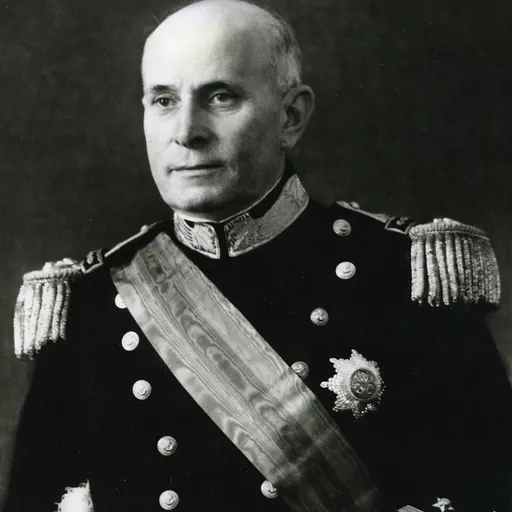
Américo Tomás
(1894-1987) President of Portugal
About Américo Tomás
Lived 1894 – 1987 (aged 92). Américo Tomás was a Portuguese politician, military personnel and sports executive.
Biography Early life Américo de Deus Rodrigues Tomás (also Thomaz) was born in Lisbon to his parents António Rodrigues Tomás and Maria da Assumpção Marques. He married Gertrudes Ribeiro da Costa in October 1922. The couple had two children, Maria Natália Rodrigues Tomás (born 1923) and Maria Magdalena Rodrigues Tomás (born 1925). Tomás entered high school at Lapa, Portugal in 1904, completing his secondary education in 1911. He then attended the Faculty of Sciences for two years (1912–1914), after which he joined the Naval Academy as a midshipman.
Military career
After Tomás graduated from the Naval Academy in 1916, he was assigned to the Portuguese coast escort service on Vasco da Gama and later assigned to the Pedro Nunes and the destroyers Douro and Tejo during World War I. In 1918, he received a promotion to Lieutenant.
On 17 March 1920, he was placed on the survey vessel 5 de Outubro, where he served for the next sixteen years. During this time, he was assigned to the survey mission of the Portuguese coast and was a board member of the Technical Commission for Hydrography, Navigation and Nautical Meteorology and a member of the Council for Studies of Oceanography and Fisheries. Tomás was also a member of the International Permanent Council for the Exploration of the Sea. Most neutral observers believed, however, that Delgado would have won had Salazar allowed an honest election. Salazar was alarmed enough that he pushed through a constitutional amendment transferring the election of the president to the legislature, which was firmly controlled by the regime. As a result, Delgado was the only opposition candidate in the history of the Second Republic (including its first incarnation as the Ditadura Nacional) to stay in the race until Election Day. Tomás was re-elected by the legislature in 1965 as the only candidate.
Although vested with sweeping constitutional powers, Tomás functioned largely as little a figurehead during his first decade in office, while Salazar, as prime minister held the real power for most of the Estado Novo's existence Salazar had reportedly selected Tomás as a successor to Craveiro Lopes because the latter had displayed an independent streak that Salazar found undesirable. Tomás' limited authority relegated him largely to ceremonial role at inaugurations and public events, a position reinforced by his limited skill as a public speaker, which made him a frequent subject of jokes.
In September 1968, Salazar was incapacitated by a coma. Believing that Salazar did not have long to live, Tomás dismissed Salazar and appointed Marcelo Caetano to succeed him. For all intents and purposes, the president's power to dismiss the prime minister had been the only check on Salazar's power. However, he never informed the recovered Salazar that he had been removed as leader of the regime he had largely created. Reportedly, when Salazar died two years later, he still believed that he was prime minister.
Tomás' ouster of Salazar would be the only time he exercised his presidential prerogatives during his first decade in office. In contrast, Tomás took a much more active role in the government after Caetano took power. While he had given Salazar more or less a free hand, he was not willing to do the same for Caetano. Eventually, Tomás became the rallying point for hardliners who opposed Caetano's efforts to open up the regime. Caetano's reforms did not go nearly far enough for a populace that had no memory of the instability and chaos that had preceded Salazar. For instance, he left the presidential election in the hands of the regime-dominated legislature, which re-elected Tomás unopposed in 1972. However, Caetano had to expend nearly all of his political capital to wrangle even these meagre reforms out of Tomás and the hardliners. He was thus in no position to resist when Tomás and the other hardliners forced the end of the reform experiment a year later.
Tomás, unlike his predecessor, lived in his private residence while President of the Republic, using the Belém Palace only as an office and for official ceremonies.
Later life On 25 April 1974, the Carnation Revolution ended 48 years of authoritarian rule in Portugal. After being removed from power, Tomás was exiled to Brazil; in 1978, President António Ramalho Eanes allowed his return to Portugal. In 1981, his eldest daughter, Natália, suddenly died.
National honours
Foreign honours Source:
Brazilian Imperial Family:
Published works
Don’t just read it —
keep it.
Full-length biographies made to live with: read them, listen on the way to work, watch them tonight.
- E-book
- Audio
- Video
Instant download · yours to keep · every purchase keeps this site free
Important facts
People in Américo Tomás's life
Named in this biography and alive at the same time

Related people
Same field, nearest in time





Contemporaries
People whose lives overlapped Américo Tomás's


Frequently asked questions
Who was Américo Tomás?
(1894-1987) President of Portugal
When was Américo Tomás born?
Américo Tomás was born on 19 November 1894 in Lisbon.
When did Américo Tomás die?
Américo Tomás died on 18 September 1987 in Cascais.
What was Américo Tomás's occupation?
Américo Tomás was a politician, military personnel and sports executive.
What nationality was Américo Tomás?
Américo Tomás was Portuguese.
Sources & further reading
Cite this page
APA: Biography.guide. (2026). Américo Tomás. https://biography.guide/americo-tomas/
MLA: "Américo Tomás." Biography.guide, https://biography.guide/americo-tomas/.
Chicago: "Américo Tomás." Biography.guide. https://biography.guide/americo-tomas/.
Data last updated: 2026-09-22 · Spot an error? Report a correction.
Portrait: Wikimedia Commons · author & licence
Page generated 2026-09-27 05:02 UTC