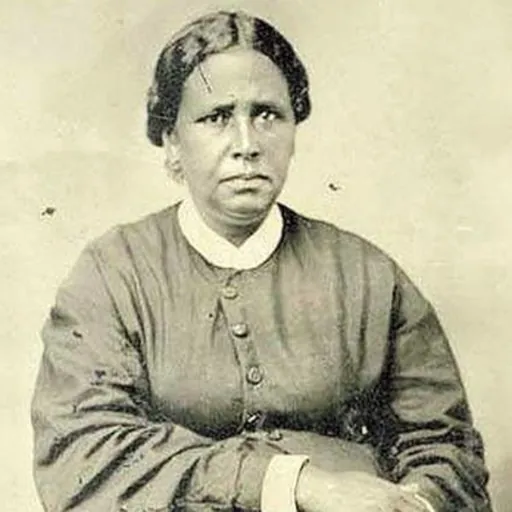
Amelia Piper
American former slave and abolitionist
About Amelia Piper
Lived 1796 – 1856 (aged 59–60).
Amelia Piper (c. 1796–1856) was a former slave and abolitionist, who organized anti-slavery fairs, was a manager of the New Bedford Female Union Society, and was a fundraiser for the abolition of slavery. She and her husband were conductors on the Underground Railroad. She worked within the African-American community and the greater New Bedford, Massachusetts community to coordinate the efforts of others to provide lives of freedom to those who had been enslaved.
Personal life
Amelia J. Piper, born in Alexandria, Virginia, was married to William Piper (1786–1870), both of whom had been enslaved. Piper, her husband, and four children left Alexandria on a shipping vessel for New Bedford, Massachusetts between 1826 and 1830. Family legend contends that they traveled on a schooner owned by the Rotch family. Generations of the Piper family worked for William Rotch Rodman as ship workers, domestics, and farm hands. Former slaves often became part of the middle class in New Bedford. and worked for him for decades. The New Bedford Republican Standard states in 1854 that William, "in the employ of William R. Rodman for a number of years, and by his integrity and great fidelity to the trusts committed to his charge, has won for himself an honorable name." Robert was also a waiter for Rodman from 1845 and likely into the 1850s. worked on the Rebecca Simms in 1839, the family home of William and Amelia. It was sold in 1841. who was a civil rights advocate, suffragette, and educator. Amelia and William's daughter, Sarah, married William H. Roshier, who also worked for William Rotch Rodman for a number of years. and a daughter, Rebecca G. Piper, born about 1839 who married Moses Olmstead on February 23, 1871. Olmstead, two years her senior, was a clothing dealer from Norfolk, Virginia. Amelia and William were members of the Second Baptist Church and William was a deacon there.
Abolitionist
On January 1, 1840, Piper organized one of the first anti-slavery fairs in New Bedford, Massachusetts. The money was used for the Massachusetts Anti-Slavery Society; to fund abolitionist's speaking tours; and to help support The Liberator, an anti-slavery newspaper. Sometimes funds were used to ensure that fugitive slaves were not returned to slavery. The money was made by selling baked goods, handmade items, and autographs of noted women and men.
Underground Railroad With her husband, Piper helped fugitive slaves attain their freedom, like John S. Jacobs, the brother of Harriet Jacobs, an abolitionist and writer. William and Amelia Piper are buried at the Oak Grove Cemetery in New Bedford, Massachusetts.
The Piper's children and grandchildren also worked to end slavery and vie for equitable civil rights.
Don’t just read it —
keep it.
Full-length biographies made to live with: read them, listen on the way to work, watch them tonight.
- E-book
- Audio
- Video
Instant download · yours to keep · every purchase keeps this site free
Important facts
People in Amelia Piper's life
Named in this biography and alive at the same time

Contemporaries
People whose lives overlapped Amelia Piper's






Frequently asked questions
Who was Amelia Piper?
American former slave and abolitionist
When was Amelia Piper born?
Amelia Piper was born in 1796 in Alexandria.
When did Amelia Piper die?
Amelia Piper died in 1856.
What was Amelia Piper known for?
Amelia Piper was known for Abolitionist and Underground Railroad.
Sources & further reading
Cite this page
APA: Biography.guide. (2026). Amelia Piper. https://biography.guide/amelia-piper/
MLA: "Amelia Piper." Biography.guide, https://biography.guide/amelia-piper/.
Chicago: "Amelia Piper." Biography.guide. https://biography.guide/amelia-piper/.
Data last updated: 2026-09-22 · Spot an error? Report a correction.
Portrait: Wikimedia Commons · author & licence
Page generated 2026-09-27 05:04 UTC