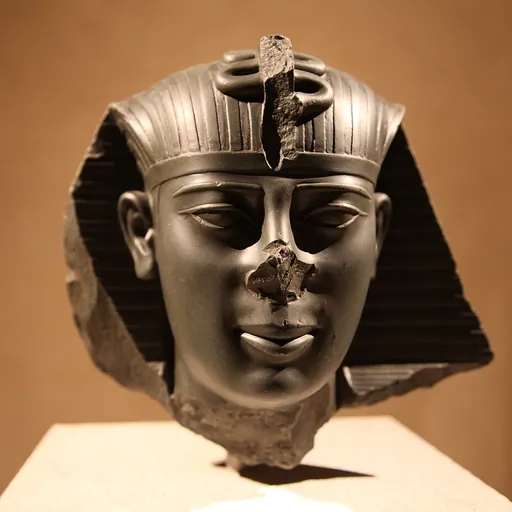
About Amasis II
Lived 610 BC – 526 BC (aged 83–84). Amasis II was an Egyptian statesperson.
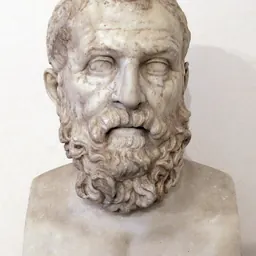
Amasis II ( ; ḤMS) or Ahmose II was a pharaoh (reigned 570526 BCE) of the Twenty-sixth Dynasty of Egypt, the successor of Apries at Sais. He was the last great ruler of Egypt before the Persian conquest. He was also the first pharaoh to conquer Cyprus after Thutmose III.
Life
Most of our information about him is derived from Herodotus (2.161ff) and can only be imperfectly verified by monumental evidence. According to the Greek historian, he was of common origins. He was originally an officer in the Egyptian army. His birthplace was Siuph at Saïs. He took part in a general campaign of Pharaoh Psamtik II in 592 BC in Nubia.
A revolt which broke out among native Egyptian soldiers gave him his opportunity to seize the throne. These troops, returning home from a disastrous military expedition to Cyrene in Libya, suspected that they had been betrayed in order that Apries, the reigning king, might rule more absolutely by means of his Greek mercenaries; many Egyptians fully sympathized with them. General Amasis, sent to meet them and quell the revolt, was proclaimed king by the rebels instead, and Apries, who then had to rely entirely on his mercenaries, was defeated (though it is suggested that Apries had more native support than classical sources describe). Apries then fled to an "island" (possibly an elevated or isolated base of Apries within Egypt) and was killed while mounting a final insurrection against Amasis in 567 BCE with the aid of a shipped force (probably Greek and maybe Carian), while the Babylonians also invaded Egypt the same year. An inscription confirms the struggle between the native Egyptian and the foreign soldiery, and proves that Apries was killed and honourably buried in the fourth year of Amasis ( BCE).
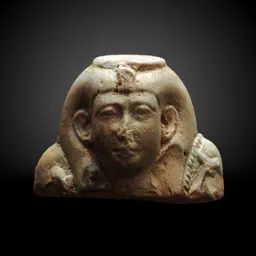
Some information is known about the family origins of Amasis: his mother was a certain Tashereniset, as a bust of her, today located in the British Museum, shows. A stone block from Mehallet el-Kubra also establishes that his maternal grandmother—Tashereniset's mother—was a certain Tjenmutetj.
Nitetis, who was, as per Herodotus's account, "tall and beautiful", naturally betrayed Amasis and upon being greeted by the Persian king explained Amasis's trickery and her true origins. This infuriated Cambyses and he vowed to take revenge for it. Amasis died before Cambyses reached him, but his heir and son Psamtik III was defeated by the Persians.
Amasis was described by Herodotus as a philhellene. He assigned the commercial colony of Naucratis on the Canopic branch of the Nile to the Greeks, and when the temple of Delphi was burnt, he contributed 1,000 talents to the rebuilding. He also married a Greek princess named Ladice daughter of King Battus III and made alliances with Polycrates of Samos and Croesus of Lydia.
Under Amasis, Egypt's agricultural based economy reached its zenith. Herodotus, who visited Egypt less than a century after Amasis II's death, writes that:
His kingdom consisted probably of Egypt only, as far as the First Cataract, but to this he added Cyprus, and his influence was great in Cyrene, Libya.
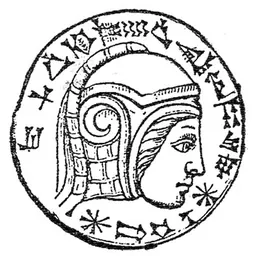
In his fourth year, around 568–567 BC, Egypt was invaded by the Babylonians, under the leadership of Nebuchadnezzar II. This assault was recorded by a fragmentary Babylonian inscription, with the modern designation BM 33041; the inscription from that year records the word "Egypt" as well as possible traces of the name "Amasis". A stele of Amasis from the 4th year of his reign in 567 BC, also fragmentary, may also describe a combined naval and land attack by the Babylonians. Recent evidence suggests that the Babylonians were initially successful during the invasion and gained a foothold in Egypt, but they were repelled by Amasis' forces. It is believed that this forced Nebuchadnezzar II to retire plans to conquer Amasis' kingdom. (However, some have suggested that Nebuchadnezzar came to defeat Apries, with the combined forces of Amasis and Nebuchadnezzar managing to kill him, securing Amasis' throne, though as vassal king.) Amasis was later faced with another formidable enemy with the rise of Persia under Cyrus who ascended to the throne in 559 BCE; his final years were preoccupied by the threat of the impending Persian onslaught against Egypt. With great strategic skill, Cyrus had destroyed Lydia in 546 BCE and finally defeated the Babylonians in 538 BCE which left Amasis with no major Near Eastern allies to counter Persia's increasing military might.
Herodotus also relates the desecration of Amasis' mummy when the Persian king Cambyses conquered Egypt and thus ended the 26th (Saite) Dynasty:
Later reputation This head probably came from a temple statue of Amasis II. He wears the traditional royal nemes head cloth, with a protective uraeus serpent at the brow. Circa 560 BCE. Walters Art Museum, Baltimore. From the fifth century BCE, there is evidence of stories circulating about Amasis, in Egyptian sources (including a demotic papyrus of the third century BCE), Herodotus, Hellanikos, and Plutarch's Convivium Septem Sapientium. 'In those tales Amasis was presented as a non-conventional Pharaoh, behaving in ways unbecoming to a king but gifted with practical wisdom and cunning, a trickster on the throne or a kind of comic Egyptian Solomon'.
A bronze footbath from ancient Greece. Circa 400 BCE. Metropolitan Museum of Art, New York City. For example, Herodotus relates that, when the Egyptians disrespected Amasis for having been born a commoner, he had his golden footbath (ποδανιπτήρ) melted down, made into a statue of a god, and placed in the centre of city where people would worship it. After the people of that city had worshipped and "did great reverence" to it, Amasis gathered them and declared to them that the golden image they now worshipped had once been a footbath where people would vomit, urinate and wash their feet. He claimed that likewise, although he was once a man of the people, he was now their king and they ought to fittingly respect him.
On another occasion, Herodotus tells that Amasis' friends admonished him for spending his time frivolously instead of on governing the country. He responded to them that archers stretch their bows only when they need them, because if they kept them constantly stretched the bows would break. "So also is the state of man: if he should always be in earnest and not relax himself for sport at the due time, he would either go mad or be struck with stupor before he was aware; and knowing this well, I distribute a portion of the time to each of the two ways of living."
Gallery of images
Don’t just read it —
keep it.
Full-length biographies made to live with: read them, listen on the way to work, watch them tonight.
- E-book
- Audio
- Video
Instant download · yours to keep · every purchase keeps this site free
Important facts
Family & relationships
People in Amasis II's life
Named in this biography and alive at the same time

Related people
Same field, nearest in time


Contemporaries
People whose lives overlapped Amasis II's
Frequently asked questions
Who was Amasis II?
Egyptian pharaoh from 570 to 526 BC
When was Amasis II born?
Amasis II was born in 610 BC.
When did Amasis II die?
Amasis II died in 526 BC.
What was Amasis II's occupation?
Amasis II was a statesperson.
What nationality was Amasis II?
Amasis II was Egyptian.
Sources & further reading
Cite this page
APA: Biography.guide. (2026). Amasis II. https://biography.guide/amasis-ii/
MLA: "Amasis II." Biography.guide, https://biography.guide/amasis-ii/.
Chicago: "Amasis II." Biography.guide. https://biography.guide/amasis-ii/.
Data last updated: 2026-09-23 · Spot an error? Report a correction.
Portrait: Wikimedia Commons · author & licence
Page generated 2026-09-27 05:05 UTC