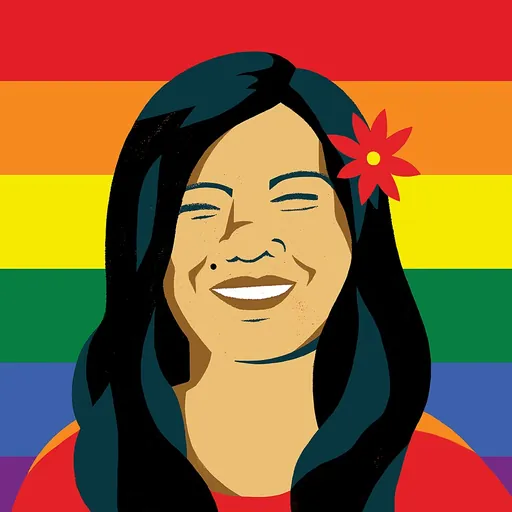
About Amancay Diana Sacayán
Lived 1975 – 2015 (aged 39). Amancay Diana Sacayán was an Argentine lGBTQ rights activist and activist.
Organizations Sacayán created the Anti-Discrimination Movement of Liberation (MAL), a non-governmental organization, in 2001. to the establishment of a health office for both mental and physical healthcare needs in the LGBT community in both Morón and La Matanza. Sacayán and MAL regularly worked to overcome the idea of prostitution being a viable and genuine career The tenets of inclusion of travesti, transsexual, and transgender persons eventually led to the creation of the National Gender Identity Law. In addition to her work with MAL, Sacayán also served on the board of the International Lesbian, Gay, Bisexual, Trans and Intersex Association.
The Ministry of Health of Buenos Aires released a statement, reproduced by the media, in which MAL is directly named as contributing to the passage of Resolution 2359, in accordance with law 13.175 (equal access to healthcare), on 5 July 2007 which required that all medical personnel in the province of Buenos Aires address patients by their preferred names. The city of Santa Fe passed similar legislation, Resolution 1877/09, as did the city of Buenos Aires, Law 3.062.
MAL and several other groups advocated for the eligibility of the trans community in Argentina to receive the constitutionally-guaranteed adequate housing in 2009. Despite the right enshrined in Article 14a of the National Constitution, transgender, transsexual and travesti persons were denied inclusion in the Federal Housing Plan under President Cristina Kirchner's administration. Sacayán also helped establish the Silvia Rivera cooperative, a group focused on training members of the trans community for careers in the food service and catering industry. They registered with the INAES [es] while trying to establish the restaurant in La Matanza for training. Mayor Fernando Espinoza stymied the development of the cooperative by refusing to meet with its leaders in 2011 regarding a physical location. in promoting an event at which she was able to impress upon the nearly 200 attendees the need for travesti, transsexuals, and transgender persons to have access to traditional employment.
Several of the LGBT civil rights groups came together to work with Diana Conti in 2014 in an attempt to establish Project 8194 which would require the government to compensate individuals detained by government authorities on the basis of the sexual identity or orientation.
Visibility
Sacayán, along with Berkins, aided in the nationwide demonstration on 3 June 2015 decrying femicide in Argentina. The movement spread to several other countries under the name Ni una menos. She was kept with male prisoners and left without food or blankets for several days. The Undersecretary of Justice of the province of Buenos Aires admitted to keeping Sacayán in Don Bosco due to her being a travesti, and the head of that section of the jail filed a report on Sacayán's 'aggressiveness'.
When she was arrested alongside her sister Johana on 10 July 2004, the feminist socialist group Bread and Roses [es] supported her actions. Supporters from multiple groups – a total of at least 4,000 people – gathered in the Plaza de Mayo and demanded the release of several prisoners who had been held solely for political reasons. Police released Sacayán from jail but kept her on house arrest. Police responded by arresting Sacayán, Díaz, and another activist, Martín Lanfranco; Sacayán had been pushed into traffic in front of an oncoming taxi, but it was able to brake and avoid hitting her.
One of the complaints about how the investigation into Sacayán's murder was being handled is that police treated it as a femicide only. Amnesty International responded to the gruesome murder, stating that if Argentina did not effectively investigate and prosecute the perpetrators, those who killed Sacayán – as well as the individuals responsible for the murders of Marcela Chocobar and Coty Olmos that occurred within the month prior to Sacayán's death – would understand the lack of action as tacit approval to murder trans people.
The police arrested two suspects: Gabriel David Marino and Felix R. Because there was insufficient evidence to prosecute Felix R., the plaintiffs in the case requested that Marino be put on trial alone to keep the case from being closed 'unsolved'. On 14 February 2018, Oral Criminal Court 4 ruled that Marino would remain in custody until at least 27 June 2018 pending the outcome of the trial. For the first time in history, the Argentine Justice acknowledged that the murder was "a hate crime against the travesti identity", known as "travesticide" or "transvesticide" (Spanish: travesticidio; a portmanteau of "travesti" and "homicide"). The ruling was widely celebrated by LGBT activists and has been considered "one more example of the [social] changes underway in Argentina." The verdict was celebrated by INADI as progress towards an inclusive Argentina.
On 7 February 2019, Minister Patricia Bullrich offered a reward of 500,000 Argentine pesos using resolution 67/2019 for information leading to the arrest of the second assailant. The amount was increased to 2 million Argentine pesos on 12 January 2022, per Resolution 36/2022.
On 2 October 2020, the National Chamber of Cassation in Criminal and Correctional Matters confirmed Marino's conviction; however, they removed the transvesticide aspect, stating only that it was aggravated violence based on Sacayán's gender. In his decision, Judge Jorge Luis Rimondi commented that the cuts to Sacayán's breasts did not indicate an intent to convey a message regarding her gender identity. This decision was upheld by the Supreme Court, with the vote of irregular member García-Mansilla.
Legacy On 17 September 2015, the Buenos Aires legislature passed , or the Travesti Transsexual Job Quota Law, which made it a requirement that 1% of the jobs in public administration be provided to qualified travesti, transsexuals, and transgender people. Sacayán had started lobbying for the legislation in 2010, working alongside other groups and with representative Karina Nazábal. Regardless of its passage, however, the government of Buenos Aires did not enforce the law.
On 11 June 2021, the Argentine Chamber of Deputies approved the Diana Sacayán – Lohana Berkins Law, enacting the 1% quota on a national level. It also included incentives for private firms to recruit travesti, transsexual, and transgender employees. It passed with 207 votes in favor, 11 against and 7 abstentions. On 24 June 2021, the Argentine Senate passed the act into law, with 55 Senators approving the measure, 1 voting against it, and 6 abstentions.
On 2 July 2023, the Google Doodle depicted Sacayán. On 11 October 2023, Casa Rosada, the official workplace of the President of Argentina, hung an enlarged photograph of Sacayán and one of Claudia Pía Baudracco in the women's and dissidents' room. On 8 March 2024 – International Women's Day – President Javier Milei changed the name of the room to the "Hall of Heroes" and removed all pictures of women activists hanging on its walls, with a spokesperson arguing for Milei that having a room celebrating women is discriminatory to men.
A documentary titled Fue travesticidio has garnered several prizes, including the Work in Progress prize for the 36th Festival de la Mujer y El Cine in 2024.
Writings Sacayán frequently wrote for El Teje magazine and was the editor of the "I Am" supplement of Página 12.
Don’t just read it —
keep it.
Full-length biographies made to live with: read them, listen on the way to work, watch them tonight.
- E-book
- Audio
- Video
Instant download · yours to keep · every purchase keeps this site free
Important facts
People in Amancay Diana Sacayán's life
Named in this biography and alive at the same time





Related people
Same field, nearest in time



Contemporaries
People whose lives overlapped Amancay Diana Sacayán's

Frequently asked questions
Who was Amancay Diana Sacayán?
Argentinian LGBT rights activist (1975-2015)
When was Amancay Diana Sacayán born?
Amancay Diana Sacayán was born on 31 December 1975 in San Miguel de Tucumán.
When did Amancay Diana Sacayán die?
Amancay Diana Sacayán died on 11 October 2015 in Flores.
What was Amancay Diana Sacayán's occupation?
Amancay Diana Sacayán was a lGBTQ rights activist and activist.
What nationality was Amancay Diana Sacayán?
Amancay Diana Sacayán was Argentine.
Sources & further reading
· Wikipedia: Amancay Diana Sacayán
Cite this page
APA: Biography.guide. (2026). Amancay Diana Sacayán. https://biography.guide/amancay-diana-sacayan/
MLA: "Amancay Diana Sacayán." Biography.guide, https://biography.guide/amancay-diana-sacayan/.
Chicago: "Amancay Diana Sacayán." Biography.guide. https://biography.guide/amancay-diana-sacayan/.
Data last updated: 2026-09-23 · Spot an error? Report a correction.
Portrait: Wikimedia Commons · author & licence
Page generated 2026-09-27 05:07 UTC