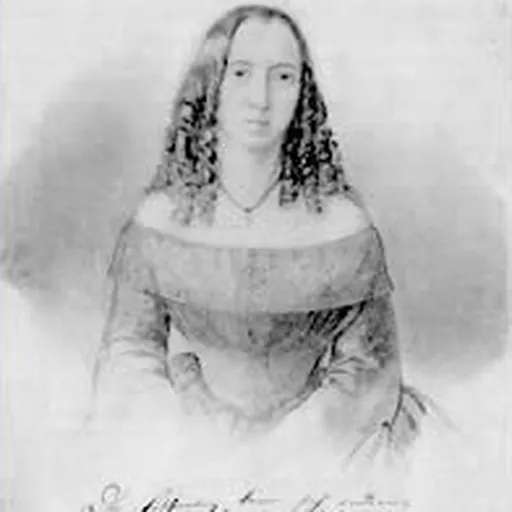
About Amalie Struve
Lived 1824 – 1862 (aged 37). Amalie Struve was a German writer, revolutionary and feminist.
Amalie Struve (born Amalie Siegrist, after her adoption by her step father Amalie Düsar: 2 October 1824 – 13 February 1862) was a democratic radical participant in the 1848 March Revolution. She is also remembered as an early feminist and author.
Life Provenance and early years Elise Ferdinandine Amalie Siegrist was born in Mannheim, the city at the confluence to the rivers Rhine and Neckar. Her mother, Elisabeth Siegrist and her father, the army officer Alexander von Sickingen, were not married to each other. After her mother married, however, in 1827 Amalie was adopted by her new step father, a languages teacher called Friedrich Düsar. He saw to it that Amalie and her younger brother Pedro received a sound education, as a result of which she was later able to support her family, when necessary, by working as a languages teacher. Because of her adoption she is sometimes identified in sources as Amalie Düsar. The Düsar family were not wealthy, and by the time she was 21 Amalie had already started working as a teacher of French and German. In 1847 Gustav Struve took the further step of renouncing his own title: Gustav Karl Johann Christian von Struve became Gustav Struve.
Amalie Sruve first came to prominence as the wife of Gustav Struve, at his side in the struggle and agitation that were part of the March Revolution during 1848 in Baden. Their insurrection ended in failure after just three days. On this and other occasions Amalie Struve was particularly focused on inspiring and mobilising women in support of the 1848 revolutionary ideals.
After the uprising had been put down at the "Battle" of Staufen, by troops under by General Friedrich Hoffmann, both Gustav and Amalie Struve were sentenced to prison terms, at separate trials. They spent the eight months between September 1848 and April 1849 imprisoned in Freiburg. Amalie was held in solitary confinement, but she was able to write sketches about the French revolutionary hero 'Manon' Roland whom she idolised. A few years later, in 1851, she published a piece based on these sketches entitled "Eine Republikanerin" in a literary journal called "Deutescher Zuschauer". By this time her own involvement in the "Heckerzug" (uprising) and subsequent actions meant that she, too, was becoming something of a celebrity in revolutionary circles. On 14 May 1849 the Grand Duke fled. On 1 June 1849 a republic was proclaimed, with a provisional government led by the left-wing liberal politician Lorenzo Brentano. In order to defeat the republican uprising, Prussian troops advanced on Baden. Brentano was keen (like the temporarily absent the Grand Duke) to avoid bloodshed and to progress the revolution's democratic objectives through negotiation. He delayed arming a popular militia only to be overthrown by Struve and other radicals. Amalie Struve participated in the fierce fighting against the battle-hardened Prussian troops that followed, but the battle was completely uneven and the last of the revolutionaries were blockaded into the walled fortress of Raststatt and forced to surrender on 23 July 1949. As it would have seemed at the time, that really did mark the end of the March Revolution.
Aftermath of a failed revolution Many of the revolutionaries were exiled or sentenced to long jail terms. Some of the movement's most prominent leaders, including Friedrich Hecker, along with Gustav and Amalie Struve, managed instead to move abroad via, initially, Switzerland. In France, according to a remark in a letter written by Gustav Struve, they found the police surveillance intolerable and they moved again. Other German revolutionaries, including the Struves, must have arrived in London at about the same time. Certainly by the time Amalie Struve completed and published her "Erinnerungen aus den badischen Freiheitskämpfen" ("Memories from the Baden Liberation Struggles"), she did so from London where, according to sources, it had also been written. Although the book was published (in Hamburg) only in 1850, the first line printed at the head of the main text reads, "London, den 12. Oktober 1849".
New World There are signs of tensions surfacing between the German political exiles in London during 1850 and 1851, but the more acute difficulties for the Struves were economic. Karl Marx had found himself a wealthy sponsor and had taken the further precaution, while still in Germany, of marrying an heiress. In contrast, without any secure source of income ("...ohne sichere Erwerbsquelle"), the Struves felt themselves forced to leave London in favour of New York. Although the employment prospects for an ex-revolutionary might not have appeared too encouraging, there was already, in the United States a lively market for German-language newspapers from which work might be expected. On 11 April 1851 Gustav and Amalie Struve set sail from Liverpool aboard the sailing ship "Roscius". They arrived in New York precisely one month later.
In their new homeland Amalie Struve became an author. Some of what she wrote was clearly aimed at supporting the American feminist movement. She wrote novels and articles covering voting rights for women as well as education and training for girls and women. She wrote about the fates of emigrant families in the United States. Another theme she tackled involved comparing the Baden Revolution with the French Revolution of 1789, which many people still saw as a something of a template for any effective political uprising. She also wrote about the ways in which the Protestant Reformation had unfolded and continued to resonate differently in France, England and Germany.
Amalie Struve died on Staten Island (NY) in 1862, still aged only 37, as a result of complications following the birth of her third daughter. Her brother, Pedro Friedrich Dusar (1828-1901), also left Germany. He settled in Britain during the early 1850s, working initially as a typesetter in London
Output (selection) Historische Zeitbilder. I. Westminster. Franz Schlodtmann, Bremen 1850 Digitalisat Historische Zeitbilder.II. Heloise Desfleurs. Franz Schlodtmann, Bremen 1850 Digitalisat Historische Zeitbilder. III. Der Fall von Magdeburg. Franz Schlodtmann, Bremen 1850 Digitalisat Erinnerungen aus den badischen Freiheitskämpfen. Den deutschen Frauen gewidmet. Hoffmann und Campe, Hamburg 1850 Digitalisat Eine Proletarierin. Roman aus der Revolutionszeit. In: Sociale Republik. Organ der freien Arbeiter. New York 1858 Nr. 1–20 Die Tochter des Gefängniswärters. In: Sociale Republik. Organ der freien Arbeiter. New York 1859 Monica Marcello-Müller (editor-producer): Frauenrechte sind Menschenrechte! Schriften der Revolutionärin und Literatin Amalie Struve. Centaurus-Verlag Herbolzheim 2002 (Frauen in Geschichte und Gesellschaft. produced by Annette Kuhn & Valentine Rothe, vol 37)
Don’t just read it —
keep it.
Full-length biographies made to live with: read them, listen on the way to work, watch them tonight.
- E-book
- Audio
- Video
Instant download · yours to keep · every purchase keeps this site free
Important facts
People in Amalie Struve's life
Named in this biography and alive at the same time


Related people
Same field, nearest in time


Contemporaries
People whose lives overlapped Amalie Struve's




Frequently asked questions
Who was Amalie Struve?
German author
When was Amalie Struve born?
Amalie Struve was born on 2 October 1824 in Mannheim.
When did Amalie Struve die?
Amalie Struve died on 13 February 1862 in New York City.
What was Amalie Struve's occupation?
Amalie Struve was a writer, revolutionary and feminist.
What nationality was Amalie Struve?
Amalie Struve was German.
Sources & further reading
Cite this page
APA: Biography.guide. (2026). Amalie Struve. https://biography.guide/amalie-struve/
MLA: "Amalie Struve." Biography.guide, https://biography.guide/amalie-struve/.
Chicago: "Amalie Struve." Biography.guide. https://biography.guide/amalie-struve/.
Data last updated: 2026-09-23 · Spot an error? Report a correction.
Portrait: Wikimedia Commons · author & licence
Page generated 2026-09-27 05:05 UTC