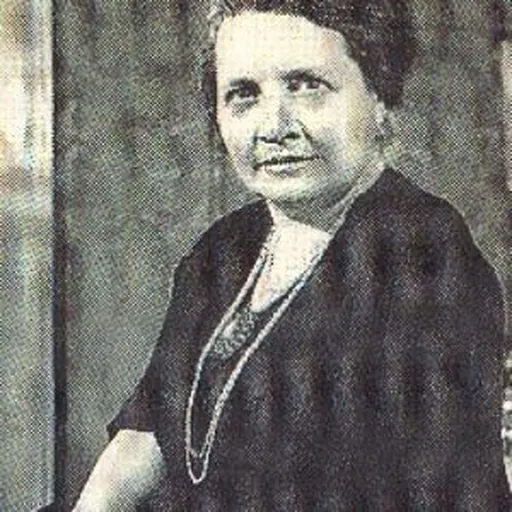
About Amalia Moretti Foggia
Lived 1872 – 1947 (aged 75). Amalia Moretti Foggia was an Italian journalist, physician and researcher.
Amalia Moretti Foggia (11 May 1872 – 11 July 1947) was an Italian physician and journalist. She is the third woman to graduate in medicine at the University of Bologna. She is also known as Dottor Amal and Petronilla, pseudonyms used by her during her career in journalism.
Biography
Early life Amalia Moretti Foggia was born on 11 May 1872 in Mantua in a progressivist and secular family, from a pharmacist and expert herborist Giovanni Battista, who was also a chemistry professor, and Carolina Rinoldi. The couple lost a child years before having Amalia due to smallpox, and when she was nearly one year old she was diagnosed with a strong enteritis, of which she was expected to die for, as at the time there wasn’t any cure for the disease. Although it was a primary cause for infant mortality at the time, thanks to her father's pharmacist abilities and knowledge she was able to recover. In one of her last expected nights her father made a saving potion composed of different kind of herbs, which unexpectedly changed the situation giving her a new beginning. That episode of her life became crucial in defining the intense love she began to have towards nature from that moment until her death. In her autobiography book she states “nature is a friend and saves us if we respect it and if we try to know its secrets and possibilities”.
Medical career She gained a scholarship and graduated in natural science in 1895 and decided to apply for medical school at the University of Bologna, where she attended the lectures of clinician Augusto Murri. Her romantic relationship ended badly when her partner was forced to marry another woman but the delusion didn't stop her from achieving her goals. In 1893 she graduated in medicine with honors discussing her thesis, "Le ovaie nelle peritoniti sperimentali", with professor Giovanni Martinotti. Amalia was the third woman to graduate in medicine from the University of Bologna.
She then studied pediatrics (being the first woman to complete that specialization) in Florence at Meyer Children's Hospital, where she met the famous Anna Kuliscioff, founder of the Italian Socialist Party together with Filippo Turati. Her vocation in becoming a pediatrician was due to her inability to bear children, after suffering from a serious peritonitis. In 1899, after her specialization, she moved to Milan and looked for a job with the support of a group of famous feminists, whom she got to know thanks to Anna Kuliscioff: Alessandrina Ravizza, Paolina Shiff, Linda Malnati, and Ersilia Majno Bronzin.
It was Ersilia Majno Bronzin who helped her gain a job as a tax doctor at the Women Workers Society (Società Operaia Femminile). In 1902 she was hired by the Ambulatorio Della Poliambulanza di Porta Venezia where she remained for 40 years working as a pediatrician and in the same year she bought her first house in Via Tadino. Her particular interest was in children suffering from malnutrition. She also helped her patients' mothers gain independence against their violent husbands and cured women workers who were sick because of toxic fumes inhaled in factories. The same year she married doctor Domenico della Rovere, an anatomopathologist, with whom she did not have any children but cared for her young patients as if they were her own. September 12, 1902 the news of their wedding was published in the newspaper "La provincia di Mantova".
Amalia as Dottor Amal and Petronilla She gave some speeches at the University of Milan on the topic of tuberculosis and became a personal doctor and friend of the author Ada Negri, with whom she exchanged letters. In Milan she worked as a volunteer giving free care and advice to the people in need. In 1926 she published a column on health and hygiene under the pseudonym "Dottor Amal" in La Domenica del Corriere, after the request of Carlo Zanicotti, the head of the journal. It was Eugenio Balzan, director of Il Corriere della Sera, who introduced her to journalism. The column was titled "Il parere del medico", in which she used anonymity to reach as many readers as possible, being aware of the fact that a male name of doctor would mean more opportunities for her career. Under that name she wrote a book, "Le piante alimentari e medicinali del Dottor Amal", in which she explains the importance of using herbs to treat diseases.
Her contributions, aimed at improving the lives of the disadvantaged, also included recipes published under the pseudonym "Petronilla" (after the Italian name of Maggie, the female main character of the comic strip Bringing Up Father, published in Italy by the Corriere dei Piccoli), to spread knowledge about healthy diets. Her writing style was very thoughtful of her uneducated audience, composed of young inexperienced wives and large families.
She had a simple way of writing, offering humble recipes that were inexpensive, but still had a high nutritional value. In "La massaia scrupolosa" she also gave out household economics advice. Amalia was interpreting two different characters: an emancipated and educated woman and on the other side a housewife, dedicated to her husband and to taking care of the house. Several collections of these recipes were later published separately, including "Ricette" and "Altre ricette" which became best-sellers.
Two years after her first article, by the 1930s, she opened a new column about nutrition, "Tra i fornelli", in which she showed her knowledge of culinary art. After 1941 Petronilla’s cuisine became synonymous with the cuisine of less, meaning reproducing popular dishes without ingredients that were difficult to find at the time. Her last work, "200 suggerimenti per questi tempi", was written in 1943 during wartime.
Death On the 11th of July 1947 she died in her house in Via Sandro Sandri, Milan. dedicated Amalia Moretti Foggia a building in Conegliano, Italy (TV). This corporation manages professional training courses for young people, adults, companies and for apprenticeships. It also provides career guidance and accompaniment services and deals with professional qualifications and retraining. They decided to dedicate a headquarters because she is an example of culture, values and professionalism. She represents a role model for young women being the 3rd woman to graduate in medicine at the University of Bologna.
Works Amalia's recipes were collected in the following books:
Dottor Amal, La parola del medico: Camminare (April 28, 1935) Petronilla, Tra i fornelli: Un'altra tortina (March 4, 1945) Dottor Amal, La parola del medico: Il nostro sangue (April 8, 1945)
Articles collected in Giornale dei Piccoli:
Dottor Amal, Il consiglio del dottore: Un Bimbo dorme (June 10, 1945)
Don’t just read it —
keep it.
Full-length biographies made to live with: read them, listen on the way to work, watch them tonight.
- E-book
- Audio
- Video
Instant download · yours to keep · every purchase keeps this site free
Important facts
People in Amalia Moretti Foggia's life
Named in this biography and alive at the same time




Related people
Same field, nearest in time

Contemporaries
People whose lives overlapped Amalia Moretti Foggia's


Frequently asked questions
Who was Amalia Moretti Foggia?
Italian journalist and physician (1872-1947)
When was Amalia Moretti Foggia born?
Amalia Moretti Foggia was born on 11 May 1872 in Mantua.
When did Amalia Moretti Foggia die?
Amalia Moretti Foggia died on 11 July 1947 in Milan.
What was Amalia Moretti Foggia's occupation?
Amalia Moretti Foggia was a journalist, physician and researcher.
What nationality was Amalia Moretti Foggia?
Amalia Moretti Foggia was Italian.
Sources & further reading
· Wikipedia: Amalia Moretti Foggia
Cite this page
APA: Biography.guide. (2026). Amalia Moretti Foggia. https://biography.guide/amalia-moretti-foggia/
MLA: "Amalia Moretti Foggia." Biography.guide, https://biography.guide/amalia-moretti-foggia/.
Chicago: "Amalia Moretti Foggia." Biography.guide. https://biography.guide/amalia-moretti-foggia/.
Data last updated: 2026-09-23 · Spot an error? Report a correction.
Portrait: Wikimedia Commons · author & licence
Page generated 2026-09-27 05:07 UTC