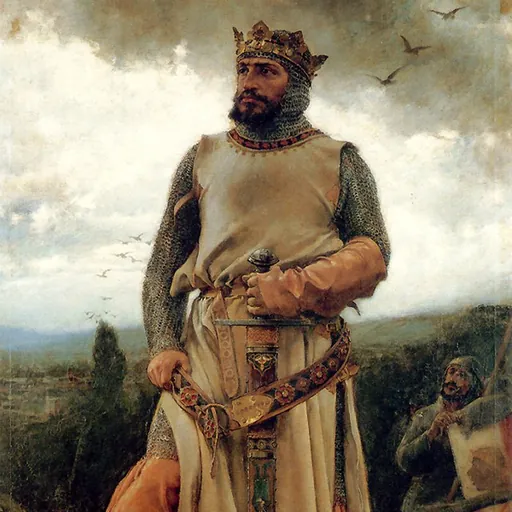
About Alphonse the Battler
Lived 1073 – 1134 (aged 60–61). Alphonse the Battler was a ruler and miles Christianus.
Alfonso I (7 September 1134), called the Battler or the Warrior , was King of Aragon and Navarre from 1104 until his death in 1134. He was the second son of King Sancho Ramírez and successor of his brother Peter I. With his marriage to Urraca, queen regnant of Castile, León and Galicia, in 1109, he began to use, with some justification, the grandiose title Emperor of Spain, formerly employed by his father-in-law, Alfonso VI. Alfonso the Battler earned his sobriquet in the Reconquista. He won his greatest military successes in the middle Ebro, where he conquered Zaragoza in 1118 and later took Ejea, Tudela, Calatayud, Borja, Tarazona, Daroca, and Monreal del Campo. He died in September 1134 after an unsuccessful battle with the Muslims at the Battle of Fraga.
Alfonso's nickname comes from the Aragonese version of the Chronicle of San Juan de la Peña (c. 1370), which says that "they called him lord Alfonso the battler because in Spain there wasn't as good a knight who won twenty-nine battles" (clamabanlo don Alfonso batallador porque en Espayna no ovo tan buen cavallero que veynte nueve batallas vençió).
Early life His earliest years were passed in the monastery of Siresa, learning to read and write and to practice the military arts under the tutelage of Lope Garcés the Pilgrim, who was repaid for his services by his former charge with the county of Pedrola when Alfonso came to the throne.
During his brother's reign, he participated in the taking of Huesca (the Battle of Alcoraz, 1096), which became the largest city in the kingdom and the new capital. He also joined El Cid's expeditions in Valencia. His father gave him the lordships of Biel, Luna, Ardenes, and Bailo.
A series of deaths put Alfonso directly in line for the throne. His brother's children, Isabella and Peter (who married María Rodríguez, daughter of El Cid), died in 1103 and 1104 respectively.
Matrimonial conflicts A passionate fighting-man (he fought twenty-nine battles against Christian or Moor), he was married (when well over 30 years and a habitual bachelor) in 1109 to the ambitious Queen Urraca of León and Castile, a passionate woman unsuited for a subordinate role. The marriage had been arranged by her father Alfonso VI of León in 1106 to unite the two chief Christian states against the Almoravids, and to supply them with a capable military leader. But Urraca was tenacious of her right as queen regnant and had not learnt chastity in the polygamous household of her father. Husband and wife quarrelled with the brutality of the age and came to open war, even placing Urraca under siege at Astorga in 1112. Alfonso had the support of one section of the nobles who found their account in the confusion. Being a much better soldier than any of his opponents he won the Battle of Candespina and the Battle of Viadangos, but his only trustworthy supporters were his Aragonese, who were not numerous enough to keep Castile and León subjugated. The marriage of Alfonso and Urraca was declared null by the pope, as they were second cousins, in 1110, but he ignored the papal nuncio and clung to his liaison with Urraca until 1114. During his marriage, he had called himself "King and Emperor of Castile, Toledo, Aragón, Pamplona, Sobrarbe, and Ribagorza" in recognition of his rights as Urraca's husband; of his inheritance of the lands of his father, including the kingdom of his great-uncle Gonzalo; and his prerogative to conquer Andalusia from the Muslims. He inserted the title of imperator on the basis that he had three kingdoms under his rule.
Church relations A denarius of Alfonso's, minted at Jaca, bearing his effigy and the inscription ANFUS-REX ARA-GON (Anfusus rex Aragonensium, King Alfonso of Aragon). The king quarrelled with the church, and particularly the Cistercians, almost as violently as with his wife. As he defeated her, so he drove Archbishop Bernard into exile and replaced the abbot of Sahagún with his brother. He was finally compelled to give way in Castile and León to his stepson, Alfonso VII of Castile, son of Urraca and her first husband. The intervention of Pope Calixtus II brought about an arrangement between the old man and his young namesake. According to the second of these, the pretender was then living in Louis's domains, meaning the Principality of Catalonia, which was ruled by Alfonso under Louis's suzerainty. This pretender was an old man (appropriately, since the Battler had died some decades earlier) and Alfonso II expressed confidence that Louis would arrest him at the earliest possible moment and bring him to justice. The first letter supplies sufficient information to date it approximately, since the Bishop sojourned at the court of Louis on his way to Rome. It is known from other sources that Berengar attended the Third Lateran Council in March 1179. The letters were probably written towards the end of 1178 or in January 1179 at the latest. According to an annalist source for the years 1089–1196, the pretender was received with honour and pomp in Zaragoza, Calatayud, and Daroca, which the Battler had conquered, but after it was found out that he was false he was executed before the city of Barcelona in 1181. Modern historian Antonio Ubieto Arteta has hypothesised that the Aragonese lords of the tenancies of Zaragoza, Calatayud, and Daroca – Pedro de Luesia, Loferrench de Luna, Pedro de Castillazuelo (lord of Calatayud), Pedro Cornel (lord of Murillo de Gállego), and the majordomo Jimeno de Artusilla, all of whom disappear between 1177 and 1181 in the documentation of their tenancies – supported, at least initially, the pretender. These lords also appear in the later legend of the Bell of Huesca, which has no historical basis, as the victims of Ramiro II (1136). Since, historically, they were not active in the 1130s, it is possible that the historically based legend of the pseudo-Alfonso had some influence on the genesis of the Bell of Huesca.
The earliest chronicle source for the imposture is Rodrigo Jiménez de Rada, writing in the middle of the thirteenth century, who records that there were several legends then current about the death of Alfonso the Battler: some believed he perished in the battle of Fraga, some that his body had never been recovered, others that he was buried in the monastery of Montearagón, and still others that he had fled from Fraga in shame after his defeat and became a pilgrim as an act of penance. Some years later, Rodrigo writes, though he does not give a year, an impostor arose and was received by many as the Battler, though Alfonso II had him arrested and hanged. This is the earliest reference to the impostor's end. The legend was amplified in later years. According to the fourteenth-century Crónica de los Estados Peninsulares, the Battler went on a pilgrimage to Jerusalem, where he lived for many years. The Crónica de San Juan de la Peña also recounts the incident, but it depends entirely on Rodrigo and the Estados Peninsulares. It is not until the seventeenth-century historian Jerónimo Zurita penned his Anales de la Corona de Aragón that new details were added to the legend. Zurita dates the impostor's appearance to the death of Raymond Berengar IV of Barcelona, who had been exercising power in Aragon, and the succession of the child Alfonso II in 1162. The death of the impostor, by hanging, must have occurred in 1163.
Competitors for succession
Candidates for the crowns of Navarre and Aragon in 1134 Marriage and legitimate descent Liaison and illegitimate descent
Don’t just read it —
keep it.
Full-length biographies made to live with: read them, listen on the way to work, watch them tonight.
- E-book
- Audio
- Video
Instant download · yours to keep · every purchase keeps this site free
Important facts
Family & relationships
People in Alphonse the Battler's life
Named in this biography and alive at the same time
Related people
Same field, nearest in time

Contemporaries
People whose lives overlapped Alphonse the Battler's




Frequently asked questions
Who was Alphonse the Battler?
King of Aragon and Pamplona (1073-1134)
When was Alphonse the Battler born?
Alphonse the Battler was born in 1073 in Kingdom of Aragon.
When did Alphonse the Battler die?
Alphonse the Battler died on 7 September 1134 in Poleñino.
What was Alphonse the Battler's occupation?
Alphonse the Battler was a ruler and miles Christianus.
What nationality was Alphonse the Battler?
Alphonse the Battler's recorded nationality: Kingdom of Aragon, Kingdom of Pamplona.
Sources & further reading
· Wikipedia: Alphonse the Battler
· DBpedia: Alfonso the Battler
Cite this page
APA: Biography.guide. (2026). Alphonse the Battler. https://biography.guide/alphonse-the-battler/
MLA: "Alphonse the Battler." Biography.guide, https://biography.guide/alphonse-the-battler/.
Chicago: "Alphonse the Battler." Biography.guide. https://biography.guide/alphonse-the-battler/.
Data last updated: 2026-09-23 · Spot an error? Report a correction.
Portrait: Wikimedia Commons · author & licence
Page generated 2026-09-27 05:06 UTC