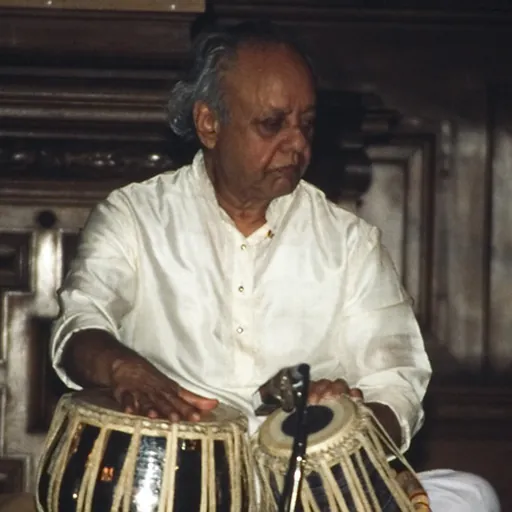
About Alla Rakha
Lived 1919 – 2000 (aged 80). Alla Rakha was an Indian composer, percussionist and musician.
Alla Rakha Qureshi (29 April 1919 – 3 February 2000) was an Indian tabla player who specialised in Hindustani classical music. Widely revered as one of history's most iconic players of the tabla, belonging to Punjab gharana of tabla players.
He was a frequent accompanist of sitar player Pandit Ravi Shankar and was largely responsible for introducing tabla to the Western audience.
Personal life and education Allah Rakha Qureshi was born on 29 April 1919 in Ghagwal village in the Jammu Province of the princely kingdom of Jammu and Kashmir under British Raj; today located in the Samba District of the union territory of the same name in India. His mother tongue was Dogri and his family were Muslim Dogras, although most of the Dogra clan around them were Hindus. Finding little chances for grooming and appreciation, the determined young lad began his training in tabla with Mian Kader Baksh of the Punjab gharana of tabla players. Mian Kadir Bakhsh, who had no sons, formally adopted Alla Rakha and called him the next head of the Punjab gharana of tabla players (a 'gharana' is a community of musicians sharing a distinctive musical style).
Allah Rakha had a third daughter named Roohi Bano (1951–2019) who was born in Pakistan and achieved a "legendary" status in television and film acting in that country.
Career Ustad Alla Rakha began his career as an accompanist in Lahore and then as an All India Radio, Delhi staffer in 1936 but later moved to Bombay in 1940, playing the station's first ever tabla solo and elevating the instrument's position in the process. Soon after, he also started composing music for Hindi/Urdu films under the name A. R. Qureshi. He composed for a total of 23 films between 1943 and 1964.
Alla Rakha's partnership with Ravi Shankar began in the early 1950s.
Awards and recognition Padma Shri in 1977
Death and legacy Qureshi died on 3 February 2000 at his Simla House residence on Nepean Sea Road following a heart attack, which he suffered on learning of the death of his daughter, Razia, the previous evening during cataract surgery.
In his obituary, The New York Times called him "the most important tabla drummer of his generation". The newspaper further stated that Alla Rakha was given the title Ustad or master musician and teacher of the art of tabla playing. Alla Rakha... "used his skill to invigorate every musician who shared the stage with him."
The Then-Prime Minister of India Atal Bihari Vajpayee also issued a formal statement regretting the loss in his death.
Don’t just read it —
keep it.
Full-length biographies made to live with: read them, listen on the way to work, watch them tonight.
- E-book
- Audio
- Video
Instant download · yours to keep · every purchase keeps this site free
Important facts
People in Alla Rakha's life
Named in this biography and alive at the same time



Related people
Same field, nearest in time



Contemporaries
People whose lives overlapped Alla Rakha's


Frequently asked questions
Who was Alla Rakha?
Indian tabla player (1919–2000)
When was Alla Rakha born?
Alla Rakha was born on 29 April 1919 in Jammu division.
When did Alla Rakha die?
Alla Rakha died on 3 February 2000 in Mumbai.
What was Alla Rakha's occupation?
Alla Rakha was a composer, percussionist and musician.
What nationality was Alla Rakha?
Alla Rakha was Indian.
Sources & further reading
Cite this page
APA: Biography.guide. (2026). Alla Rakha. https://biography.guide/alla-rakha/
MLA: "Alla Rakha." Biography.guide, https://biography.guide/alla-rakha/.
Chicago: "Alla Rakha." Biography.guide. https://biography.guide/alla-rakha/.
Data last updated: 2026-09-22 · Spot an error? Report a correction.
Portrait: Wikimedia Commons · author & licence
Page generated 2026-09-27 05:01 UTC