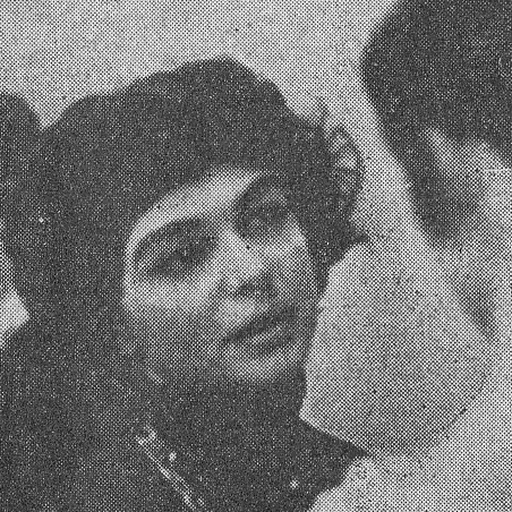
About Alina Szapocznikow
Lived 1926 – 1973 (aged 46). Alina Szapocznikow was a Polish and French sculptor, artist, draftsperson, photographer and graphic artist.
Alina Szapocznikow (; May 16, 1926 – March 2, 1973) was a Polish artist and Holocaust survivor. Recognized as one of the most important Polish sculptors of the post-war era,
Born in 1926 in Kalisz, Poland, into a Jewish family, she grew up in Pabianice near Łódź. Her childhood was disrupted by the outbreak of World War II. Szapocznikow was later imprisoned in the Nazi concentration camps at Auschwitz and Bergen-Belsen before being transferred to Terezin in 1943. After the end of the war in 1945, Szapocznikow moved to Prague, where she began her formal training in sculpture. Her education continued at the École nationale supérieure des Beaux-Arts in Paris, under Paul Niclausse. During the late 1940s and early 1950s, she moved between Prague and Paris, and later became ill with peritoneal tuberculosis.
In 1952, Szapocznikow married Polish art historian Ryszard Stanisławski, but the marriage ended in 1958. She participated in numerous competitions for public monuments conforming to the doctrine of Socialist Realism in Soviet-aligned Poland. After the Khrushchev Thaw, Szapocznikow returned to avant-garde works, focusing on the subject of her own body, a theme that would remain central to her work throughout the rest of her artistic career. In 1962, she was offered a solo show at the Venice Biennale and moved to Paris in 1963, where she became friends with Pierre Restany and experimented with innovative materials and techniques in sculpture. Szapocznikow died in March 1973 of bone cancer. After the fall of communism in Poland, her work gained recognition domestically and abroad, including a major retrospective at the Museum of Modern Art in New York in 2013. Her father, Jakub, was a dentist and her mother, Ryfka "Regina" Auerbach, was a pediatrician. Her family lived in Pabianice near Łódź. The artist's experiences during the end of the war are unknown. After the war, Szapocnikow headed to Prague with a group of prisoners while her mother returned to Łódź.
Alina Szapocznikow barely spoke of her war experiences during the entirety of her life. However, there are letter fragments of correspondences with her first husband, that mention her war experience: "But the difference is that in the process of your formation in the last 10 years you have not gone through that baptism of despair, all these things, everything didn't end for you irretrievably several times as it did for me in the ghettos and the camps. I'm sorry, Rys, I am embarrassed. You know how much I hate, how ashamed I am for those people who go on or "brag" about the years of torment they have lived through. "
Late life (1945-1973)
Alina Szapocznikow, once in Prague, decided to study the art of sculpture. She trained as a sculptor in Otokar Velimsky's studio in Prague from 1945 to 1946. In 1947 she studied at the Academy of Art and Industry in Prague under the tutelage of Josef Wagner, She returned to Poland, where she married Stanisławski July 1952 and that same summer they adopted a son named Piotr. The artist took part in numerous competitions to create public monuments to Chopin, Polish-Soviet friendship, Warsaw heroes, the victims of Auschwitz, and Juliusz Słowacki. Szapocznikow and Stanisławski only stayed together for 6 years, before divorcing the summer of 1958, though they remained close for the rest of their lives. Her choice of using photographs of herself and of friends in forms of synthetic resin calls upon the processes of sculpture and photography as grave diggers and carriers of melancholy. Exhumed, from 1955, is a portrayal of the body after war with a pitted surface texture and hollowed torso. The work evokes heroic Herculean figures and victims of the 79 CE Eruption of Mount Vesuvius in Pompeii, further driving the idea that valorized bodies are not immune to the impact of war.
Human body Alina Szapocznikow is known for her sculptures of the fragmented female. Created in 1956, Difficult Age is constructed of patinated plaster—a delicate medium for sculpture—that can be interpreted as a metaphor for the fragility and impermanence of youth and beauty.
After being diagnosed with breast cancer, Alina Szapocznikow began her Tumors Personified series experimenting with polyester resin and polyurethane—a new use of materials which most artists had not utilized at this time. She abstracts feminine sensuality in Illuminated Lips, Marching Lips, and Illuminated Breast among others from 1966 on, which transforms female body parts into utilitarian objects and changes their function. Her male contemporaries (e.g., César Baldaccini, Arman) had exhausted this notion of the mechanized body, but Szapocznikow's functional household objects maintain a strange sensuality.
One of her most recognized and well known works is Grands Ventres (Big Bellies) which depicts two large bellies stacked on top of each other, each around five feet tall. Compared to her other works regarding the body, these are very realistic and soothing to look at. Many of her other works have been regarded as impolite and are not what one might call "tasteful".
There are several photographs of Szapocznikow with Bird, including one made by Tadeusz Rolke.
The sculpture was last exhibited at Polish Painting and Sculpture in 1961 at the Gres Gallery in Washington, D.C., and was considered lost for over 50 years until it was rediscovered in the outhouse of an art collector in upstate New York. When Bird was sold at an auction in April 2016 This work was shown to the public for the first time in 56 years at The Hepworth Wakefield art gallery.
Exhibitions (solo and two-person) 1960 – 2nd Exhibition of the Sculptures of Alina Szapocznikow at BWA Arsenał, Poznań, Poland 1960 – Alina Szapocznikow (Drawings) at Farsettiarte, Prato, Italy 1960 – Alina Szapocznikow Confrontations at Galeria Krzywe Koło, Warsaw, Poland 1960 – Sculptures of Alina Szapocznikow at 13th Festival of Fine Arts, BWA Gallery, Sopot, Poland 1961 – Alina Szapocznikow (along with Roman Cieślewicz) at Gallery of Fine Arts, Rijeka, Yugoslavia 1961 – Alina Szapocznikow at Kordegarda Gallery, Warsaw, Poland 1962 – Alina Szapocznikow at 31st Biennale, Venice, Italy 1967 – Alina Szapocznikow at Florence Houston Brown Gallery, Paris, France 1967 – Sculptures of Alina Szapocznikow at Zachęta National Gallery of Art, Warsaw, Poland 1968 – Alina Szapocznikow at Cogeime Gallery, Brussels, Belgium 1969 – Outdoor show at Port-Barcarès, France 1970 – Envahissement de Tumeurs (Invasion of Tumors) at Stedelijk Museum, Amsterdam, Netherlands 1971 – Instant et Chose at Aurora Gallery, Geneva, Switzerland 1973 – Alina Szapocznikow – Tumeurs, Herbier at City of Paris' Museum of Modern Art, Paris, France 1974 – Alina Szapocznikow (Drawings) at Museum of Modern Art, Warsaw, Poland 1975 – Alina Szpocznikow (Drawings) at Aurora Gallery, Geneva, Switzerland 1975 – Retrospective Exhibition of Alina Szapocznikow: 1926–1973 at Museum Sztuki, Łódź, Poland 1976 – Untitled show at Municipal Gallery Arsenal, Poznań, Poland 1976 – Untitled show at Pałac Sztuki i Galeria Pryzmat (Palace of Art), Kraków, Poland 1976 – Untitled show at Municipal Art Gallery of Bydgoszcz, Bydgoszcz, Poland 1976 – Untitled show at National Museum, Gdańsk, Poland 1977 – Untitled show at Municipal Art Gallery of Białystok, Białystok, Poland 1978 – Untitled show at Regional Museum of the Kalisz, Kalisz, Poland 1978 – Alina Szapocznikow PhotoSculptures at Salon Krytyków, BWA, Lublin, Poland 1989 – Alina Szapocznikow: 1926–1973 at Galeria Sztuki Sceny Plastycznej KUL, Lublin, Poland 1990 – Alina Szapocznikow: 1926–1973 at Polish Library, Paris, France 1998 – Alina Szapocznikow: 1926–1973 at Zachęta National Gallery of Art, Warsaw, Poland 1998 – Alina Szapocznikow: 1926–1973 at National Museum, Kraków, Poland 1999 – Alina Szapocznikow: 1926–1973 at Museum Sztuki, Łódź, Poland 1999 – Alina Szapocznikow: 1926–1973 at National Museum, Wrocław, Poland 2000 – Alina Szapocznikow at Czech Museum of Art, Prague, Czech Republic 2010 – Out of My Mouth: Chewing Gum Sculptures The Photosculptures of Alina Szapocznikow at the Henry Moore Institute, Leeds 2012 – Alina Szapocznikow: Sculpture, Undone, 1955–1972, at The Museum of Modern Art, New York and at The Hammer Museum, Los Angeles 2013 – Alina Szapocznikow: Du dessin à la sculpture, at Musée National d'Art Moderne, Centre Pompidou, Paris 2015 – Them at Schinkel Pavillon, Berlin, Germany 2015 – Alina Szapocznikow at Andrea Rosen Gallery, New York 2017 – Alina Szapocznikow: Human Landscapes, at The Hepworth Wakefield, England
Don’t just read it —
keep it.
Full-length biographies made to live with: read them, listen on the way to work, watch them tonight.
- E-book
- Audio
- Video
Instant download · yours to keep · every purchase keeps this site free
Important facts
Family & relationships
People in Alina Szapocznikow's life
Named in this biography and alive at the same time


Related people
Same field, nearest in time



Contemporaries
People whose lives overlapped Alina Szapocznikow's

Frequently asked questions
Who was Alina Szapocznikow?
Polish sculptor (1926-1973)
When was Alina Szapocznikow born?
Alina Szapocznikow was born on 16 May 1926 in Kalisz.
When did Alina Szapocznikow die?
Alina Szapocznikow died on 2 March 1973 in Praz-Coutant.
What was Alina Szapocznikow's occupation?
Alina Szapocznikow was a sculptor, artist, draftsperson, photographer and graphic artist.
What nationality was Alina Szapocznikow?
Alina Szapocznikow was Polish and French.
Sources & further reading
· Wikipedia: Alina Szapocznikow
Cite this page
APA: Biography.guide. (2026). Alina Szapocznikow. https://biography.guide/alina-szapocznikow/
MLA: "Alina Szapocznikow." Biography.guide, https://biography.guide/alina-szapocznikow/.
Chicago: "Alina Szapocznikow." Biography.guide. https://biography.guide/alina-szapocznikow/.
Data last updated: 2026-09-22 · Spot an error? Report a correction.
Portrait: Wikimedia Commons · author & licence
Page generated 2026-09-27 05:01 UTC