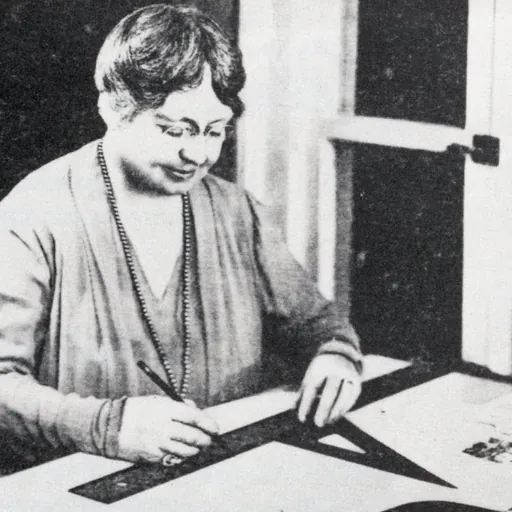
About Alice Trythall Washburn
Lived 1870 – 1958 (aged 87–88). Alice Trythall Washburn was an American architect.
Alice Trythall Washburn (July 15, 1870 – November 17, 1958) was an American self-taught architect who designed so many homes in New Haven County that she is considered the founder of a distinct typology: the "Washburn Colonial". While she died relatively unknown, her work has been the subject of retrospectives and exhibits, beginning in 1990 at the Eli Whitney Museum in Hamden, Connecticut.
Early life Born Alice Frances Trythall, she was the youngest of four children born to Samuel Trythall, a farmer born in Cornwall, England, and Frances Preston, a descendant of early settlers of Cheshire, Connecticut. Trythall was raised in the Preston family homestead on Cornwall Avenue in Cheshire and attended a school for young ladies located close by. In addition to her self-initiated projects, Washburn was commissioned by many prominent figures, such as playwright Thornton Wilder, who requested a medieval English-style home built in 1929.
Style Washburn houses are known for their functional floor plans, abundance of light, and details. Generally working in the Colonial Revival style (with some exceptions), Washburn designs tend to be symmetrical. She placed a high value on craftsmanship and was known to supervise every detail of construction, prioritizing meticulous touches over budget, to the point of taking on the added cost herself if it came to that. Classical columns were employed generously, along with lavish hand-crafted bannisters, curving walkways, and each home was reported to have its own, unique fireplace.
Social context While less than 1% of architects at the time were women, Washburn's work can be interpreted as part of timely movements. During the housing expansion that she flourished in, it was not unusual for houses to be designed by those who had no formal training. Additionally, in 1919 the Nineteenth Amendment to the United States Constitution was passed, giving women the right to vote; according to historian Emily Clark, "female entrepreneurs in all professions blossomed" following this landmark decision.
Washburn was known to be "very tough… she'd ask her crew to tear apart a bookcase that wasn't right even if the client was happy with it;" this meticulous work ethic was attributed to being a woman in a male-dominated field.
Legacy It is speculated that Washburn's perfectionism may have contributed to her downfall; as Jim Collins describes, through the work of biographer Martha Yellig:"insisting on the highest-quality materials or a certain window or fireplace treatment, even when the owners couldn't afford it – increasingly required her to pay money out of her own pocket, costing her profits. When the Depression hit a few years later, Mrs. Washburn owed more than $82,000 to local suppliers and contractors. The courts stripped her of nearly everything she owned, including the family homestead in Cheshire where she grew up." She declared bankruptcy in 1931, and, as her husband had died in 1926, moved into an apartment with her sister in Cheshire. When she died in 1958, her occupation was listed as housewife. While her career was not celebrated widely during her lifetime, that began to change in later years in which she became known for her thoughtful designs, as well as for being so prolific. As William Brown, the director of the Eli Whitney Museum, is quoted as saying in a 1990 New York Times article:"Alice Washburn was not the greatest architect who ever lived, or even the greatest woman architect. But to build so many houses so late in life and to have those houses so loved is an extraordinary achievement."
Alice Washburn Award A yearly prize given by the Connecticut branch of the American Institute of Architecture pays homage to Washburn's iconic homes:"The Alice Washburn Award is named for the distinguished Connecticut designer and builder of the 1920's, largely self-taught, whose work is known for her thoughtful stylistic and programmatic invention. Focusing on style: the program acknowledges excellence in traditional house design through the thoughtful adaptation of tradition to address 21st-century needs. Works are to be located in Connecticut and designed in a style broadly considered as 'traditional.'"
Don’t just read it —
keep it.
Full-length biographies made to live with: read them, listen on the way to work, watch them tonight.
- E-book
- Audio
- Video
Instant download · yours to keep · every purchase keeps this site free
Important facts
People in Alice Trythall Washburn's life
Named in this biography and alive at the same time


Related people
Same field, nearest in time


Contemporaries
People whose lives overlapped Alice Trythall Washburn's
Frequently asked questions
Who was Alice Trythall Washburn?
1870 - 1958; American; Architect
When was Alice Trythall Washburn born?
Alice Trythall Washburn was born in 1870.
When did Alice Trythall Washburn die?
Alice Trythall Washburn died in 1958.
What was Alice Trythall Washburn's occupation?
Alice Trythall Washburn was an architect.
What nationality was Alice Trythall Washburn?
Alice Trythall Washburn was American.
Sources & further reading
· Wikipedia: Alice Trythall Washburn
· DBpedia: Alice Trythall Washburn
Cite this page
APA: Biography.guide. (2026). Alice Trythall Washburn. https://biography.guide/alice-trythall-washburn/
MLA: "Alice Trythall Washburn." Biography.guide, https://biography.guide/alice-trythall-washburn/.
Chicago: "Alice Trythall Washburn." Biography.guide. https://biography.guide/alice-trythall-washburn/.
Data last updated: 2026-09-21 · Spot an error? Report a correction.
Portrait: Wikimedia Commons · author & licence
Page generated 2026-09-27 04:59 UTC